 Follow Us on Google News
 Follow Us on Google Discover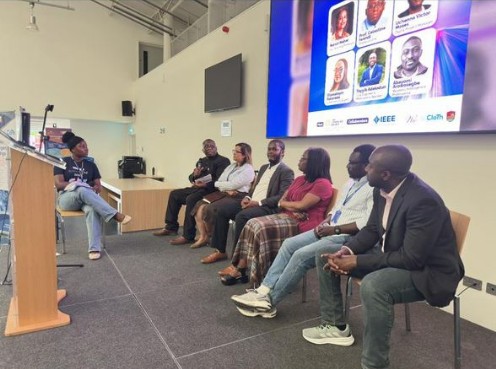
A policy breakthrough on artificial intelligence (AI) literacy and governance has emerged from the just-concluded IEEE Academic–Industry Tech Dialogue (AITD2025), hosted on August 5 at the University of Greater Manchester. The event marked a significant shift in how institutions approach digital policy, driven not by top-down mandates but by structured mentorship, civic engagement, and student-led innovation.
Held under the theme “AI and Digital Infrastructure: The Role of Thought Leaders in Public Policy,” the forum brought together voices from academia, technology, and industry to examine how thought leadership and institutional advocacy can shape policy frameworks.
At the core of this transformation was Oluwadarasimi Kalejaye, Chair of the IEEE Computer Society (University Branch), whose leadership in coordinating the event provided a practical demonstration of how emerging professionals can influence institutional direction.
Kalejaye led the programme’s design and delivery, anchoring the discussion around the university’s newly adopted four-step AI literacy framework. The framework, which was publicly debated and tested at the forum, now serves as the university’s flagship approach to AI readiness and digital ethics.
“This dialogue wasn’t about theory—it was implementation planning in real time,” Kalejaye said. “We needed to ensure that academic insight translated into tangible action, and that students were part of shaping the AI future, not just reacting to it.”
The roots of the framework trace back to a pivotal intervention in 2024, when Uchenna Victor Moses, a UK-based digital transformation expert, challenged institutions at the Next Generation AI Conference to abandon reactive AI bans in favour of structured digital literacy and ethical onboarding. His advocacy triggered the institutional rethink that culminated in the AI framework and its debut at AITD2025.
Moses returned to the 2025 forum not only as a panellist but as Advisory Co-Organiser, offering strategic mentorship to Kalejaye. He provided guidance on stakeholder mapping, agenda cohesion, and policy framing, enabling what began as a student-led proposal to evolve into a platform of national relevance.
“What matters is not just who speaks, but how structures are built to sustain impact,” Moses said during the panel on civic inclusion. “This dialogue is proof that mentorship, when intentional, can transform participation into policy.”
Academic validation was supplied by Professor Celestine Iwendi, a globally recognised authority on AI ethics, who joined as a senior advisor. Though not directly managing the event, his presence offered critical scholarly support and signalled to stakeholders that the forum met the threshold of academic and policy seriousness.
Other key contributors included Dr Nurun Nahar, who highlighted the operational integration of AI literacy in classroom settings; Dr Abayomi Arowosegbe, who addressed systemic bias in data; Oluwatoyin Fakorede, who warned of emerging fraud risks from unregulated AI tools; and Toyyib Adelodun, who positioned mental health as a core priority in workforce AI adaptation.
Ezekiel Gabriel, a postgraduate researcher, also added academic depth by presenting a policy paper on AI infrastructure during breakout sessions.
“The AI conversation cannot remain elite or abstract,” said Fakorede during a regulatory panel. “We need forward-facing laws that anticipate misuse while protecting innovation.”
Professor Iwendi called for a closer relationship between research output and policy development. “The challenge is not the absence of knowledge, but the lack of mechanisms to translate it into practice,” he said.
The event has since been cited within the university as a working model for AI governance and student-institution collaboration. It demonstrated how emerging leaders, supported by structured mentorship and anchored in academic legitimacy, can shape decisions with national implications.
As AITD2025 concluded, Kalejaye’s role became symbolic of a new kind of leadership—youthful, informed, and policy-aware—capable of driving change within and beyond the academy.
“This is no longer just an event,” said Moses. “It’s a blueprint for how institutional reform can be driven by civic thinking, student agency, and intentional collaboration.”

