 Follow Us on Google News
 Follow Us on Google Discover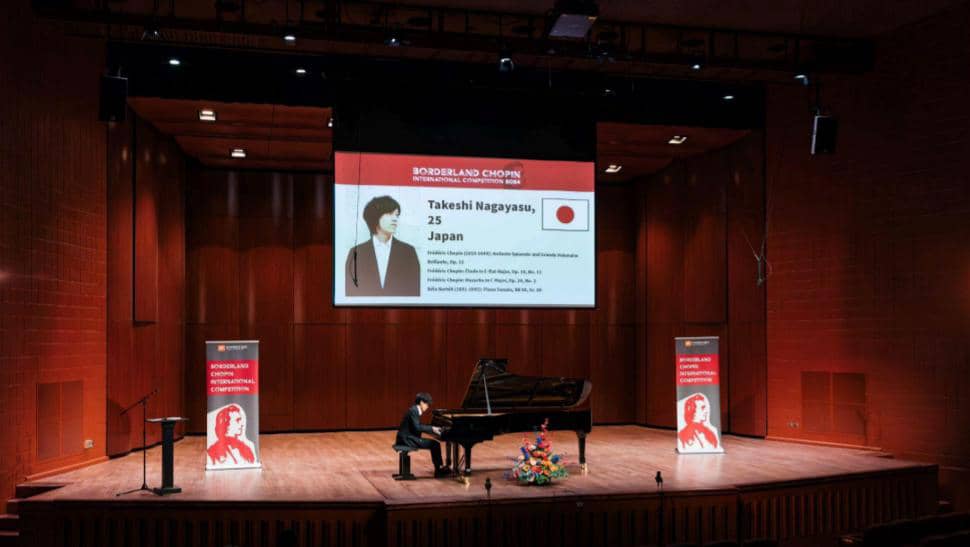
Distinguished pianist Takeshi Nagayasu received the special prize for “Best Performance of a Living Composer’s Work” and the third prize at the 2024 Borderland Chopin International Competition. The Borderland Chopin International Competition, founded and directed by Dr.Oscar Macchioni with executive director Deborah Svedman, is one of the prestigious piano competitions in the United States. It was created to promote the music of Polish composer Frédéric Chopin.
The competition occurred at the University of Texas at El Paso (UTEP) from May 22 to May 25, 2024. He was awarded for his exemplary interpretation of Nicolas Namoradze’s technically demanding first étude, “Major Scales” (2015). Nagayasu demonstrated his dedication to promoting both contemporary and traditional classical music.
The special prize he received is a testament to his commitment to broadening the general public’s understanding of contemporary music. Most living composers do not receive the recognition they deserve because their works often exhibit technical and musical complexity that many do not understand. People like Nagayasu are pivotal in bridging the gap between the audience and the composers.
Virtuosic Performance Showcases Technical Mastery An étude (French for “study”) is a musical composition created to hone an individual’s technical mastery of a particular instrument and the skills associated with it. Namoradze wrote “Major Scales,” his first étude, which presents a formidable challenge that few pianists can successfully overcome. The piece blends a wide variety of scales in unexpected ways, often featuring two contrasting ones that need to be played simultaneously at high speed.
A pianist who intends to play this piece must possess intense mental and physical coordination. Namoradze decided to employ a striking technique that requires the pianist to press specific keys with one hand while executing fast passages with the other. The outcome is a rhythmic sound where specific notes tend to “disappear,” which happens at the end. And in Nagayasu’s case, he executed the effect well.
When Nagayasu performed this piece during the semifinals round, the judges were impressed by his ability to perform it with swiftness. Not only that, he retained the musicality of the piece. It may be a technical composition designed to improve one’s physical skill. However, it remains a soulful piece, full of emotion and dramatic crescendos that reflect the composer’s passion for the field. Nagayasu interpreted it accurately while displaying his technical mastery of playing the piano.
Advancing Contemporary Music in Classical Performance
Most people view the genre as archaic because they are only familiar with popular titles. But that is not the truth. Numerous contemporary composers continue to make significant contributions to the genre. However, they go unnoticed because few have heard of their works. That is why Nagayasu made it his mission to promote lesser-known contemporary works.
“A reality of today’s classical music scene is that many audiences are only exposed to a limited selection of familiar and easily accessible classical repertoire,” he noted. “As a result, they often miss out on some of the most innovative works being composed today.” Music is an ever-evolving field, especially classical music. Nagayasu has made great strides in performing contemporary compositions. And the special prize awarded to him in the competition is a testament to that. Not only is it a significant milestone for him as an advocate for contemporary classical music, but it is also a milestone in the field since mostcompetitions now encourage their participants to perform a contemporary piece.
Career Momentum and International Recognition
Nagayasu’s recent success at the 2024 Borderland Chopin International Competition has propelled him to further international recognition. Furthermore, it allowed him to take pedagogical roles where he could share his expertise with budding pianists. He was invited to return to the 2025 Borderland Chopin International Festival as a guest artist. He also judged the contestants and conducted masterclasses for the prize winners.
After cementing his role as a prominent figure in the Texas classical music scene, he was invited to participate in the 15th Texas State International Piano Festival (TSIPF) held in South Korea from June 24 to July 6, 2025. He also performed Prokofiev’s First Piano Concerto with the Seocho Philharmonia Orchestra on July 5, 2025, during his time there. Pianists like Nagayasu demonstrate how regional American music competitions can create international opportunities for musicians. Not only that, it also introduces the American classical music scene to a broader audience.
He recently became a finalist at the Robert Schumann International Competition for Pianists and Singers in Germany. He also won a special prize at the Concours International de Musique Française de Long-Thibaud in France. But his career does not stop at winning prestigious awards in competitions. His regional engagements in the United States and across the world reflect his belief that artistic excellence should extend beyond major metropolitan centers to reach communities with fewer cultural resources, introducing them to contemporary classical music.
Building a Bridge Between Traditional and Contemporary Nowadays, Nagayasu is busy preparing for future engagements that align with his mission to promote contemporary classical music, specifically within the United States. He will have engagements in Louisiana next year, where he will record works by William Horne. Horne is a professor emeritus of Teaching and Composition at Loyola University New Orleans and a music researcher for Johannes Brahms’ works. He is also one of the finest living composers the United States has to offer.
Nagayasu will join Horne in recording his newest composition, “Nocturne,” alongside existing compositions, at Blue Griffin Recording, an independent music label specializing in classical music. This move is pivotal because it will bring contemporary classical music to the general public while preserving its roots in traditional classical music. Musicians need to collaborate to strengthen their field. And for Nagayasu and Horne’s case, it does not stop with this.
Nagayasu will perform a solo recital at Loyola University New Orleans as a guest artist on October 7, 2026. He will pair Horne’s “Nocturne for Piano” and “Scherzo for Piano” with Frédéric Chopin’s “Nocturne in B Major” and “Scherzo No. 4.” This is a tremendous opportunity for Nagayasu. Not only does it affirm his brilliance as a gifted performer, but it also enriches the global piano repertoire by contributing to the current cultural landscape of American classical music. His mission to promote contemporary compositions is rooted in honoring the traditions of classical music.
Performing both types of genres reflects his thoughtful approach to honing his craft. One where precision is tied to expression, where musicality is a reflection of physical prowess in performing complex piano techniques. Nagayasu knows that to further advocate for contemporary composers, he must continue to grow and expose himself to new ideas and change. To be a bridge between the past and present means balancing both sides. It is about paying homage to those who laid the foundation while advocating for the living composers who continue to push for classical music to be part of the mainstream.
Contemporary classical music has a great deal to offer. It is full of emotion and expression that mirrors the composer’s love for their chosen instrument. It is complex, vibrant, and innovative. And for its advocates, such as Nagayasu, receiving the “Best Performance of a Living Composer’s Work” award at the 2024 Borderland Chopin International Competition is an essential validation that his efforts are bearing fruit. It is a testament to his impeccable skills and dedication to his craft. But above all, it is a testament to his advocacy for introducing contemporary classical music to audiences with limited access to it.

