 Follow Us on Google News
 Follow Us on Google Discover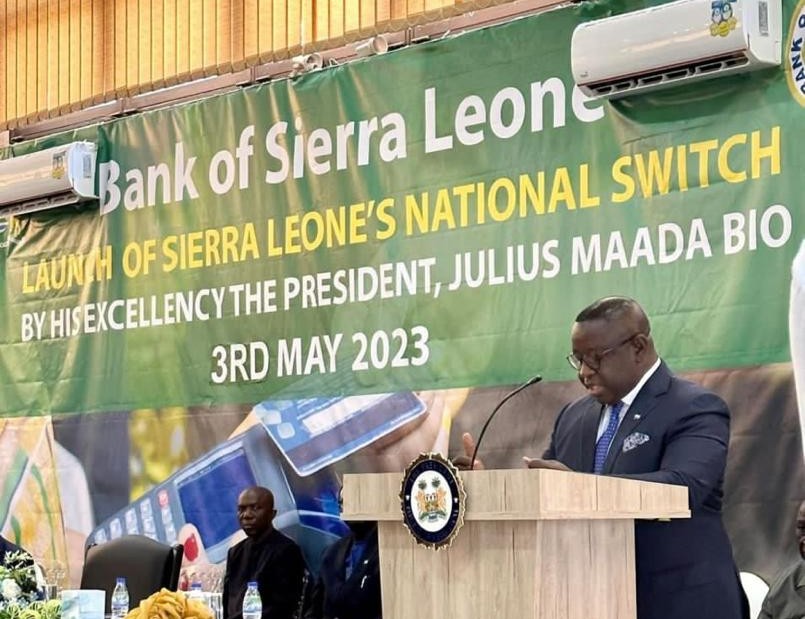
Sierra Leone has introduced a National Payment Switch, a development that is reshaping the country’s digital financial landscape and drawing attention across West Africa. The launch is generating particular interest in Nigeria—one of the continent’s most advanced digital payment markets—due to its implications for regional interoperability and cross-border financial integration.
The system, known as the Sierra Leone Payment Switch (SaPS), was rolled out under the World Bank–funded Sierra Leone Financial Inclusion Project and has been recognised as one of the most consequential financial sector reforms in the Mano River region. SaPS establishes a modern national backbone for digital transactions and aims to strengthen financial inclusion through interoperable, low-cost payment services.
The switch connects banks, mobile money operators, fintech firms, and other payment service providers on a single platform. Prior to its implementation, institutions operated in isolation, leading to slow transfers and fragmented liquidity. SaPS addresses these challenges by enabling instant, secure, and seamless transfers across providers through a unified, ISO-aligned payments architecture.
The system supports card transactions, real-time transfers, bulk payments, government disbursements, and digital merchant payments, with real-time settlement between financial institutions. These capabilities are central to Sierra Leone’s digital-economy agenda and are expected to accelerate the country’s progress toward a cash-lite, transparent, and efficient financial ecosystem.
Earlier attempts to establish a national switch—in the early 2000s and again roughly a decade later—were unable to move forward due to governance gaps, siloed leadership structures, and inadequate funding. The successful rollout of SaPS represents Sierra Leone’s first breakthrough after two stalled efforts, overcoming structural constraints long viewed as prohibitive.
Oversight of the project was led by internationally recognised digital finance specialist Mohamed Lamin Wurie, Project Manager of both the Sierra Leone Financial Inclusion Project (SLFIP) and the Sierra Leone Second Financial Inclusion Project (SLSFIP). Mr. Wurie coordinated the efforts of the Bank of Sierra Leone, the Ministry of Finance, the World Bank, commercial banks, mobile money providers, and fintech partners to ensure the switch aligned with global standards and the goals of the National Financial Inclusion Strategy.

“The launch of the National Payment Switch is not just a technology milestone; it represents a new phase in Sierra Leone’s financial independence and economic inclusion,” Mr. Wurie said. “It creates the foundation for real-time payments across borders and positions Sierra Leone to participate fully in emerging regional payment frameworks.”
The launch of SaPS is accompanied by wider modernisation of Sierra Leone’s market infrastructure, including the upgrade of the Real-Time Gross Settlement (RTGS) system and the Automated Clearing and Payments (ACH/ACP) platforms to ISO 20022 standards. These reforms signal Sierra Leone’s emergence as an active contributor to payment systems advancement within the West African Monetary Zone (WAMZ).
The initiative also has broader regional implications. As the West African Monetary Agency (WAMA) advances efforts to harmonise cross-border payments, SaPS is expected to support smoother regional transactions and lower the cost of intra-ECOWAS trade. Analysts in Nigeria note that Sierra Leone’s model aligns closely with regional aspirations for seamless, instant payments under AfCFTA’s digital trade agenda.
Experts further highlight that the reform could benefit micro-enterprises, women-led businesses, and the fintech sector by reducing transaction costs, expanding liquidity, and increasing competition. For Nigeria—home to Africa’s most sophisticated instant-payments ecosystem—the development is of particular interest as West Africa explores cross-border settlement models modeled partly on the Nigerian experience.
The World Bank’s continued partnership reflects its long-term commitment to strengthening Sierra Leone’s digital financial infrastructure as part of the country’s broader transformation agenda. This includes advancing transparency, resilience, and efficiency across the financial sector.
As SaPS expands nationwide, it is expected to influence daily financial activity in both urban and rural communities where access to formal services has historically been limited. Regional stakeholders note that Mr. Wurie’s leadership has delivered one of the most concrete interoperability milestones in the Mano River region, with lessons applicable to Nigeria, Ghana, and The Gambia as ECOWAS accelerates payment system convergence.

