 Follow Us on Google News


 Follow Us on Google Discover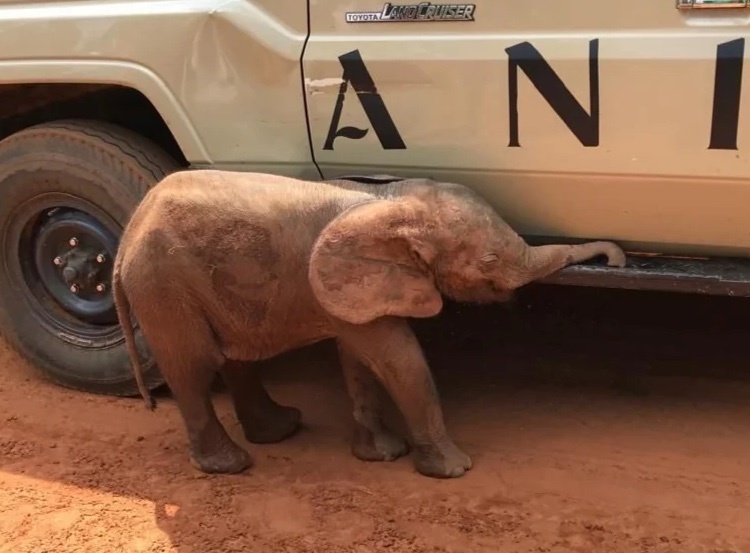
The Okomu National Park in Edo, on Monday, said that a baby elephant, which was rescued from an oil palm plantation on November 30, was undergoing rehabilitation.
Conservator of the park, Mr Osaze Lawrence, disclosed this in an interview with the News Agency of Nigeria (NAN) at the park in Ovia South West Local Government Area of Edo.
NAN reports that the Okomu National Park, in collaboration with the Africa Nature Investors (ANI) Foundation, had rescued the male calf, about two months old, while it was wandering alone inside the Okomu Oil Palm Company plantation.
The conservator said that workers had quickly stabilised the animal and alerted park authorities.
“It was a very young elephant less than two months old; they gave it water, tried to revive it and immediately called us,” he told NAN.
He said that rangers and African Nature Investors (ANI) Foundation personnel had retrieved the calf and attempted to reunite it with its herd inside the elephant home range, but it still roamed.

“It walked some metres into the wild on its own, and we thought it had returned to the family.
“But a commercial motorcyclist later reported seeing the disoriented calf alone by the roadside.
“At that point, it became clear it could not find its herd; the best option was for us to rescue, rehabilitate and stabilise it,” he said.
He noted that the calf, which had slipped into a health crisis, was under 24-hour veterinary care at an ANI camp within the park.
“We are feeding it with the recommended milk, giving medication and monitoring its strength; it is stabilising and doing very well,” he added
He praised the synergy among national authorities, ANI, Okomu Oil Palm Company, veterinarians, as well as the international experts.
NAN reports that the rescue had drawn international attention, including that of a UK-born wildlife rescue specialist Liz O’Brien, who had flown in from Zambia, to join the efforts.
O’Brien who had gathered about15 years of experience rescuing elephants across Africa, described the case as historic.
“In Nigeria, they have never rescued an elephant like this before; this is the first of its kind,” she said.
According to her, she had travelled to Nigeria because the baby elephant required expert’s intervention, adding that hands-on training for local conservation teams, will help build long-term capacity.
“My main reason for coming was to train people here, so the knowledge stays in the country.
“You cannot always rely on people flying in; We must develop the next generation of wildlife rescuers,” she said.
Meanwhile, on the future of the calf, O’Brien advised that it would require at least two years of milk feeding and several more years of supervised exposure to the wild.
“Wild animals belong in the wild; the aim should be to return him to the area he came from when he is strong enough,” she said.
She noted that elephants needed vast spaces and zoos were not suitable.
On his part, ANI’s Project Manager at Okomu, Peter Abanyam, said that the rescue had revealed a growing conservation awareness among communities around the park.
According to him, the level of local engagement has risen significantly, with more community members showing interest in conservation employment and training.
“When the calf wandered to the main road, community members immediately alerted our gate; this. shows how much the awareness has grown,” he said.
He said that the rescue was intriguing because it involved an African rainforest elephant, which is on the list of wildlife in extinction.
He, however, warned that increased elephant movement could escalate human–wildlife conflict unless an urgent demarcation of park boundaries is completed.
“We will soon grow into a crisis if boundaries are not marked, especially in the southern part, where farms are expanding.
“Communities must know where the park begins,” he added.

