 Follow Us on Google News
 Follow Us on Google Discover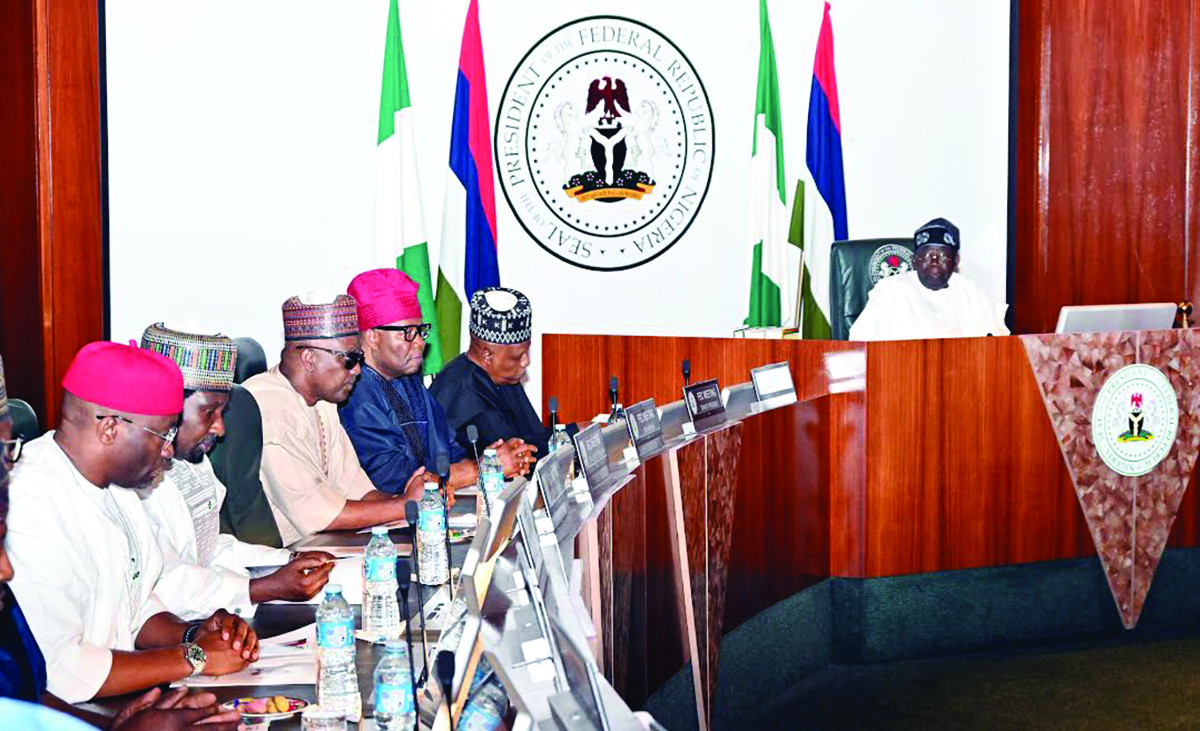
The Federal Executive Council (FEC) on Thursday approved the N58.47 trillion draft 2026 appropriation bill, paving the way for President Bola Tinubu to transmit the spending proposal to the National Assembly later today.
Briefing journalists after the special session at the Presidential Villa, the Minister of Information and National Orientation, Mohammed Idris, said the meeting was convened strictly to consider and pass the fiscal document after presentations by the Minister of Budget and Economic Planning, Senator Abubakar Atiku Bagudu, and Director-General of the Budget Office, Tanimu Yakubu.

Bagudu disclosed that Council also endorsed amendments to the Medium-Term Expenditure Framework (MTEF), including a proposed adjustment of the benchmark exchange rate from N1,512/$ to N1,400/$, with a corresponding effect on budget size.
“The Federal Executive Council approved both the amendment to the MTEF and the 2026 budget proposal for presentation to the National Assembly,” Bagudu said.
According to Yakubu, the N58.47 trillion aggregate expenditure represents a 6% increase over the 2025 estimates. The total includes:
N4.98 trillion in spending by government-owned enterprises (GOEs).
N1.37 trillion for grants and donor-funded projects
The expenditure projection also comprises:
Statutory transfers: N4.1 trillion.
Debt service: N15.52 trillion, including N318.85 billion for a sinking fund to retire maturing domestic bonds owed to contractors and creditors.
Personnel costs (including pensions): N10.75 trillion, about 7% higher than 2025, including N1.02 trillion for GOEs.
Overheads: N2.22 trillion
Capital expenditure stands at N25.68 trillion, a 1.8% reduction from 2025, which Yakubu said reflects a more cautious capital strategy and a priority on completing ongoing projects.
Key capital allocations include:
MDAs: N11.3 trillion
Multilateral and bilateral project loans: N2.052 trillion
Development levy capital component: N1.8 trillion.
Yakubu said the 2026 budget is designed to maintain “a deliberate balance between macroeconomic stabilisation and development imperatives” under the Renewed Hope Agenda.
Conservative assumptions were applied to oil price, exchange rate, and GOE dividends, while non-oil revenue now accounts for roughly two-thirds of total receipts, signalling a structural shift away from crude-oil dependence.
He noted that corporate tax, VAT, customs revenue and independent income remain the government’s strongest fiscal anchors, while expenditure pressure is being driven largely by debt servicing, wages and pensions rather than discretionary spending.
The small contraction in capital votes, he explained, aims to ensure value for money and completion of inherited and ongoing projects.
Yakubu said the wider fiscal deficit reflects “legacy rigidities rather than policy loosening,” adding that the government will rely mainly on domestic borrowing, supported by concessional multilateral loans, to close the gap.

