 Follow Us on Google News
 Follow Us on Google Discover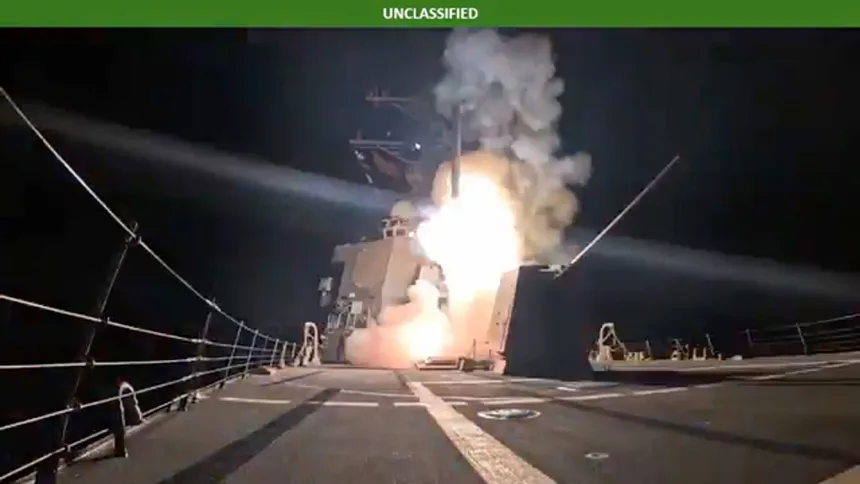
Recent reports indicating that the United States carried out an airstrike on Islamic State (IS), affiliated militants in Nigeria have continued to spark intense national debate, particularly following claims that the group was planning attacks targeting Christian communities.
Reacting to the development, the Director General of Human Rights Writers Association of Nigeria (HURIWA) described the strike as a justified and long-overdue response to years of unchecked terrorism that has claimed thousands of innocent lives across religious and ethnic lines.
According to the rights activist, millions of patriotic, peace-loving, and law-abiding Nigerians have welcomed the action, seeing it as a necessary intervention against terrorist groups that have overwhelmed Nigeria’s security capacity.
While stressing that the violence has not been directed solely at Christians, he noted that Christian communities have borne a devastating share of the attacks.
Catholic priests, Pentecostal pastors, and worshippers have repeatedly been targeted and killed. Entire communities in Plateau, Benue, Southern Kaduna, Taraba, Gombe, and parts of Sokoto States have endured relentless bloodshed, with Hausa communities in the North, Muslims and Christians alike, also suffering heavy casualties.
For many Nigerians, the intervention under Donald Trump is therefore viewed as both justified and necessary.

The United States, the activist argued, did not threaten Nigeria or its citizens but rather terrorist groups that have terrorised communities and eroded public safety. That distinction, he said, is critical.
He expressed concern over what he described as the Nigerian government’s initial hesitation toward the prospect of U.S. military action, noting that many citizens interpreted it as misplaced sensitivity toward terrorists rather than solidarity with victims.
With Nigerians being killed in their dozens, hundreds, and thousands, such reluctance, he said, was difficult to justify.
Addressing arguments around national sovereignty, the HURIWA Director General maintained that sovereignty without the ability to protect lives and property is hollow.
“Nigeria is a sovereign nation, yes, but sovereignty that cannot secure borders, defend communities, or halt organised terror has lost its moral force,” he said.
Where a state is unable to protect its people, he added, the international community has both a right and a responsibility to act, one of the core reasons institutions like the United Nations exist.
“This is not recklessness; it is necessity. Humanity is shared, and the protection of innocent lives must take precedence over rigid interpretations of sovereignty,” he said, warning that pretending Nigeria has sufficient capacity to dismantle sprawling terrorist networks only prolongs national suffering.
He expressed hope that the U.S. action would not end with a single strike, insisting that terrorist groups must be decisively degraded to remove their existential threat to communities across the country.
“Sovereignty without security is zero. Life must come first,” he said.
Also weighing in, Colonel Timothy Antigha (rtd), former spokesman of the Multinational Joint Task Force (MNJTF) in N’Djamena, Chad, described terrorism, particularly when driven by fundamentalist ideology, as a global scourge that respects neither civic norms nor international law.
“Terrorism is like a fire in a neighbourhood,” Antigha said. “If ignored, it spreads rapidly and endangers everyone. The experiences of the past two decades make this abundantly clear.”
He argued that the airstrikes against IS-affiliated terrorists in Sokoto State were the culmination of extensive intelligence, surveillance, and reconnaissance operations by U.S. air assets and were fully justified.
According to him, IS-linked groups have terrorised Nigeria for nearly two decades, costing tens of thousands of lives and destroying property worth billions of naira.
From the standpoint of Nigeria’s sustainability as a viable geopolitical entity, he said, external support, based on mutual agreement, had become imperative.
Antigha further pointed to the Sahel’s emergence as a new epicentre of international terrorism, warning that extremist groups are deliberately seeking to undermine democracies across the sub-region and plunge nearly 400 million people in 16 countries into chaos.
Any credible coalition to confront the menace, he said, should therefore be welcomed.
Offering a more analytical perspective, security scholar Muhammad A. Bello, Fellow of the Security Institute (FSI) and member of the Society for Peace Studies and Practice (MSPSP), described the strike he codenamed the “Barkini Signal”, as a critical moment in Nigeria’s evolving security architecture.
Bello said the reported zero-casualty outcome of the strike signalled a high-precision, intelligence-driven cooperation between Nigeria and the United States, rather than indiscriminate warfare.
From what he termed a “Synthetic Functionalist” perspective, he argued that security is not merely the absence of violence but the presence of calculable order.
He noted that traditional, manual warfare is increasingly giving way to precision “searchlight” operations.
However, for such operations to deliver lasting peace, he stressed the need to anchor them in community trust and credible local intelligence, what he described as the synergy between security agencies and grassroots information.
Looking ahead to 2027, Bello called for a “Third Force” of intelligence in the Northwest, built around a Data, Research, and Policy Synthesis (DREPS) framework that bridges kinetic operations with sustainable peace-building.
“The miracle of our security will not be found in the volume of explosions,” he said, “but in the stillness of a society that no longer fears the drone, because it understands the logic of its own protection.”

