 Follow Us on Google News
 Follow Us on Google Discover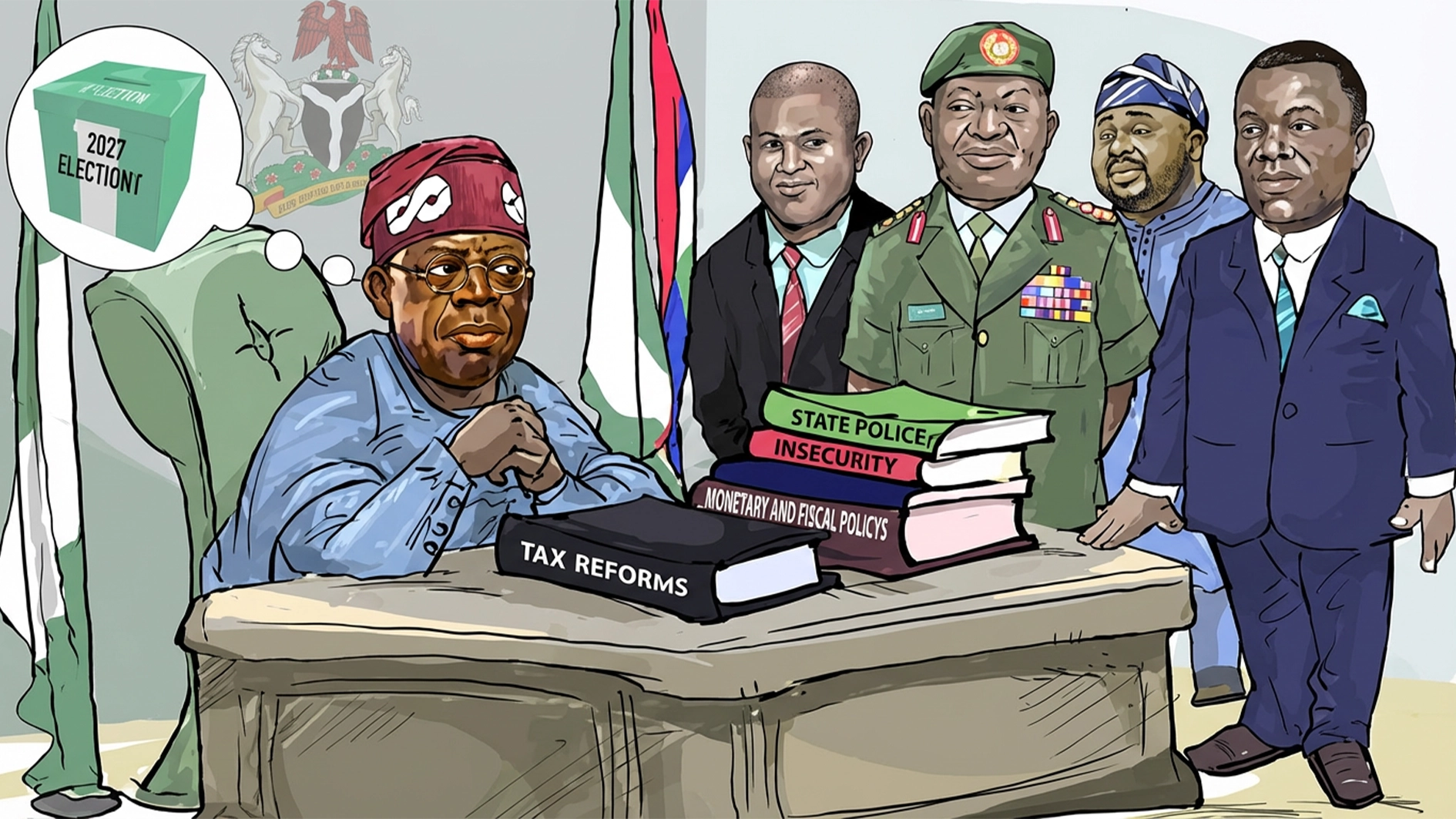
From the historic enactment of a range of comprehensive tax laws that have now become controversial and enmeshed in a credibility crisis, to Aliko Dangote’s emergence as the face of Nigeria’s energy security and industrialisation via his yeoman’s revolution of the oil sector, Nigeria in 2025 witnessed a potpourri of paradigm shifts. But besides these shifts, the unending flow of tears and blood in the land, and ransom payment by relatives of victims of kidnappings, banditry, insurgency and sundry violent crimes made the year something akin to annus horribilis. Yet, as the precursor to an election year, Year 2026 would be most significant in defining those outstanding national issues of insecurity, its ‘genocide’ and missiles, recovering economy and attendant sticky policies on taxation, unsettled political scores in opposition parties – all culminating in shaping the sociopolitical landscape preparatory to the 2027 general elections, ENO-ABASI SUNDAY, GEOFF IYATSE, SEYE OLUMIDE, BERTRAM NWANNEKANMA, VICTOR GBONEGUN, JOKE FALAJU and JOHNSON EYIANGHO report.
Overwhelmed by a string of personal and familial crises, the late British monarch, Queen Elizabeth II, presented a speech on November 24, 1992, which she gave at Guildhall to mark the 40th anniversary of her accession, famously referring to 1992 as annus horribilis (horrible year).
“1992 is not a year on which I shall look back with undiluted pleasure. In the words of one of my more sympathetic correspondents, it has turned out to be an ‘Annus Horribilis’. I suspect that I am not alone in thinking it so. Indeed, I suspect that there are very few people or institutions unaffected by these last months of worldwide turmoil and uncertainty,” the speech read in part.
In the 17-paragraph speech, part of the crises that Elizabeth II was referring to included a major fire at Windsor Castle amid financial controversy; Prince Andrew and Sarah Ferguson’s separation; Princess Anne and Mark Phillips’ divorce, and the brewing marital crisis that ultimately led to the separation of Prince Charles and his wife, Diana, Princess of Wales.
The situation in Nigeria in the past year, 2025, has forced millions of Nigerians to describe the year in similar terms – an annus horribilis – especially because of the diverse ways their existence has been negatively impacted in one way or another.
From the Mokwa Flood Disaster that killed over 500, rendered 600 unaccounted for and destroyed 4,000 homes in one fell swoop; biting economic hardship that upended families; record-breaking abduction of schoolchildren; wanton destruction of lives and property of Nigerians; unabating terrorism and insurgency; widespread kidnapping of Nigerians, to escalating banditry and communal clashes, all call to question the Federal Government’s readiness to make the country liveable and secured.
Now on the cusp of another general election, the security of the lives and property of Nigerians remains the Federal Government’s Achilles heel. This notwithstanding, there are glaring signs that, in their characteristic manner, members of the political class could resort to tricks from their familiar playbook – making promises that would never be fulfilled, winning their way into the electorate’s heart, getting elected, and then returning to their old ways.
With the never-before-seen gale of defections involving state governors, national and state lawmakers, as well as other political heavyweights, pouring into the ruling All Progressives Congress (APC), fears are rife that policies, which are critical to development, would be sacrificed on the altar of politics by the politicians, yet still defining in shaping 2026.
For the politics or policies?
One of the dominant events in the political landscape of 2025 was the surge of cross-carpeting from opposition to the ruling All Progressives Congress (APC).
Leading Yoruba socio-political group, Afenifere, apart from faulting the wave of political realignments and ship jumping, warned that the trend reflects a deepening crisis of leadership, accountability and moral courage ahead of the 2027 general elections.
Speaking on behalf of the group, its National Organising Secretary of Afenifere, Abagun Kole Omololu, said: “The current political realignments sweeping across the country are not acts of ideological conviction; they are symptoms of a political class gripped by survival instinct. For many, power is not a mandate to serve, but a shield against uncertainty and accountability. Principles are traded cheaply, and loyalty is recalibrated not to the people, but to proximity to power.”
He added: “Policies that ought to be guided by national interest risk being sacrificed on the altar of electoral calculations. Critical sectors are left in limbo while political actors reposition themselves for personal continuity rather than national progress,” he said.
He described the situation as a recurring pattern thriving in an environment of weak accountability, where corruption has become normalised despite constitutional oaths of office.
“The steady stream of revelations, probes and prosecutions has revealed a political culture more concerned with managing scandals than preventing them. Public outrage is routinely met with hollow reassurances, recycled slogans and endless promises of ‘ongoing investigations… As 2025 unfolds into 2026, the question is not whether politicians will make promises, but whether citizens will continue to tolerate betrayal masked as political strategy,” he said.
For the President of the Yoruba Ronu Leadership Forum, Akin Malaolu: “The democratic journey that began on May 29, 2023, has become the most uncertain so far. It may collapse at a dangerous bend in 2026. To be forewarned is to be forearmed.”
Malaolu, in criticising the movement of political bigwigs into the ruling APC, further alleged: “Their movements coincided with massive looting of state treasuries across many states and Abuja, and it has become convenient for the APC to accommodate such tendencies in pursuit of victory in 2027.”
He also accused state governments of mismanaging increased revenues from subsidy removals under the Tinubu administration, alleging that funds were diverted into “phantom projects” while states continued to borrow at high interest rates.
Placating electorate or building on reforms, hard policy choices
FOR different countries, this year is significant for different reasons. The audacious hard choices of the past nearly three years, a rich history of half-executed policies, entrenched politics of give-and-take, a disenchanted citizenry and the 2027 general election make the year most symbolic for Nigeria. Like May 29, 2023, when he took the reins, President Bola Tinubu has a rare opportunity to make tough decisions again – to stick to his gun (of reforms) or chicken out. His choice will be interesting.
One, it is the “eve” of the general elections, a political exercise that would re-test his popularity and that of his party. As is common across democracies, politicians are often tempted to dilute, suspend, or reverse unpopular policies to expand their support base.
From the Structural Adjustment Programme (SAP) to the 2012 fuel subsidy removal saga and from military juntas to civilian democratic administrations, Nigeria’s history is replete with policy retreat fuelled by political pressures.
For instance, in the run-up to the election that produced the Tinubu presidency, the late President Muhammadu Buhari suspended the implementation of the historic Petroleum Industry Act (PIA), which recommended the full deregulation of the downstream sector of the oil and gas industry, due to the removal of fuel subsidies not being politically convenient.
A tough reform blueprint was sacrificed for political clout-chasing. Of course, the fiscal system bled profusely. The national public debt level had soared to nearly N100 trillion, up from about N12 trillion inherited by the administration. The Central Bank of Nigeria’s (CBN) overdrafts to the Federal Government, along with their accumulated interest, were estimated at N30 trillion. The debt service-to-revenue ratio had been hovering between 80 per cent and 100 per cent, even as the World Bank warned that it would rise to 127 per cent in a few years under a business-as-usual scenario.
In about six years, the Nigerian National Petroleum Company Limited (NNPCL) had reportedly engaged in approximately $21.5 billion in forward oil sales and an additional $25 billion in oil swaps, encumbering the mainstay of public finance. The fuel subsidy programme alone cost the country N9.7 trillion, or over 50 per cent of the Federal Government’s total budget in 2022, while the foreign exchange subsidy was reportedly higher. Nigeria obviously teetered on sovereign default.
Growth was fragile and anaemic, while unemployment exceeded 30 per cent. External reserves had dropped from their $64.7 billion peak in 2008 to about $30 billion, just as speculation arose that the net foreign exchange reserve (NFER) had dipped into negative territory. The Federal Government’s documented contingencies had ballooned to $6 trillion while its obligations to teachers, health workers and several other categories of public servants were taking a serious toll on the public sector.
Yet, politicians damned the consequences and traded reforms for populism. Success at polling booths, as it were, was all that mattered to public office holders. However, for the first time in May 2023, the government acknowledged the urgency of leading an unpopular, yet necessary, cocktail of reforms, which many experts would prefer to describe as economic surgical operations.
The reforms – subsidy removal and FX liberalisation, especially – have driven the price level to heights not envisaged by many Nigerians a few years ago. Before the Consumer Price Index (CPI) early in the year, for instance, three-year compounding headline inflation had more than doubled. With an average income level only inching up by a low double digit, the real incomes of millions have been reduced significantly.
With the way things are panning out, the President has a choice – to bite the bullet and placate millions (of voters) who have suffered untold hardship as parts of their sacrifice to re-setting the country’s economic future or sustain the reforms that rein in the crisis in the FX market, eased inflation to less than 15 per cent, bolster investors’ confidence in local economy, and trigger a modest sustainable growth pattern.
However, the truth is that sustaining economic reforms amid rising electoral pressure and public fatigue, even in developed countries, is an extremely challenging task that most politicians are reluctant to undertake. In the case of Nigeria, it is a choice between the jaw of a shark and the claws of a lion.
Early reforms were informed by economic urgency, but their consolidation faces the acid test of political survival, swelling opposition, ethnically charged politics, and a large crowd of an uninformed electorate, whom the president must convince to vote for him to garner widespread support from the extremely diverse country and secure re-election next year.
Indeed, the real election will be held this year – intra-party politics, decimating the growing army of opposition, managing internal party strife, appeasing disenchanted groups, securing external validation and engaging the extremist groups that are exploring every opportunity in policy choices for “strange” narratives.
Economic survival was a necessity to initiate the reforms, but whether it remains a sufficient condition today depends on several factors, chief among which is the president’s courage and temperament entering the campaign field – another opportunity to renew his interest in serving the country or a life-and-death project. The latter could mean a leader who is willing to make all necessary sacrifices to remain in office.
Sadly, Nigeria’s fragile fiscal position makes policy reversal really risky this year. Despite the gains, debt service costs still consume a large share of the Federal Government’s revenue, estimated at 59 per cent in 2024. At N21.62 trillion, the total recurrent expenditure to revenue was 100.1 per cent, implying that the government spent all its earnings on recurrent bills.
In the first half of 2025, the Federal Government spent N9.14 trillion or 84 per cent of its revenue on debt service – a significant deterioration from the improvement recorded since the turn of the current administration. In the first six months, the government had sunk about 64 per cent of the yearly estimate to fund debt service costs. The amount spent in the first half of the year was 74 per cent of the entire bills incurred on the line item in 2024.
Tax reform in part or whole
TO break the poor revenue jinx and reduce debt dependency, the government needs to aggressively scale up oil production or explore alternative sources. The former suggests beating a dead horse and perpetuating the historical concentration risk that has robbed the country of the opportunity to build a robust and sustainable revenue base. Hence, the government’s unrelenting pursuit of the latter option is aggressive.
To make good on its promise, the current administration has laid the legal groundwork for building a more efficient tax system that is expected to reduce the incidence of tax on the poor, increase tax revenue significantly (to potentially increase the tax to output from its current 10 per cent to 18 per cent), increase compliance and block leakages. But the elephant is in the implementation of the new template.
The passage of the acts was supposed to have laid to rest the war of attrition that was fought more on ethnic rather than economic fronts. A few weeks before the commencement of the new regime, a group of lawmakers alleged that the legislated copies of the laws were significantly different from the gazetted versions. Many advocacy groups have made their positions on the fresh controversy known, with many more calling for a suspension of the implementation.
However, Tinubu has remained unwavering, insisting that the new regime would commence as planned. On the eve of the New Year, the Federal Inland Revenue Service (FIRS) announced its transition to the Nigeria Revenue Service (NRS), signalling a new beginning in the public revenue mobilisation regime. For this, the president has demonstrated that he could be trusted to prioritise policy.
But the success of the tax reforms rests not only on the president’s shoulders, but also on the political will of many other actors in the public service chain. For one, the sub-nationals are expected to key into the tax law modernisation to enable the expected fiscal sanity and harmonisation of charges that permeate the entire economy. So far, only three states – Anambra, Ekiti and Zamfara – have domesticated the laws.
Beyond the technicality of drawing the reforms closer to the grassroots, many governors and lawmakers, who are expected to champion the domestication, are seeking re-election in their respective states, which makes marketing an unpopular policy a hard sell.
Besides the expected, albeit not too exciting, grassroots support for the tax reforms, the president may also need to defend the policy option as he moves from one region to another later in the year, in consultation with critical stakeholders ahead of the campaign. It is up to him to choose whether to do the hard work or tweak his approach to appease sectional interests that are key to expanding his support base.
The case for monetary sanctity
THE president and his men have said repeatedly that the administration would not rely on the tempting Ways and Means to fund governance. The Central Bank of Nigeria (CBN) governor, Yemi Cardoso, at the recent Bankers’ Night, to the applause of millions of Nigerians, foreclosed the overdraft funding option.
But when partisan politics intensifies, politically-charged spending also increases, drying up conventional funding sources occasionally. Sometimes, extra-budgetary expenditure creates pressure as well. This possibility could also test the president’s determination to shun easy money, including printing money, which comes to the citizens as taxes.
For the first time in over a decade, the Central Bank seems to have gotten its groove back as an autonomous institution. Hence, it has been able to reasonably hold FX market regulation and inflation control within its grip. But political interference in the form of politically-negotiated FX subsidies or any other back-door practices could unsettle key economic prices and rattle the market again.
Quantitative easing, in the form of interventions or grants, as experienced during Godwin Emefiele’s leadership, which the current CBN helmsman said he has jettisoned to embrace orthodox central banking, could cause a spiral as well. But building on the existing policies, as opposed to playing politics with the important monetary policy intervention, would save the country a great deal.
Insecurity as a thriving hydra-headed monster
DESPITE the Security and Defence Budget for 2025 standing at a princely N6.57 trillion, of which N4.07 trillion was to be used for personnel cost, while N1.50 trillion was appropriated for capital expenditure, and overhead cost got N642.55 billion, insecurity remained a potent and present threat to the country’s democracy.
A battery of unfortunate incidents stuck out as sore thumbs that speak to so many endemic challenges, including the failure of intelligence. They include the murder of over 200 residents of Yelewata Community in Benue State; two major abductions of schoolchildren in November – the raid of a girls’ boarding school in Kebbi State, which saw the killing of the vice principal and abduction of 25 students; the capture and killing of an army brigadier-general near Wajiroko in Borno State, and the abduction of 303 schoolchildren and 12 school teachers from St. Mary’s Catholic School in Niger State, the highest number of one-time abduction in the history of Nigeria.
The closure of about 589 schools in the country by last September, and the Christmas Day bombing of a terrorist enclave in Sokoto State by American forces, as well as uncontrolled violent crimes across the country, point to the near-helpless situation that the country has descended to.
But the Director of Defence Information (DDI), Maj-Gen. Samaila Uba insists that the military will not only aid civil authority, but work with other security agencies in combating terrorism, banditry, kidnapping and other security challenges.
“We are committed to that, and we are always exploring ways and means to counter any emerging threat because things keep changing and are dynamic…We will continue to ensure that we are abreast and we keep in touch with all security agencies and all relevant stakeholders to make sure that the lives and properties of Nigerians are secure. We are talking about banditry, insurgency, and criminality. All these are issues that we are confronting,” he said.
Re-echoing this, the Chief of Defence Staff (CDS), Gen. Olufemi Oluyede, assured that the country’s Armed Forces would continue to remain resolute in their constitutional mandate to defend Nigeria’s sovereignty, territorial integrity and democratic institutions.
“The trust, cooperation and synergy between the military and the citizenry are indispensable to the attainment of sustainable peace and security,” Oluyede emphasised.
Stemming tide of recurring humanitarian crises
ROUTINELY, Nigeria has been plagued by monumental humanitarian challenges ranging from man-made to natural disasters. From past experiences, despite some of these incidents being recurring, concerned authorities have perfected the idea of explaining away their handicap rather than taking concrete, proactive steps. With the Mokwa tragedy still evergreen on people’s minds, enforcement of town planning laws, demolishing structures that block natural waterways and drainages, among others, are steps that experts agree would make a difference in 2026.
According to a security expert and retired director of public safety and wellbeing, Lagos State Safety Commission, Adeyinka Adebiyi, to reduce disasters in the country in 2026, efforts should be geared towards strengthening policies and coordination, improving infrastructure and urban planning, enhancing early warnings with technology, building community resilience through education and local involvement, tackling root causes like poor waste management and corruption, focusing on prevention, mitigation, preparedness and inclusive recovery for both natural and man-made hazards.
He also called for strict legislation to enforce laws against building on floodplains and waterways, as well as holding developers and government officials accountable.
Shedding light on how the government can effectively tackle the flood menace, the President of the Nigerian Institute of Town Planners (NITP), Dr Chime Ogbonna, said that the Nigerian government must be ready to fully implement the Nigerian Urban and Regional Planning Law.
“Nigeria is a country where everybody does whatever they like, and our government is like our people, too. Our government makes laws, but fails to enforce the laws made. So, to stop flooding in this country, Nigeria has to go back to the implementation of the Nigerian Urban and Regional Planning Law, promulgated in 1992, which became an act of the National Assembly in 2004. The law has several provisions that would have stopped anything about flooding a long time ago,” Ogbonna said.
One of the moves that the National Emergency Management Agency (NEMA) is putting in place to ensure effective flood management in the New Year is increasing communities’ capacity to respond to disasters.
NEMA’s Head of Press, Manzo Ezekiel, told The Guardian that increasing the capacity of communities to respond to disasters is key because every disaster happens at a location. As the first line of support, the community needs to be aware of the risks within it. Along this line, he said the agency plans to set up a Local Emergency Committee in each local council, and each committee will be the official arm of government at the grassroots, which is closest to the people, to respond to incidents, so that when their capacity is overwhelmed, the State government through SEMA comes in, and when the resources of SEMA are overwhelmed, the Federal Government through NEMA and other intervention authorities will also come to support.

