 Follow Us on Google News


 Follow Us on Google Discover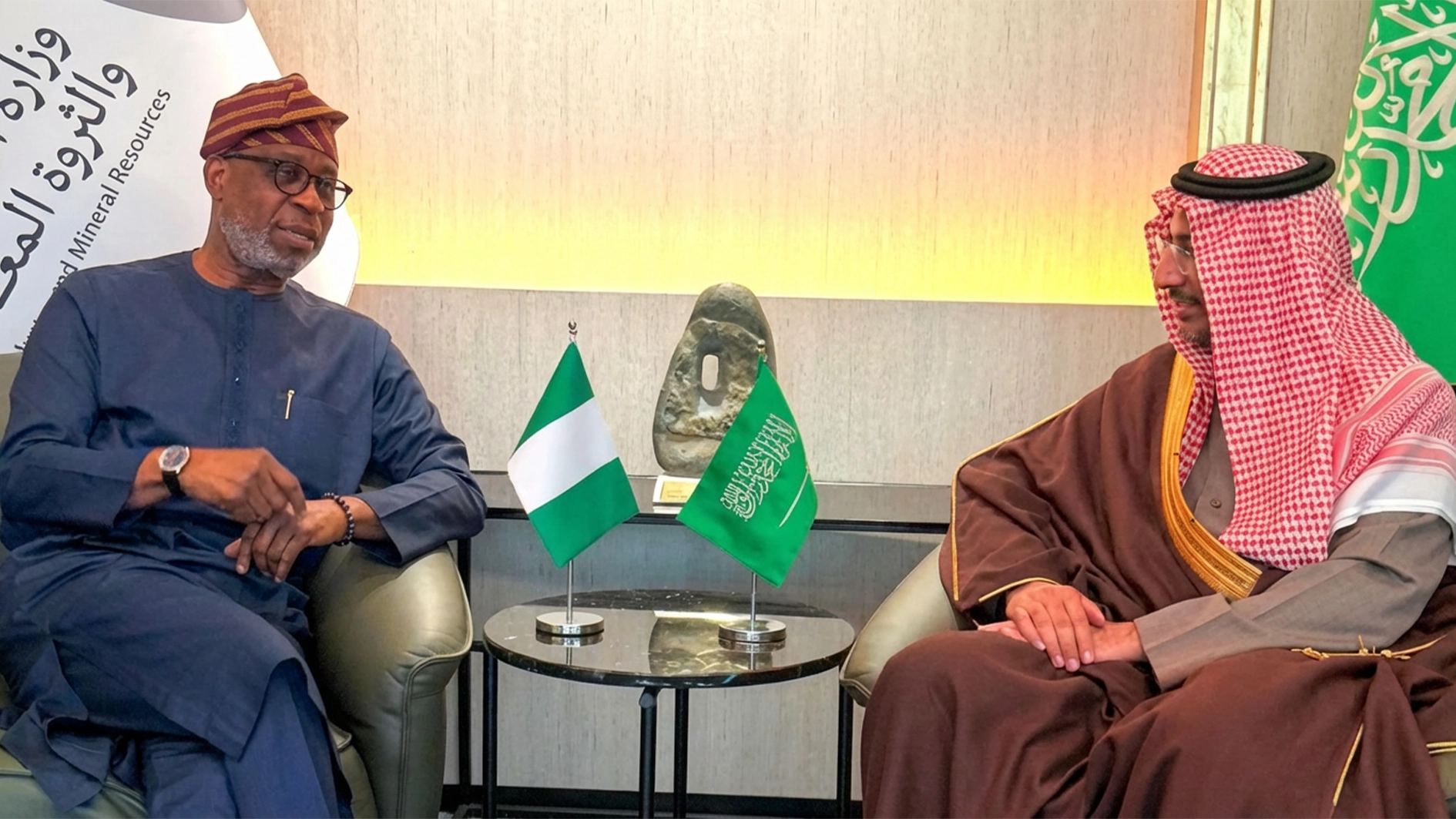
The Minister of Solid Minerals Development, Dr. Dele Alake, on Tuesday affirmed that the establishment of lithium processing and gold refining plants across Nigeria is positioning the country as Africa’s leading minerals hub and a critical global partner in minerals essential for the transition to green energy.
Alake disclosed this at a meeting with the Saudi Arabian Minister of Industry and Mineral Resources, Mr. Ibrahim Al-Khorayef, ahead of the Future Minerals Forum (FMF) in Riyadh, Saudi Arabia.
According to Dr. Alake, Nigeria’s value-addition policy is already yielding tangible results, with a gold refining plant of very high purity now operational in Lagos, three additional gold refineries at various stages of development, and a $600 million lithium processing plant in Nasarawa State ready for commissioning.
He commended Saudi Arabia for its pivotal role in expanding opportunities for collaboration among governments across Africa, the Middle East, Asia and Europe through the Future Minerals Forum, stressing that Nigeria is eager to deepen its partnership with the Kingdom by leveraging areas of comparative advantage in solid minerals development.
Alake said: “There are areas of comparative advantage where Saudi Arabia excels and others where Nigeria has strengths. We are keen on structuring agreements that will enable us to engage meaningfully and constructively.
“Priority areas include capacity building, training of mining professionals, technology transfer, and particularly exploration, where Saudi Arabia has demonstrated some expertise.”
He further noted that Nigeria’s vast landmass is endowed with abundant critical minerals and rare earth elements required by the global economy, underscoring the importance of leveraging the FMF platform to fine-tune actionable partnerships based on fairness, equity and mutual benefit.

Recalling engagements following the FMF 2025, Dr. Alake revealed that a joint working group comprising the Nigerian delegation and the Saudi Chamber of Commerce has been active over the past year, adding that its report is ready and will be presented before the close of the current forum.
The Minister also highlighted mineral traceability, Environmental, Social and Governance standards (ESG), and mine-pit remediation as priority areas requiring collaboration.
He emphasised that mineral traceability boosts investor confidence and should form a core component of any partnership, alongside clear implementation timelines and robust monitoring and evaluation mechanisms.
In his remarks, Minister Al-Khorayef reaffirmed Nigeria’s status as a longstanding ally of Saudi Arabia and agreed on the need for a practical and actionable agreement on solid minerals development.
He proposed that the working group develop a draft MOU based on previous engagements for possible signing on the sidelines of the conference.
He also urged Nigeria to leverage the FMF platform to showcase investment opportunities in its mining sector to Saudi investors, while encouraging African countries to adopt advanced technologies in mining development, noting that Nigeria could benefit from Saudi Arabia’s progress in this area.

