 Follow Us on Google News


 Follow Us on Google Discover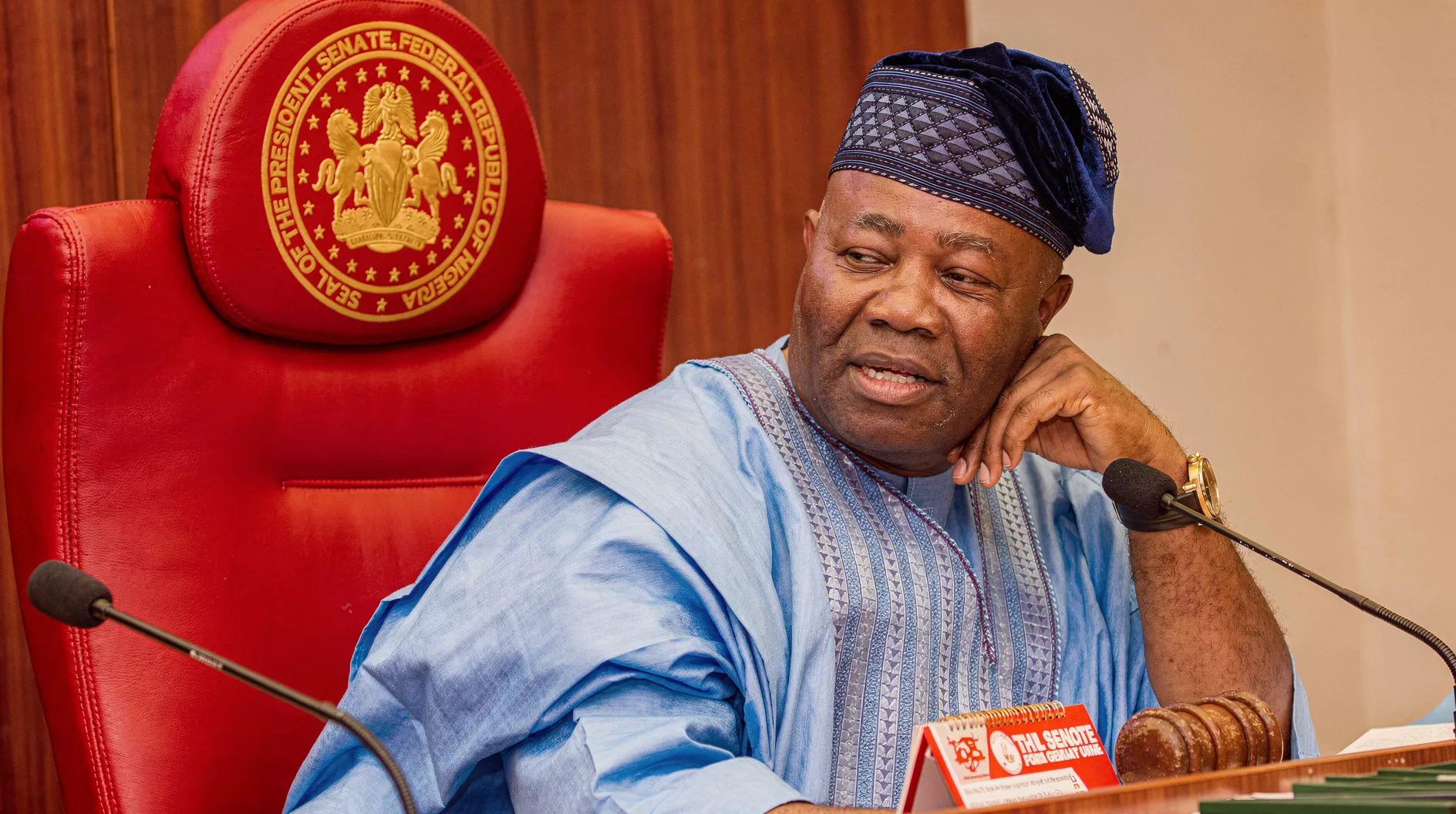
The Senate President, Godswill Akpabio, says that the Senate did not remove the electronic transmission of election results from the proposed amendment.
Speaking in Abuja as the special guest of honour at the unveiling of a book titled The Burden of Legislators in Nigeria, authored by Senator Effiong Bob, the Senate president clarified that lawmakers only raised concerns about making real-time transmission mandatory.
He defended the Senate’s ongoing amendment of the Electoral Act, saying critics are misjudging lawmakers based on an incomplete legislative process.
His comments followed criticism from key stakeholders and opposition parties over reports that the Senate had rejected mandatory real-time electronic transmission of election results in the amended law. On Saturday, the Nigerian Bar Association (NBA) urged the Senate to include mandatory electronic transmission in the Act.
In a statement shared on X (formerly Twitter), the NBA criticised the Senate’s decision to retain the “current wording in the Electoral Act—which allows results to be transferred in a manner as prescribed by the Commission,” describing it as a move that weakens the legal foundation for transparent elections and leaves room for manipulation and ambiguity.
Responding to the criticism, Akpabio said the Senate had not concluded work on the bill and that public debate at this stage was premature.“The Electoral Act amendment is incomplete. We have not completed it, but they are already on television. They don’t understand lawmaking.

“They don’t even know that what is in the Senate is not completed until we look at the Votes and Proceedings,” he said.
He criticised what he described as an “abuse” of the legislature, accusing some civil society actors of attempting to impose their views on lawmakers.“People have become mouth legislators. Go and contest election if you want to talk about lawmaking and join them to make the law. Retreats are not lawmaking; they are part of consultations. So why do you think that the paper agreed on during a retreat in Lagos must be what is adopted on the floor?” he asked.
Akpabio reiterated that the Senate had not removed any method of transmitting election results.
“I must state clearly, without ambiguity, that the Senate has not removed any means of transmission. If you want to use a bicycle to carry your votes from one polling unit to the ward centre, do so. If you want to use your phone to transmit, do so. If you want to use your iPad, do so,” he said.
The former Akwa Ibom State governor explained that lawmakers were concerned that mandating real-time transmission could trigger legal disputes in the event of network or power failures during elections.
“All we said was that we should remove the word ‘real time,’ because if you say real time and there is a grid failure and the network is not working, when you go to court, somebody will say it ought to have been real time,” he explained.
He added that the Independent National Electoral Commission (INEC) should be empowered to determine the mode and timing of result transmission within the framework of the law.
Akpabio warned that insisting on real-time transmission could invalidate election results in areas affected by insecurity or poor network coverage.“Real-time means that in over nine states where networks are not working because of insecurity, there will be no election results.
Nationally, if the national grid collapses and no network is working, no election results will be valid,” he said.He concluded by cautioning that electoral reforms must be grounded in legal and institutional realities, warning against imposing technology beyond the country’s infrastructure.
“When people do not understand their legislature, democracy is at risk. Democracy is measured not by passion alone, but by principles,” Akpabio said.

