 Follow Us on Google News
 Follow Us on Google Discover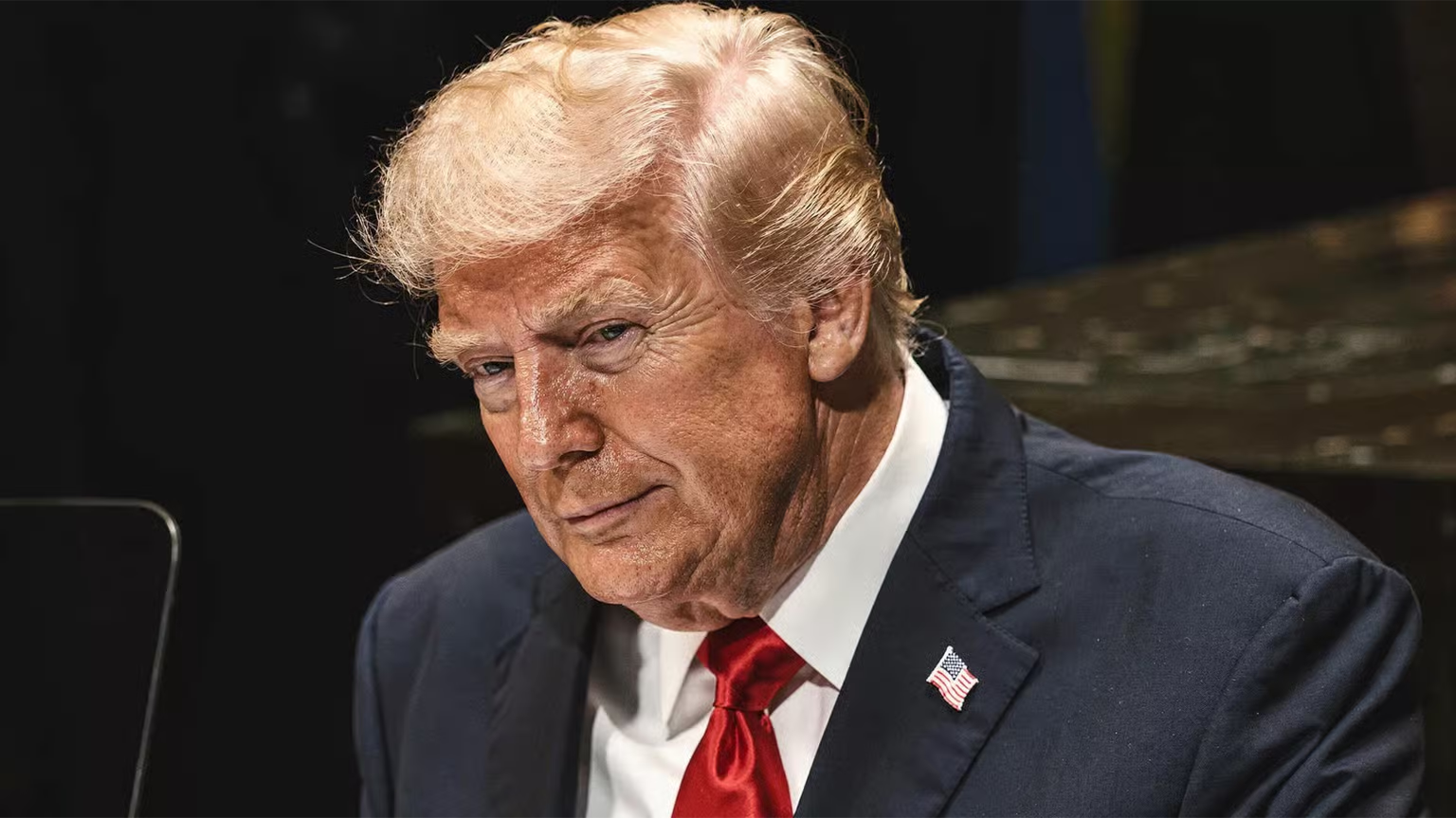
IN my view, the world is rapidly sliding back toward an era reminiscent of Viking ideology—a time when law and order were weak or nonexistent, and global affairs were governed largely by the crude doctrine of might is right.
To properly situate this argument, it is useful to recall who the Vikings were. They were formidable warriors, seafarers, and explorers who raided, traded, and settled across large swathes of Europe. Their activities left deep marks on places such as England, Ireland, and France, most notably with events like the raid on Lindisfarne in 793 AD. They also established enduring settlements, including the Duchy of Normandy and Vinland in North America.
Historically, the Vikings traversed Europe, parts of Asia, and even North America using long TFC ships that were technologically advanced for their time—fast, agile, and highly effective.
They settled in places like Iceland and Normandy, leaving behind legacies in language, culture, governance, and geography. Yet beneath this legacy lay a harsh reality: the Vikings were an exceptionally violent people, driven by conquest and domination. For centuries, they overran territories, deposed rulers, and imposed their authority through brute force.
In this respect, the Vikings bear striking similarities to modern terrorist movements such as Al-Qaeda and ISIS in the Middle East, as well as Boko Haram, ISWAP, and Al-Shabab in Africa. Like the Vikings of old, these groups seek to dismantle existing orders and impose their own rule through violence, terror, and coercion.
Although this comparison may seem like a digression, it serves a critical purpose: to underscore the timeless truth that there is little that is truly new in human affairs. Modern terrorist organisations can reasonably be viewed as contemporary equivalents of the Vikings—celebrated by some for their perceived courage, yet condemned by others for their savagery and brutality.
Importantly, the Viking age eventually came to an end, and so too will today’s violent extremist movements if the international community works collectively and resolutely.
One of history’s great ironies is that the same Arctic region once associated with conquest and bloodshed later gave rise to the Nobel Peace Prize. Instituted by Alfred Nobel of Sweden, the prize has become one of the world’s most respected symbols of peace and human coexistence. Ironically, the Nobel Peace Prize was recently awarded to Venezuelan opposition leader María Corina Machado—an honour President Donald Trump was widely believed to have coveted.
It is now being suggested that Trump’s failure to secure the Nobel Prize may have partly influenced the renewed American interest in acquiring Greenland, a territory located in the same Arctic region. Even if reports that the prize recipient donated her trophy to Trump are true, his appetite for Greenland appears undiminished.
And Trump justifies his desire for the Nobel prize with the fact that he is responsible for ending or preventing eight (8) wars since his return to the White House as the 47th president of the U.S.
This development reinforces the idea that history often repeats itself: the United States had sought to acquire Greenland decades before Trump’s presidency, meaning his efforts merely revived an old geopolitical ambition whereby the U.S. has since 1946 set its eyes on acquiring Greenland, and in 2019 when it made another attempt to do so.
Similarly, while the Viking reign of terror ended roughly a millennium ago, it has been replaced in the modern era by violent extremist groups such as Al-Qaeda, ISIS, Boko Haram, ISWAP, and Al-Shabab. These movements, too, will eventually fade into history if the global community demonstrates unity, determination, and sustained cooperation.
It therefore behoves leaders genuinely committed to ending terrorism—particularly in Nigeria and across Africa—to revisit history and study how the excesses of the Vikings were ultimately curtailed, paving the way for a more stable and peaceful Europe and North America.
Meanwhile, the North Atlantic Treaty Organisation (NATO), the world’s most powerful military alliance, appears increasingly strained. Threats by President Trump to impose 10 per cent tariffs on countries opposing a U.S. takeover of Greenland, coupled with the deployment of military contingents by the United Kingdom, Germany, and France to Greenland under NATO’s Article 5 obligations, raise the spectre of an all-out trade war between the United States and the European Union.
With the EU reportedly preparing a €93 billion trade retaliation package should tensions fail to ease, the world may be on the brink of another catastrophic trade conflict. Such a development would serve no one, especially at a time when the global economy is still struggling to recover from the devastating effects of the COVID-19 pandemic, which ravaged the world for nearly three years.
The cumulative effect of the United States’ increasingly unilateral actions suggests that the world may be drifting toward a crisis potentially more destabilising than the COVID-19 pandemic. Under President Donald Trump, power—not multilateral consensus—has become the dominant currency of global and domestic politics.
The U.S., Russia, and other powerful nations pushing their interests isn’t new, but it does feel like a shift. The disregard for international norms and institutions, as we saw with unilateral actions in various global conflicts Russia/Ukraine, Israel/Gaza, and now U.S./Venezuela contributes to a sense that “might makes right” is gaining traction.
This perceived shift has people worried about:
Erosion of international law: When powerful nations prioritise self-interest over global agreements.
Power imbalance: Smaller nations or groups having less say.
Unpredictability: Global stability suffers when big players act without consensus.
Whether this signals a “new world order” or just a messy chapter in geopolitics is being debated. However, the principle of might-is-right isn’t new historically, but the stakes feel different in today’s interconnected world.
The Trump administration justifies its aggressive posture toward Venezuela and its renewed interest in Greenland as acts of self-preservation.
The argument is straightforward: if the United States does not secure these strategic spaces, rivals such as Russia and China will. In international relations, self-preservation is often treated as the first law of nature, and Trump has embraced this logic unapologetically.
Yet these actions unfold against the backdrop of a weakened United Nations. Long tasked with arbitrating disputes between nations, the UN has seen its authority steadily eroded—accelerated by Washington’s deliberate withdrawal from its processes.
With only five permanent members still dominating the Security Council despite decades of reform demands, the 80-year-old institution appears increasingly irrelevant in shaping today’s global order.
To be continued tomorrow.

