 Follow Us on Google News
 Follow Us on Google Discover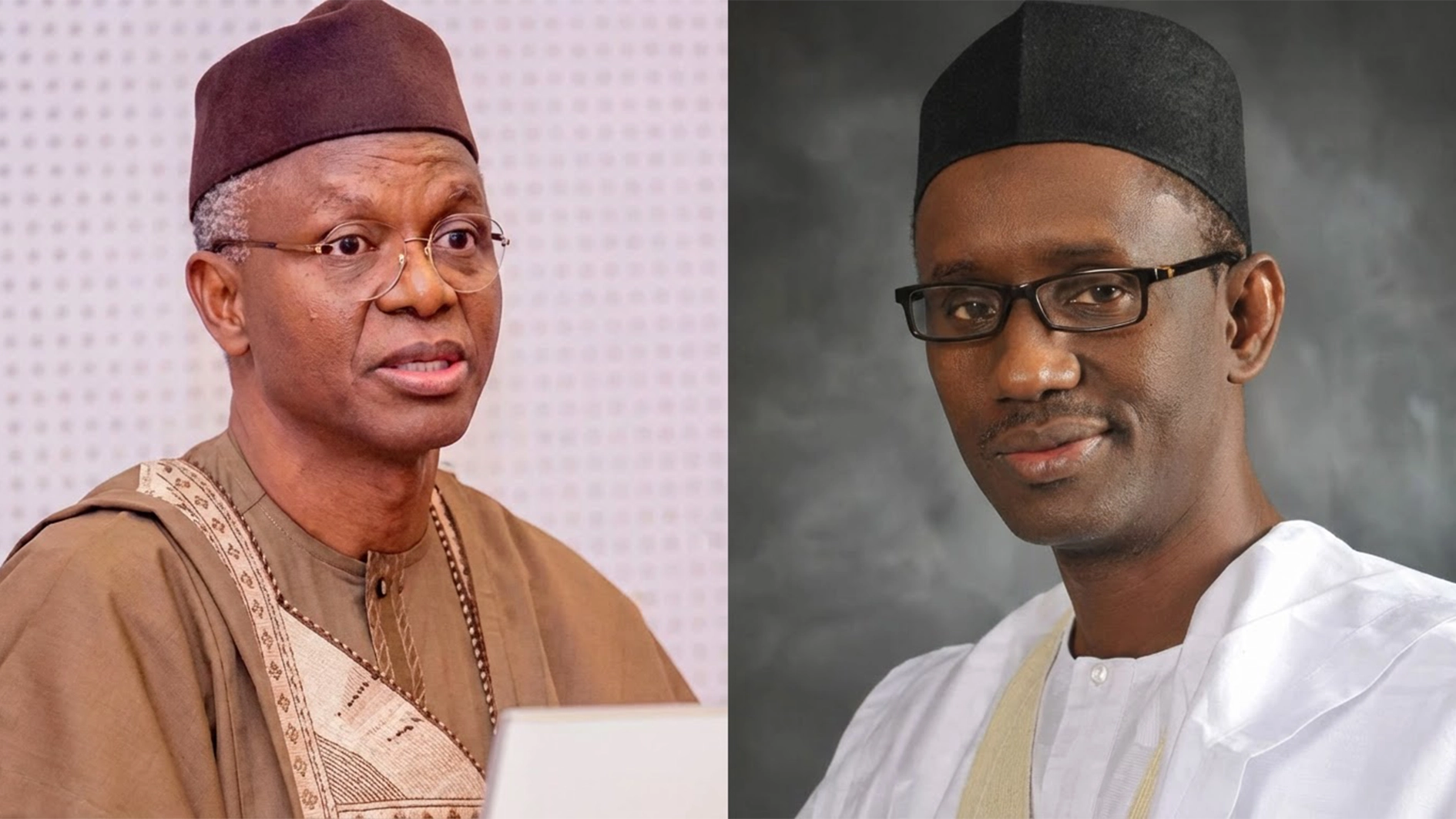
The ongoing fracas between the immediate past Kaduna State governor, Nasir el-Rufai, and the National Security Adviser (NSA), Nuhu Ribadu, comes off as a commencing metaphor about the political squabbling between the ruling All Progressives Congress (APC) and the coalition African Democratic Congress (ADC) in the lead-up to the 2027 polls, LEO SOBECHI reports.
On March 10, 2025, when he announced his exit from the ruling All Progressives Congress (APC), former Kaduna State governor, Nasir el-Rufai, declared that he was leaving the ruling party that he helped found for the Social Democratic Party (SDP).
He explained that the move would afford him the opportunity to join forces with like-minded people to ensure that President Bola Ahmed Tinubu did not secure a second term in 2027.
Some politicians, including his former colleagues in the APC, expressed mixed feelings about the political future of the former governor, alleging that his perceived troublesome disposition would make it impossible for him to enjoy harmonious relationships among members of the new party.
True to type, el-Rufai fell out with SDP leaders shortly after his entry. National leader of the party, Adewole Adebayo, said the former governor was always given to drama, pointing out that he wanted to drag SDP into a coalition through the back door. Posting on his Facebook page the same day, el-Rufai’s estranged ally, Senator Shehu Sani, had stated that his resignation from APC “is a good riddance. He stands as a liability to the party in Kaduna State. el-Rufai is now in political oblivion.”
Before his eventual defection to SDP, the former governor had hinted at turning his back on APC when he appeared on the Arise Television Prime Time News programme on February 24, 2025. He told the anchor: “I am still in the APC and will remain until they have completely failed in their founding obligations. I did not leave the party; the party left me. I will surely leave it and don’t rule that out, provided it does not return to the founding principles.”

On Friday, February 13, 2026, el-Rufai was back on Arise Prime Time programme and, like his previous appearance in March last year, what he said touched not only on his political preferences, but also much about his relationship with his former party and his determination to stunt President Tinubu’s continued stay in office beyond 2027.
Giving his perspectives on the airport drama involving him and some operatives of the Department of State Services (DSS), el-Rufai alleged that it was the Independent Corrupt Practices Commission (ICPC) that “procured the DSS to abduct me for them”. He added that officials of the anti-graft agency have become personal tools of Nuhu Ribadu (the NSA), stressing that the NSA actually ordered that he be arrested and detained. On how he found out that the NSA gave such a directive, the former Kaduna State governor, who also served as Minister of the Federal Capital Territory (FCT), disclosed that someone who taped Ribadu’s phone line heard the conversation and relayed it to him. el-Rufai dismissed the illegality of such practice on the premise that “the government thinks they are the only ones who listen to our calls with court orders, but someone tapped his phone, and I was informed.”
On Monday, February 16, the former governor was billed to honour the invitation of the Economic and Financial Crimes Commission (EFCC), which he said had been more professional in its constitutional assignments than the ICPC.
However, as el-Rufai’s declared battle with the APC and its government enters a new phase, his face-off with his former ally, Ribadu, has proved the truism expressed by the Roman philosopher, Marcus Tullius Cicero: “ambition transforms friends into enemies”.
Bases of beef
Shortly after the former Lagos State governor, Bola Tinubu, won the APC presidential straw poll in June 2022, both el-Rufai and Ribadu worked assiduously for Tinubu’s triumph at the main poll.
For Ribadu, Tinubu’s victory would ensure that his renewed presidential aspiration comes to fruition in 2031, having been supported by the APC leader to fly the presidential flag of the defunct Action Congress of Nigeria (ACN) in 2011.
On his part, el-Rufai believed that, having mobilised the 19 Northern States governors to support power shift to the South and Tinubu’s eventual emergence as APC’s standard bearer, the prospects were high that he would deputise the presidential contender as running mate. Buoyed by this anticipation, el-Rufai had argued forcefully in favour of a joint Muslim-Muslim pairing on the presidential ticket.
To demonstrate the feasibility of such a religiously insensitive arrangement, the then outgoing governor of Kaduna State pointed to a similar experiment in his state and went further to impose his deputy, Hadiza Sabuwa Balarabe, as the running mate to his preferred governorship candidate in the 2023 poll, Senator Uba Sani.
However, amid geopolitical balancing considerations, Tinubu was said to have pointed out that, since the North-West, where el-Rufai hails from, was just rounding off eight years in the office of President, it would make political sense for his running mate to come from the North-East. At the end of the day, after prolonged bargaining that nearly exceeded the deadline for the submission of names of candidates, Senator Kashim Shettima, a former governor of Borno State, was chosen as the substantive Vice-Presidential candidate.
Despite the near miss, el-Rufai was assured of a strategic position in the anticipated Tinubu Presidency, such that he became a prominent feature in the Presidential Campaign, especially making it on the delegation to the Chatham House engagement.
For Ribadu, who had contested unsuccessfully for the governorship of Adamawa State, he was also assured as a potential member of Tinubu’s inner caucus. On March 1, 2023, Tinubu-Shettima were returned by the Independent National Electoral Commission (INEC) as winners of the February 28 presidential poll on the platform of APC.
But, while Ribadu was named as NSA, the first non-military appointee to the office, the attempt to bring in el-Rufai as Minister of Power ran into political intrigues, spanning dubious security reports and clearance shenanigans at the Senate.
Seeing through the entire rigmarole, el-Rufai, who once counselled Tinubu’s underlings in Lagos State, including former governor Akinwunmi Ambode and Muiz Banire, on how to depose godfathers, threw in the towel. The former governor’s inner men blamed the troika of Ribadu, Senator Abubakar Bagudu and the Secretary to the Federal Government (SGF), George Akume, for prevailing on President Tinubu not to allow him into his cabinet or risk combustion in the government.
Still, during his appearance on a national television programme, the former Kaduna State governor stated that it was President Tinubu, rather than his aides, who ensured he did not return to the Federal Executive Council, which he left some 15 years ago.
Between regrets, betrayal
But while accusing Ribadu of ordering his arrest and detention during his Arise Television appearance last Friday, it was obvious that el-Rufai felt betrayed by his former ally and friend, the NSA.
The tone and inflexion of his voice betrayed the disappointment and pain that someone with whom he had done a lot of things together in the past could go to the extent of plotting his political diminution or even extinction.
“I feel ashamed when I remember he was once my friend. Nobody is as wicked as Nuhu Ribadu in Tinubu’s administration,” el-Rufai told the television anchor, pointing out that he would have resigned from Tinubu’s government if he had been appointed as Minister due to the rough-hand tactics of his former friend.
While stressing that the NSA not only authorises arrests without adequate prior investigation, but also extends its involvement into judicial proceedings.
He said: “The NSA exerts influence over bail decisions by urging members of the judiciary to deny bail to certain suspects, including individuals who were initially detained without thorough investigative processes.”
While drawing public attention to the alleged arrest of a former Director-General of the Nigerian Maritime Administration and Safety Agency (NIMASA), Bashir Jamoh, by ICPC, el-Rufai noted that the APC-led Federal Government has continued to target his friends in an attempt to nail him and keep him out of circulation.
Going the Malami way? The loss of camaraderie between the former Kaduna State governor and his former EFCC chairman counterpart continues to elicit reactions, even as some stakeholders claim that the Federal Government was intent on isolating forceful opposition elements as the 2027 election nears a definitive phase.
Nonetheless, some of those who know how close el-Rufai and Ribadu were believe that there must be something deeper than politics and ambition. While some believe that Ribadu’s closeness with incumbent Kaduna State governor, Uba Sani, was to blame, others point to some shared secret operations in the past.
Muhammed Safeeyan, in a post on Instagram, stated: “From my observation, it seems like el-Rufai has something strong on NSA Nuhu Ribadu. Otherwise, he wouldn’t be making such serious allegations so boldly.
“First, he claimed on national TV that Ribadu negotiates and pays bandits, yet there’s been no public disclaimer or response from the NSA’s office. Now, he is alleging that someone tapped the NSA’s phone and got information about his arrest, and still there’s silence.”
Although el-Rufai denied that he had any hand in the unexplained disappearance of citizens, like Abubakar Idris (Dadiyata), when he held sway as Kaduna State chief security officer, the silence from the ONSA (Office of the National Security Adviser) seems to be pregnant with curious implications. Are there things that the Federal Government unearthed about the former governor that ordinary Nigerians do not know? Could the chase for el-Rufai be related to the ongoing pressure from the United States on the fight against terrorism sponsors? Was el-Rufai’s disclosure that the phone lines of the NSA were tapped mere drama or part of a calculated effort to inform President Tinubu that he was naked security-wise, speaking with Ribadu as his security adviser? How far does the presidential ambition of both men influence the ongoing schisms? The following weeks will resolve those concerns.
Only when the former governor began discussions with both EFCC and ICPC could it be known whether he would join former Attorney General and Minister of Justice, Abubakar Malami, in a long residence behind the walls of freedom.

