 Follow Us on Google News
 Follow Us on Google Discover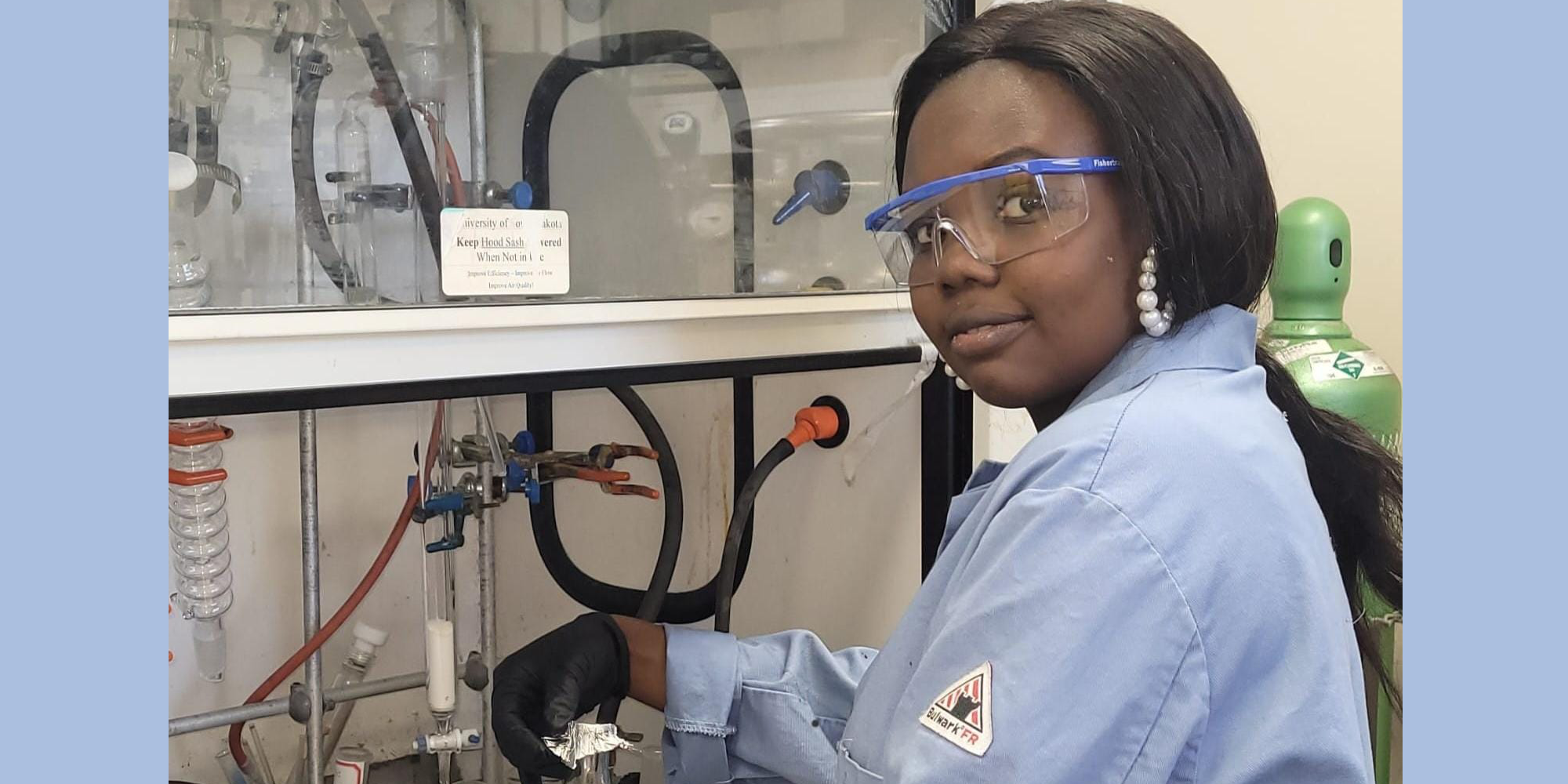
As the world seeks cleaner energy solutions, smarter electronics, and more sustainable technologies, scientists are turning to innovative chemistry to solve some of the most pressing challenges of our time. Among them is Blessing Ishola, a U.S based nigerian scientist whose work in fluorine chemistry and advanced materials is creating pathways to durable semiconductors and high-capacity energy storage research that holds value far beyond the laboratories where it is developed.
Ishola’s scientific voyage began in Nigeria with an undergraduate research project in environmental chemistry, where she explored how the widely used antibiotic rifampicin interacts with sediment systems. By examining the roles of pH, salinity, and environmental conditions in pollutant behaviour, her work shed light on real ecological issues, connecting local environmental realities with broader questions about water quality and chemical impacts on natural systems.
That foundational experience laid the groundwork for her Master of Science in Chemistry in the United States, where she focused on the design and synthesis of air- and moisture-stable fluorinated functional molecules. These materials are vital for n-type organic semiconductors, essential components of devices such as transistors, diodes, organic field-effect transistors, and organic light-emitting diodes. Organic semiconductors, prized for their flexibility and tunable properties, are increasingly central to next-generation electronics and sustainable energy technologies.
Through meticulous molecular design, Ishola created new classes of donor–acceptor molecules combining thiophene-based donor units with perfluoroalkylated acceptors and showed how subtle structural adjustments can profoundly improve charge transport, thermal stability, and performance. Complementary computational studies helped reveal how these choices influence optoelectronic properties like band gaps and electron affinity, results that point toward more efficient semiconductors and battery systems.
Her research also unveiled the redox potential of these fluorinated materials, opening up promising avenues for their use as redox-active polymers in lithium-ion batteries, a field that remains a cornerstone of global efforts to decarbonize energy systems, improve grid resilience, and enable portable power in emerging economies.
At the same time, she has extended her inquiry into the chemical and electrochemical transformation of fluorinated compounds themselves, addressing concerns about the persistence and environmental footprint of such materials. In recognizing the need for sustainable material lifecycles, she is now beginning doctoral research focused on how fluorinated structures can be repurposed into valuable chemical feedstocks, rather than contributing to waste.
Her work speaks directly to shared challenges around energy storage, electronic manufacturing, and responsible chemical design, topics that resonate in the United States as it pushes forward with energy transitions and advanced technology development, and in Nigeria and other parts of Africa, where access to adaptable, efficient materials and cleaner energy solutions remains an urgent priority.
While she is currently based in the United States, her scientific contributions are not confined by geography. The insights she is generating about materials that perform under demanding conditions and about how chemistry can be responsibly designed have relevance wherever innovation is needed, whether in bustling tech hubs, emerging industrial centres, or regions confronting energy access and environmental concerns.
Beyond research, Ishola actively engages in science communication, mentorship, and collaboration, helping to bridge scientific communities across continents and inspire young scientists from diverse backgrounds. Her work demonstrates how science can serve as a universal language of progress, connecting local insight with global innovation and offering solutions that benefit communities near and far.
While domiciled in the United States, Ishola remains deeply connected to Nigeria’s scientific and developmental needs. Her work speaks directly to challenges such as energy access, environmental protection, and materials durability in harsh climates, while simultaneously contributing to U.S. goals of technological leadership, energy security, and economic competitiveness.
Beyond research, she is actively engaged in science communication, mentorship, and innovation-focused outreach, helping to build scientific capacity and foster collaboration across borders. Her efforts reflect the growing role of scientists as bridges between nations, translating knowledge into shared progress.
From environmental chemistry in Nigeria to advanced fluorinated materials research in the United States, Ishola’s journey illustrates how globally conducted science can advance national interests on multiple fronts. In an era shaped by climate urgency, semiconductor competition, and energy transition, her work underscores the power of rational chemical design to support a cleaner, more secure, and more resilient future for both nations and the world.

