 Follow Us on Google News
 Follow Us on Google Discover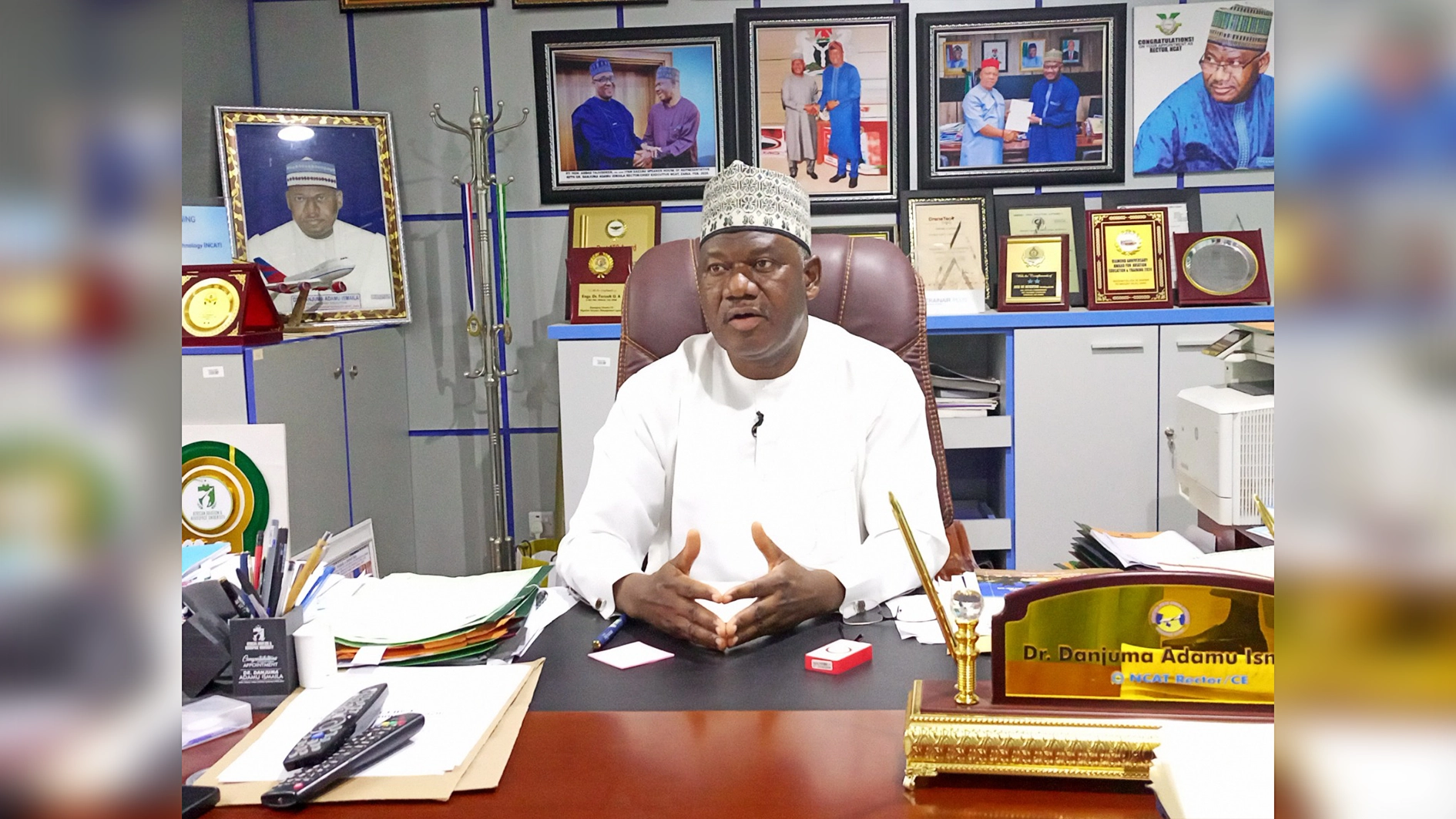
Rector of the Nigerian College of Aviation Technology (NCAT), Zaria, Dr Danjuma Ismaila, in this interview with OLUSEGUN KOIKI, speaks on his achievements in office in the last year and the constraints of paucity of funds, uncompleted Diamond 42 trainer aircraft and the recent hike in school fee by 50 per cent.
What would you say are your major achievements since you assumed office about a year ago?
The Nigerian College of Aviation Technology (NCAT) was established in 1964 with the mandate of providing training and manpower development for operational development in the aviation industry. The college has six schools: flying, aircraft maintenance engineering (AME), aeronautical telecommunications engineering (ATE), air traffic services/communications (ATS/Com), aviation management and airport engineering training.
NCAT is one of the regional centres for the International Civil Aviation Organisation (ICAO) training and we have a platinum status, which is a great achievement for the college because there is no school in the country that has attained such a lofty level. This is based on the programmes that we run. On our calendar, we have over 200 courses that we run for various aviation professions. Some of them are ab initio, while some are continuous professional development programmes.
When I came onboard, I met a school that needed most of its equipment to be upgraded to international standards; some of the facilities were inadequate, while others were obsolete and required upgrading, which I embarked upon.
However, our major challenge has been funding. I now look at two approaches: intervention funds to supplement government funding and how to improve our internally generated revenue (IGR). That will also complement our funding arrangement. So, my first task is to improve our funding capacity. We sought a way to run programmes for the international community because our programmes have met international standards.

Whatever we are doing in terms of curriculum has already been certified by the Nigeria Civil Aviation Authority (NCAA) and ICAO and as such has met all the international standards.
We have the opportunity not to only train Nigerians, but also to train people from other countries. So, we embarked on sensitisations and marketing, which yielded some results. Now, we have participants from other countries like South Africa, Niger, Egypt, South Sudan and some other French-speaking countries that are doing some programmes with us here.
Since I assumed office, I have approached some of the intervention opportunities in the Nigerian education system and aviation sector. Locally, we can be enlisted to benefit from the Tertiary Education Trust Fund (TETFund). As of this February, we were enlisted and we have received some interventions. We are working on a procurement process to utilise the fund.
We have also approached the Federal Government through the Renew Hope Agenda projects and I think our request is being considered. There are other areas that we have approached for funding for the college.
Definitely, this request would improve our funding, which will solve most of our critical needs in terms of facility upgrades. We also have engagements with important stakeholders like the NCAA, Nigerian Airspace Management Agency (NAMA), Nigerian Meteorological Agency (Nimet), Federal Airports Authority of Nigeria (FAAN) and others.
For some of them, we are the major trainer provider for their services and there were some bottlenecks in terms of our relationship, which were addressed. We signed a memorandum of understanding (MoU) with some of the organisations and we have also opened more collaboration with other government agencies like the Presidential fleet, Nigerian Air Force, African Aviation and Aerospace University, Abuja, with which we signed an MoU, and many others.
Already, we have upgraded some of our critical infrastructure, like the air traffic control simulator training. Now, we can accommodate more students for the training of air traffic control and surveillance. This is one of the areas where NAMA has been complaining that we were not meeting their training needs, but now we can increase our capacity in that area.
Besides, we have improved on our perimeter fencing, which was only about 50 per cent complete before now. This has led to the encroachment of the school’s land by neighbouring communities, which we have been battling over the years, even legally. Now, the contractors have been mobilised to the site. This will increase our security and safety for the operations of our flights.
Also, we are working towards awarding a contract for the renovation of the runway. And all our staff who have not been appropriately trained, we have been giving them appropriate training. Some of them have to renew their licenses through our capacity building projects and we ensure that they are up to date in terms of training delivery. Basically, these are what we can say we have achieved in the last one year.
Would the institution require legislative backing to be more efficient?
NCAT is supposed to be the leader in the African training institutions, but unfortunately, we are not there yet. We have the Ethiopian University, which is now ahead of us in terms of programmes and capacity because the government of Ethiopia supported their college optimally.
The aviation industry is an important factor, contributing to the economy of Ethiopia. Presently, the institution has over 30 trainer aircraft, while we only have nine. So, we can’t compare ourselves with them in terms of capacity. Yet, we are working towards increasing our capacity.
If we can get funding through the National Assembly or the Federal government for the acquisition of additional trainer aircraft, then definitely we are going to increase our capacity. Right now, the college is overwhelmed with the demand for aviation pilot training in the whole country because we are the only one that is currently providing that. We get over 100 applicants, but we can only admit 25 of them.
Most applicants are ready to pay, irrespective of the fee, because you cannot compare our price with that abroad. The same training, same package that we give here, which is commercial pilot licensing (CPL) and it’s accomplished in 18 months, is the same thing you do in Ethiopia Aviation University.
Last November, I met some Nigerians in Ethiopia going through the same CPL training there. Each student pays about $75,000, which is almost N90 million now, but at NCAT, we charge only N23 million for the same course. We are just about to increase it to N33 million this year.
What is the latest about the Boeing 737NG simulator aircraft, which NCAT acquired a few years ago?
We are working day and night to ensure that our Boeing 737NG simulator aircraft functions properly. What is delaying us is the original equipment manufacturer (OEM). I found it not functioning; now we engaged them together with our engineers and they discovered a lot of problems with it because it has not been used for many years. At the end of the day, the manufacturer, together with our engineers here, fixed 80 per cent of the challenge and this was done virtually.
But the remaining 20 per cent, has to be physical maintenance. The challenge is that they have been given so many reports about Nigeria’s insecurity and they are afraid to come to fix the remaining 20 per cent here. They now sent a security consultant and did an assessment for them and told us to put certain things in place before they could come. That is what we are working on now. Hopefully, by next month, these people will be here.
I don’t know why they are scared, because there are other facilities that we have. People from the United Kingdom came and fixed them. We have a fire simulator, where we train personnel. We have an OEM that comes every six months to fix it. They don’t have these issues. They are also white people like them.
Last December, they were here and they fixed it. Also, we are expecting them back by May to fix the facility again. But the Canadian Civil Aviation Authority (CAA) is giving us all sorts of complaints with the insecurity report given to them by their embassy. These are the challenges we are facing on the equipment. Otherwise, it is also going to generate a lot of revenue for the college.
In fact, at one time, we wanted to employ the services of an engineer who worked with the same company in Canada, but now works in Lagos. We asked them if they could authorise him to even look at it and give them his assessment, but they said no. Rather, they wanted their own engineers to come and fix it.
We can also collaborate with the Ethiopian University on the same equipment. We can ask their engineers to come and fix it for us, but the company equally disagreed with that option. You know, one thing about it is that they control it from their own end. Whenever you operate this machine, it will give them a signal over there. So, they can block you from their side. That is why we have to be very careful, especially at this initial stage.
Why is NCAT yet to take delivery of the remaining Diamond aircraft it ordered several years ago?
This is largely due to funding. No funds were released to the contractor. Already, it has been contracted; we signed a contract for supplying 20 aircraft, but the contracted company was only able to supply nine.
Unfortunately, while we have not been using them, it is because they are very costly to operate, as they use aviation gas (avgas). The fee we charge the students will not be able to cover even the cost of aviation fuel. If there is a lot of pressure on us, maybe we will start using them so that we can charge an additional cost fee for using that aircraft.
Apart from subventions, which other means have you adopted to increase revenue?
Our IGR has significantly improved in the last one year, but I cannot tell you exactly the amount. In terms of percentage, it should be around 25 to 30 per cent increase.
The strategy has been that we improved our international visibility, which gives us more opportunities to carry out more training. Also, we sat down with most of our key stakeholders for collaboration and other things necessary to elevate the college.
In our discussions with them, we told them our weaknesses, and they advised us on how we could fix them. This particularly improved our relationship with them.
We are also collaborating with airlines ahead of the 737NG, which we hope will come on stream any time soon.
Has the government approved the 50 per cent increase in NCAT’s fees?
The government has approved the 50 per cent increase in the school fees. As I told you earlier, the pilot training was N23 million. But it has increased to N34 million per student. In the end, we are going to earn additional revenue from that. We are going to maintain our intensive marketing outreach. We intend to participate in international forums to increase our visibility, which will earn us a lot of foreign exchange.
If we can properly harness most of our opportunities, I am telling you, this college can generate a lot of foreign exchange for the Nigerian government because most of our neighbouring countries go to Europe to attend some courses that we can even run here. When we are generating money in dollars, it will arrest capital flight and increase revenue for the government.

