 Follow Us on Google News


 Follow Us on Google Discover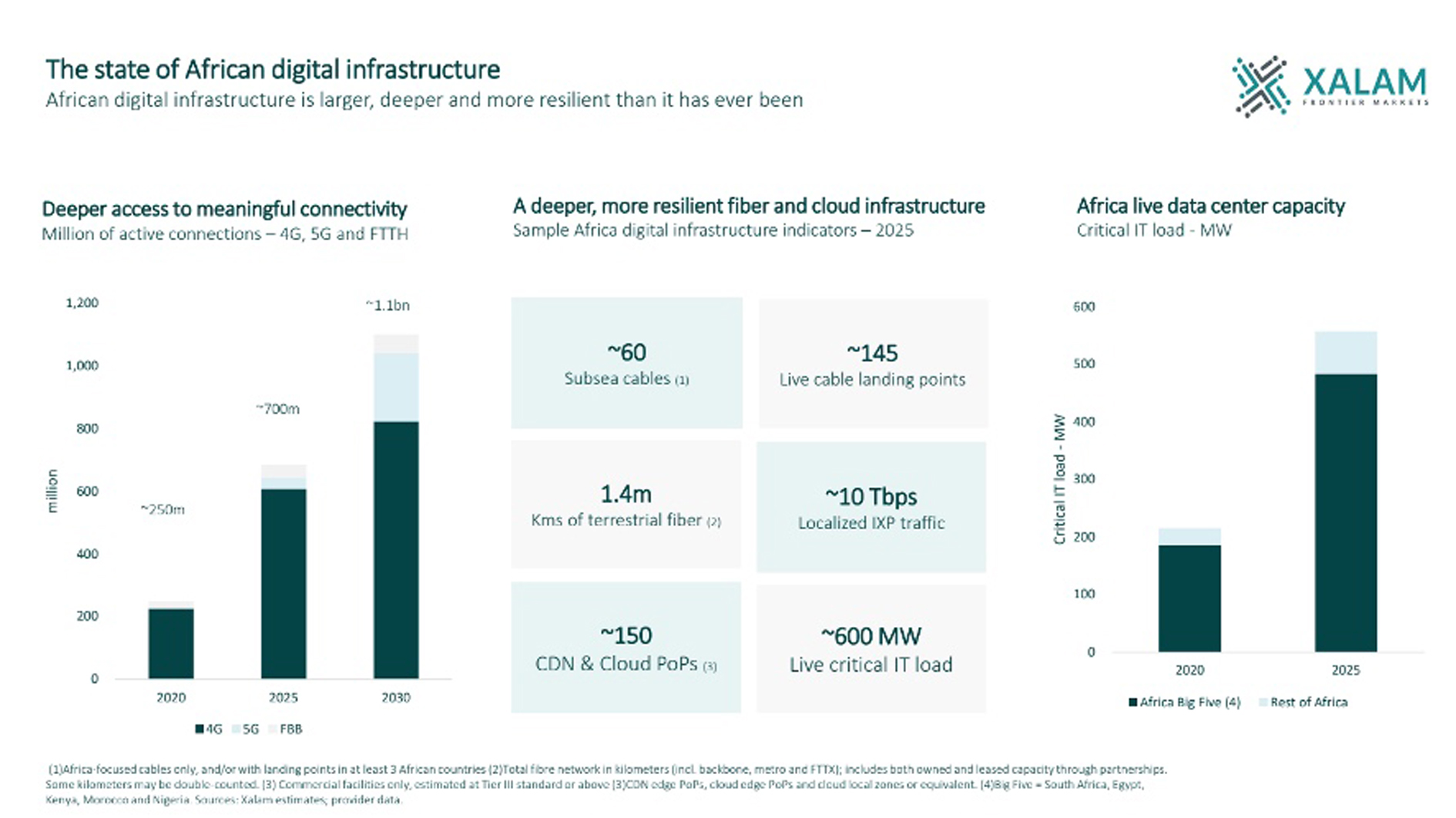
Despite a decade of record-breaking investment in subsea cables and fibre optics, Africa still accounts for less than one per cent of global compute capacity, Managing Partner at Xalam Analytics, Guy Zibi, said.
Speaking at the Africa Hyperscalers Conversations, Zibi highlighted a startling paradox – Africa has never been more connected, yet it is falling further behind in the global AI and hyperscale race.
While Africa’s digital footprint has expanded in absolute terms, it is being eclipsed by the ‘gigawatt-scale’ explosions in the U.S., Europe, and Asia.
“The next phase of growth depends less on connectivity alone and more on where workloads are actually run,” Zibi noted, stressing that cables mean little if the data is processed elsewhere.
Zibi noted that the key distinction is between absolute infrastructure growth and relative global positioning. While Africa’s connectivity footprint has expanded significantly, the continent’s share of global public cloud usage remains around 0.3 per cent, with roughly 0.2 per cent of global AI compute resources located locally.
The Guardian checks showed that as of early 2026, Nigeria is indeed connected to eight major submarine telecommunications cables, making it a pivotal hub for international connectivity in West Africa. These cables, which facilitate over 95 per cent of Nigeria’s internet traffic, have drastically increased bandwidth, although challenges remain in distributing this capacity inland.
Further to the Hyperscalers Conversations, the session also highlighted the role of “meaningful connectivity” as a prerequisite for local computer market formation. Roughly 700 million Africans now use 4G, 5G or fibre-based broadband, creating a foundation for digital service expansion, though sustained workload concentration remains necessary before large-scale cloud regions typically emerge.
Public-sector digitisation was identified as one of the most important drivers of early compute demand across emerging infrastructure markets. National identity systems, regulatory platforms and financial infrastructure were cited as examples of government workloads that can anchor local hosting ecosystems and reduce uncertainty for investors.
“When governments localise workloads, infrastructure follows,” Zibi noted.
The discussion further emphasised that hyperscaler expansion across Africa continues to follow demand maturity rather than infrastructure availability alone.
While cloud capacity has expanded through edge deployments and partner facilities in multiple markets, full hyperscaler regions remain concentrated in a small number of hubs.
Zibi concluded that the next phase of Africa’s digital infrastructure development will depend on coordination across three systems: cloud demand formation, power availability and terrestrial fibre expansion. Without alignment across these layers, the pace of compute deployment is likely to remain uneven.
Despite the decline in relative global share, Zibi stressed that Africa’s infrastructure trajectory remains positive in absolute terms. The key question is whether improvements in connectivity can translate into sustained domestic workload growth capable of supporting larger-scale compute ecosystems across the continent.
The report identifies *public-sector digitisation* as the primary engine for change. By moving national ID systems, financial infrastructure, and regulatory platforms to local servers, governments can create the ‘anchor demand’ needed to lure hyperscalers like Google, Microsoft, and AWS.
The discussion revealed that the formula for the next decade centres on three pillars. These are cloud demand, which is localising domestic workloads; power availability, which involves securing the massive energy required for AI clusters; and terrestrial fibre, which involves expanding the reach beyond coastal landing points.
Africa currently boasts 1.4 million kilometres of terrestrial fibre and 60 subsea cables, providing a foundation for 700 million broadband users. However, without a coordinated shift toward local hosting and power stability, the continent risks remaining a consumer of global digital services rather than a hub for digital production.


