 Follow Us on Google News
 Follow Us on Google Discover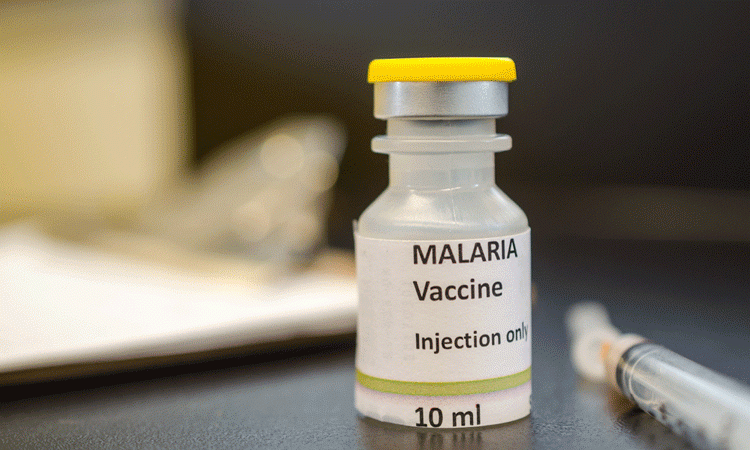
Over 1.2 million children receive Over 1.2 million children in four states have received the malaria vaccine in the country.
Executive Director of NPHCDA, Dr Muyi Aina who disclosed this at the Fist quarter 2026 media briefing in Abuja, noted the government has expanded malaria vaccine to two additional states of Bauchi and Ondo apart from the two pilot states, Bayelsa and Kebbi, adding that the selection was based on malaria burden in the states and the readiness assessments.
Giving a breakdown of the malaria vaccine uptake, Alina explained out that a total of 984,559 children have received at least one dose of malaria vaccine in Kebbi and Bayelsa, 166,342 children in Ondo and about 105,890 in Bauchi.
Aina however noted that each child is expected to take four doses of malaria vaccine to make it a complete and effective but ensuring that children return for all doses has been a major challenge.
He said, ,,” What is unique about the current malaria vaccine is that for it to be fully effective you have to take four doses which we are still learning from. What we discovered is that sometimes there’s a drop out between each stage. So we’re working through systems to learn how to successfully bring people back four times for the vaccine”.
The ED noted that about 102 million children between 9 months to 14 years were successfully vaccinated against measles and rubella during the Integrated Measles-rubella vaccination exercise.

“We are continuing to make sure that vaccines are available, spending lots and lots of money to procure the vaccines, and investing in the supply chain, the cold chain technology vaccines. Most of them, you can’t just keep them on the shelf, you have to refrigerate them. So. about 1,768 solar refrigerators, 62,000 vaccine carriers, about 237 freezers and 5,754 cold boxes have been recently procured and distributed.
Now, to enable all of this, of course, you need money. And one of the reasons, the primary reason, frankly, that the primary health system in particular was in such a bad shape when this government came was that over many years, it had been underfunded”.
Aina stated that the present administration has increased the functional level two primary health centres by 59% since March of 2026 when we compared to just two years ago when this journey actually started.
He said, “The journey of revitalisation actually commenced about March 2024. The primary health centres in the country are now functional, either level two or level one. We have level one PHCs and we have level two PHCs. Level 2 PHCs are the ones that are set up to provide services for 24 hours. Level one PHCs also provide services, but in many instances, they close in the evening to the open the following day.
“We have continued to invest in solarization through direct government intervention, but also through some of our partnerships with our development partners.Just recently, the Minister of Health and ourselves were able to take over and commission the latest 371 PHCs that were solarised across the country. We have also continued to instal wash services for rooms. We have continued to make sure that what you need to pay reliably, access water, access power, and be confident in the facilities are there.
Aina observed that there is an increased utilisation of primary health care services in the country as general attendance has increased from 29 million per quarter in middle of 2023 to 46 million, 45.4 million as of Q4 2024, even higher in 2025.
He noted that the agency has retrained over 78,000 out of the 120,000 frontline health workers target set by President Bola Ahmed Tinubu adding that over 19,000 skilled birthday attendants , nurses, midwives, and doctors,have been recruited to man the health facilities while almost 4,000 community-based health workers have been recruited across the first two states that started to reestablish the community-based health worker platform.
Aina observed that between 2023 and 2025, the country recorded 48% reduction, in circulating variant polio virus outbreaks because of the progress being made in immunisation
He noted that 48,372 women have accessed free maternal services across the country while about 2,497 others have benefited from obstetric fistula repair services
Aina emphasized that the year 2026 is is for consolidating and accelerating on some of the reforms that the government, under the leadership of the President Bola Ahmed Tinubu has initiated .
“This year, 2026, is a year of consolidation. It’s a year of scaling up and ensuring that we get meaningful and measurable impact of the key reforms and initiatives to Nigerians.
Our strategic focus remains to develop quality primary health care services in a way that is equitable, to enhance performance and accountability across all the stakeholders, and to strengthen frontline workforce capacity, strengthen infrastructure for primary health care, but to ultimately improve trust in the system”.

