 Follow Us on Google News
 Follow Us on Google Discover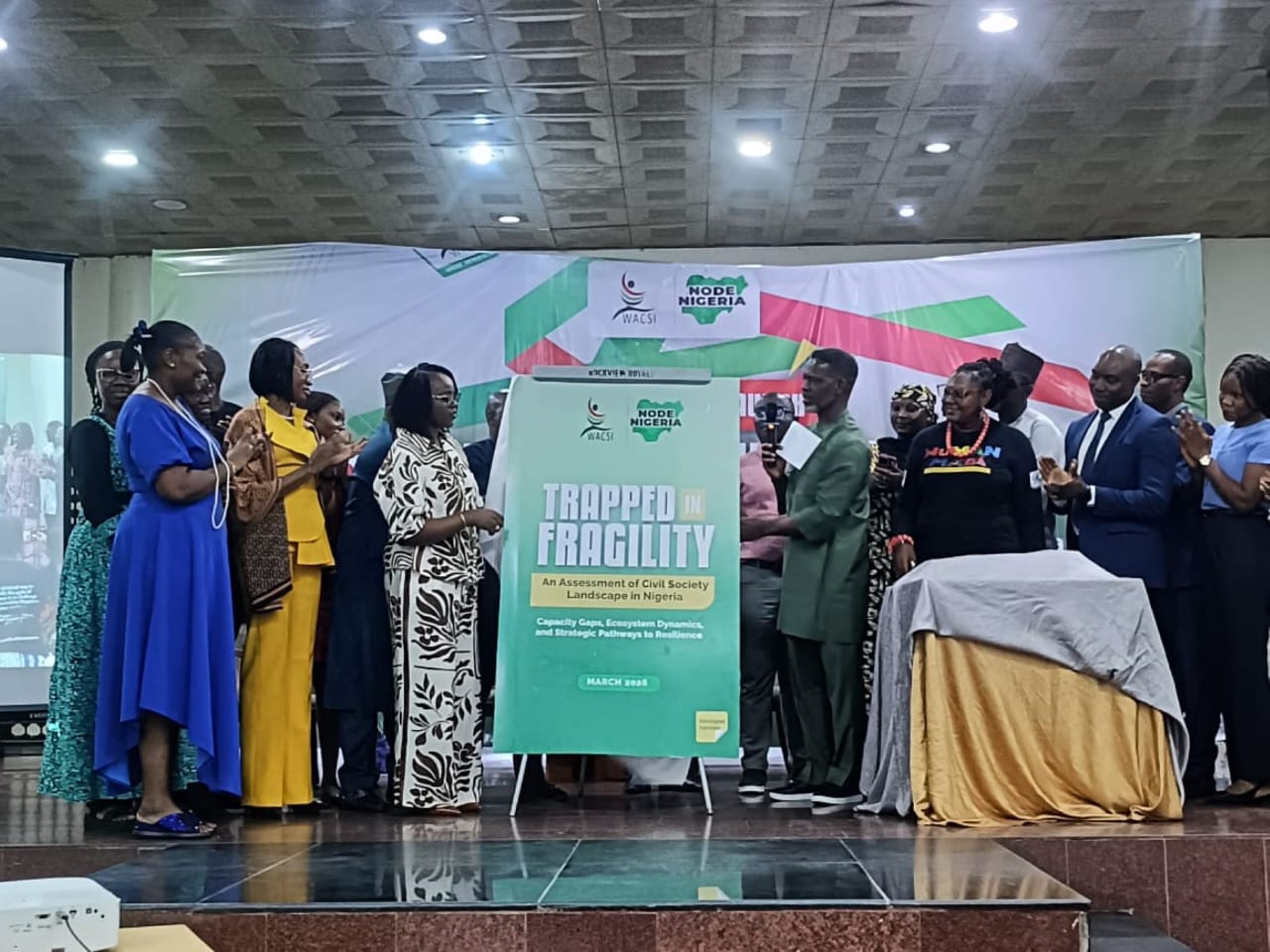
The West Africa Civil Society Institute (WACSI) has launched a new publication detailing the deepening structural and financial weaknesses confronting Nigeria’s civil society sector, warning that many organisations remain trapped in a cycle of fragility that threatens their long-term sustainability.
Presented Thursday in Abuja during a hybrid event, the publication titled “Trapped in Fragility: An Assessment of Civil Society Landscape in Nigeria” was commissioned by WACSI’s Nigeria Node and produced in collaboration with the Nigeria Network of NGOs (NNNGO).
The assessment, based on a survey of 693 civil society organisations across the country, paints a troubling picture of a sector weighed down by weak institutional systems, poor governance structures, inadequate funding mechanisms, and growing digital vulnerabilities.
According to the report, 86 per cent of the organisations surveyed operate without a documented fundraising strategy, while more than three-quarters have not undertaken formal programme evaluation within the last two years, raising concerns over planning deficits and weak accountability systems.
Researchers described the trend as evidence of a “starvation cycle” in which persistent underfunding prevents organisations from investing in governance, staffing, impact assessment, and operational systems needed to attract future support.
The report further revealed that over 60 per cent of organisations lack dedicated budgets for staff capacity development, while more than 80 per cent operate without key institutional frameworks such as IT policies, board manuals, communication plans, and data protection structures.
Governance deficits were also highlighted, with nearly 65 per cent of respondents reporting challenges in board development and 61.5 per cent citing weak strategic planning and board engagement.
Funding access remains a major constraint, the report noted, as 67.8 per cent of organisations struggle to secure government support, while over 60 per cent face difficulties accessing grants from private foundations and corporate institutions.
Speaking at the launch, Chairman of WACSI Node Nigeria, Oladayo Olaide, said the report comes at a critical period when civic space is shrinking and civil society actors face increasing pressure from state institutions.
He noted that arrests of activists under cybercrime laws, harassment by security agencies, and forced exile of some civil society leaders have compounded the operating challenges within the sector.
“Several organisations have become inactive after their leaders were detained, while others have had to scale down operations due to growing hostility and resource constraints,” he said.
Olaide, however, stressed that despite the challenges, civil society organisations remain central to Nigeria’s democratic development, particularly in advancing electoral reforms, transparency, and youth political participation.
Also speaking, WACSI Node Nigeria Country Lead, Omolara Balogun, said the findings underscore the urgent need for institutional reforms to move civil society organisations from survival mode to resilience.
She observed that recent international funding cuts have worsened the financial outlook for many organisations already operating on fragile structures.
“The sector must begin to prioritise internal systems strengthening, financial management, leadership development, and digital security if it is to remain effective and sustainable,” she said.
Balogun urged donors to shift toward more flexible and long-term support models that enable institutional growth rather than short-term project implementation.
She also called for stronger collaboration among civil society organisations, saying fragmented operations continue to weaken collective impact and advocacy outcomes.
On digital readiness, the report revealed that more than half of surveyed organisations struggle to digitise financial and fundraising systems, while cyber threats are becoming increasingly prevalent.
It noted that 35.6 per cent of organisations reported experiencing phishing attacks, with 35.5 per cent also suffering ransomware incidents.
Additionally, 88.5 per cent of organisations lack donor management systems, while none reported the use of automated data analytics tools.
The publication also identified regional imbalance in the spread of civil society organisations, with a disproportionate concentration in southern Nigeria despite heightened humanitarian and development needs in the North.
It further highlighted regulatory bottlenecks, including cumbersome registration requirements that particularly affect grassroots groups and limit access to formal banking and funding opportunities.
WACSI recommended comprehensive reforms across governance, fundraising, technology adoption, staff development, and regulatory frameworks, urging both government and development partners to create a more enabling environment for civil society operations.
The institute maintained that while the sector’s challenges are extensive, strategic reforms and coordinated stakeholder action could reposition civil society organisations for stronger institutional resilience and long-term impact.

