 Follow Us on Google News


 Follow Us on Google Discover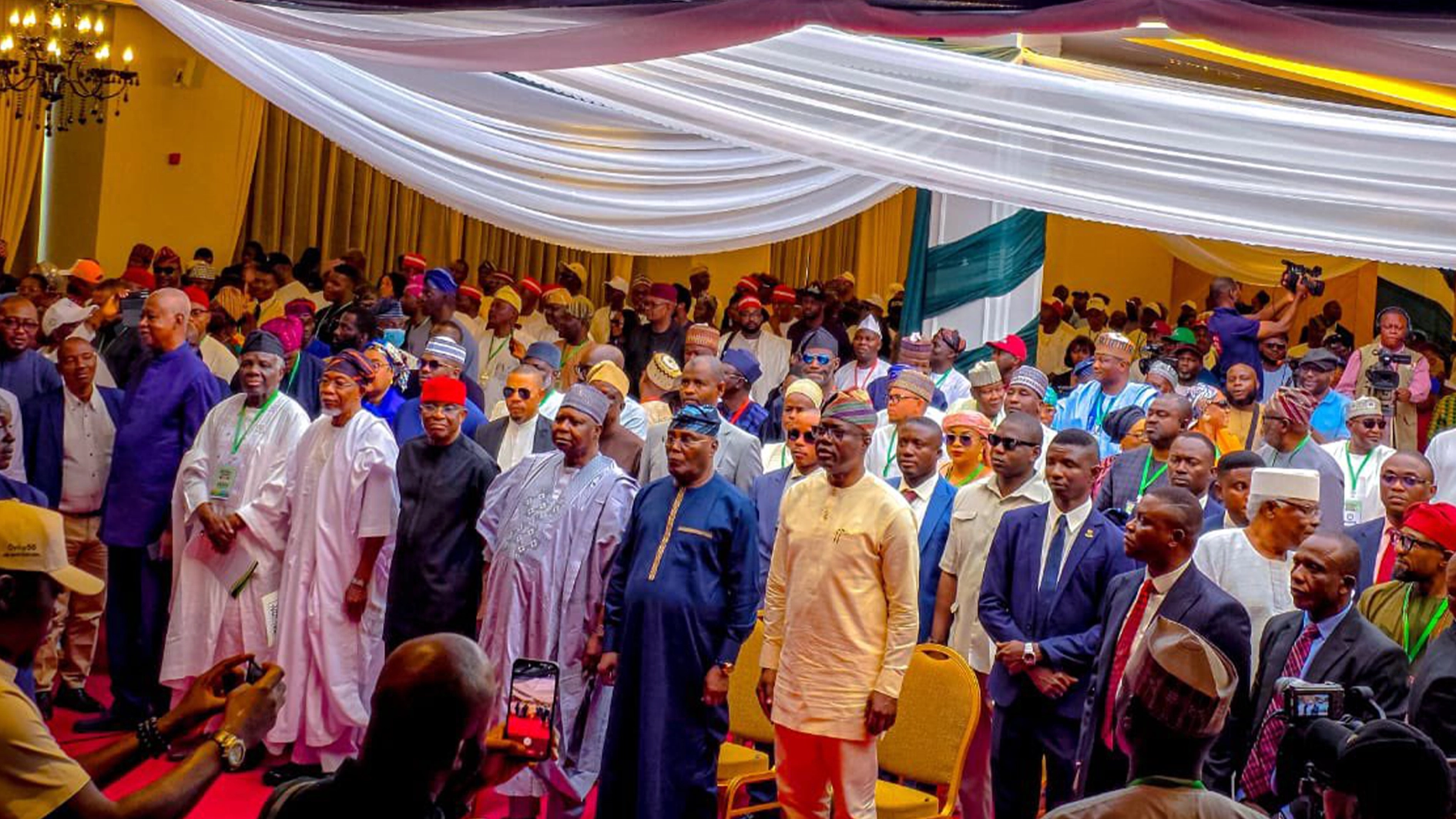
The National Summit of Opposition Parties held in Ibadan was conceived to harmonise the opposition ahead of the 2027 general elections. Yet, beyond the rhetoric of unity and renewed purpose, questions persist over whether deeply divided parties can truly overcome entrenched rivalries and present a credible alternative to the ruling All Progressives Congress, SEYE OLUMIDE reports.
For the first time since Nigeria’s return to civil rule in 1999, opposition parties are deeply fractured, hobbled by internal crises, leadership tussles, and protracted litigation. This has raised concerns among political observers and sections of the electorate about a possible drift towards a one-party state ahead of the 2027 general elections.
This anxiety is not without basis. Across the major opposition platforms, instability has become a recurring theme.
The Peoples Democratic Party (PDP) continues to grapple with unresolved disputes over zoning, leadership legitimacy, and factional alignments. The Labour Party (LP), which surged in popularity during the 2023 elections, has struggled to consolidate its gains into a cohesive national structure. Meanwhile, smaller parties, including those attempting to form coalitions, remain ideologically fluid and organisationally weak.
It is against this backdrop that a coalition of influential political figures moved to arrest what many describe as a dangerous slide. Oyo State Governor Seyi Makinde spearheaded the initiative, bringing together key actors across party lines.
Among those involved were former Vice President Atiku Abubakar, Labour Party’s 2023 presidential candidate Peter Obi, former President Olusegun Obasanjo, Senator Rabiu Kwankwaso, and former Minister of Interior Rauf Aregbesola, among others.

Their intervention culminated in the April 25, 2026, convergence in Ibadan, themed: ‘National Summit of All Opposition Parties’. The gathering was conceived both as a response to what participants described as the growing dominance and perceived overreach of the ruling All Progressives Congress (APC) under President Bola Tinubu, and as a pragmatic effort to forge unity ahead of the fast-approaching presidential poll.
At the heart of the summit was a critical objective: to build consensus around a single, formidable presidential candidate capable of mounting a credible challenge in 2027. With the election now less than a year away, the urgency of this task has become increasingly evident.
A strategic reset for fragmented opposition
Beyond its immediate political symbolism, the Ibadan summit represents what many see as a potential strategic reset for Nigeria’s disjointed opposition landscape. For parties such as the PDP, LP, and the emerging coalition around the African Democratic Congress (ADC), the meeting offered a rare opportunity to confront shared challenges collectively rather than in isolation.
In fact, the significance of this reset has been amplified by a recent Supreme Court ruling reinstating the leadership of the African Democratic Congress under the stewardship of David Mark.
The judgment, which effectively resolved a prolonged internal leadership dispute, has restored a measure of organisational clarity to a party increasingly being positioned as a coalition platform.
One of the most immediate benefits of the summit lies in its capacity to foster dialogue and reconciliation. In recent years, opposition parties have been weakened not solely by the strength of the ruling party, but by their own internal contradictions, ranging from leadership disputes to ideological inconsistencies.
The PDP, for instance, remains entangled in lingering controversies over its national secretary position, zoning arrangements, and unresolved factional grievances. These issues have not only eroded internal cohesion but have also weakened the party’s ability to present itself as a credible alternative at the national level.
Similarly, the Labour Party’s post-2023 trajectory has exposed structural deficiencies. Despite its electoral momentum and widespread youth appeal, the party has struggled to build a unified command structure capable of sustaining its political relevance beyond a single election cycle.
For the ADC, however, the Supreme Court’s reinstatement of the David Mark-led leadership has introduced a new layer of political relevance. While questions around ideological clarity and coalition management persist, the ruling has, at least for now, provided a stabilising institutional anchor for opposition actors exploring alternative platforms outside the PDP and LP structures.
Against this backdrop, the Ibadan summit provided a neutral platform for engagement, one where party leaders could begin to harmonise their interests, reduce mutual suspicion, and explore areas of convergence. In a political environment where fragmentation often strengthens the ruling establishment, such engagement is not merely desirable but essential.
The prospect of a united front
Another significant advantage of the summit lies in the possibility of forging a united opposition front. Nigeria’s electoral history demonstrates that when opposition forces coalesce effectively, they can alter the balance of power. The 2015 general elections, which led to the defeat of an incumbent administration, remain a reference point in this regard.
The Ibadan meeting, therefore, could serve as the foundation for a similar realignment. By encouraging strategic alliances, joint policy frameworks, and the possibility of a consensus presidential ticket, the summit has reopened conversations around collective political action.
With the ADC now enjoying judicial clarity on its leadership structure following the Supreme Court ruling, its potential role as a coalition vehicle has gained renewed attention. Some political actors argue that resolving its internal dispute removes one of the key uncertainties that had previously limited its attractiveness as a neutral platform for opposition consolidation.
Beyond political arithmetic, the summit also presents an opportunity to address one of the longstanding criticisms of Nigeria’s opposition parties, the absence of a clear and coherent policy alternative.
For many voters, the distinction between ruling and opposition parties often appears blurred, particularly on key national issues such as economic management, security, restructuring, and electoral reform. This has contributed to voter apathy and declining trust in the political system.
By convening a broad spectrum of stakeholders, the Ibadan gathering created a platform for articulating a unified vision on these issues. If sustained, such efforts could enhance the opposition’s credibility and provide voters with a clearer basis for electoral choice.
A major outcome of the summit was the adoption of a nine-point communiqué, commonly known as the Ibadan Declaration. The document addressed key issues ahead of the 2027 elections and has since sparked widespread debate within Nigeria’s political space.
Among its central resolutions was a commitment to resist any attempt to impose a one-party state and to defend the country’s multi-party democratic framework. The opposition leaders also resolved to field candidates in the 2027 elections while working towards presenting a single presidential candidate through consensus.
The communiqué further called for reforms within the electoral system, including amendments to the Electoral Act and an extension of deadlines for party primaries. It also criticised the leadership of the Independent National Electoral Commission (INEC), alleging bias and calling for accountability.
While the language of the communiqué was forceful, its broader significance lies in its attempt to define a shared agenda for opposition collaboration. By outlining common objectives, the declaration has provided a reference point for ongoing negotiations among political actors.
Divergent views and structural concerns
Despite the optimism surrounding the summit, not all stakeholders are convinced of its viability. A former Deputy National Publicity Secretary of the PDP, Diran Odeyemi, described the coalition effort as politically ambitious but structurally uncertain.
While acknowledging that alliances are not inherently problematic, Odeyemi noted constitutional and statutory constraints that could limit their effectiveness.
“There are aspects of the Constitution and the Electoral Act that they cannot bypass. That is the reality,” he said, emphasising the legal complexities involved in coalition-building.
However, the recent Supreme Court ruling affirming the David Mark-led ADC leadership has slightly altered the legal and political calculus. While it does not dissolve constitutional constraints around party mergers and nominations, it reduces internal legitimacy disputes that often weaken coalition bargaining power.
In contrast, Wale Okunniyi of the Movement for Credible Election (MCE) offered a more optimistic perspective. He argued that opposition unity remains achievable, provided there is sufficient political will.
According to him, the absence of explicit constitutional barriers to cooperation suggests that the primary challenge is political rather than legal. He, however, warned that time is a critical factor, noting that delays in decision-making could undermine the entire process.
Okunniyi maintained that only a commitment to collective interest, above personal ambition, can produce a viable alliance capable of challenging the ruling party.
Adding to the discourse, the Yoruba Ronu Leadership Forum described the summit as a step in the right direction. Its president, Akin Malaolu, said the gathering reflects a growing recognition of the need for coordinated opposition action.
He noted that Nigerians are increasingly demanding a credible alternative capable of addressing governance challenges, stressing the importance of clear messaging and inclusive engagement.
Between promise and reality
These differing perspectives underscore both the urgency and complexity of opposition realignment in Nigeria. While the desire for unity is evident, translating that aspiration into a functional political structure remains a formidable challenge.
Personal ambitions, entrenched interests, and regional considerations continue to shape political calculations. Without meaningful compromise, there is a real risk that the summit could become yet another high-profile gathering with limited practical outcomes.
At the same time, the structural issues confronting opposition parties cannot be ignored. From internal governance deficits to weak institutional frameworks, these challenges extend beyond electoral strategy and speak to the broader health of Nigeria’s party system.
Ultimately, the Ibadan summit has done more than signal intent; it has exposed the critical fault lines within Nigeria’s opposition politics while simultaneously offering a pathway, however narrow, towards realignment.
As the 2027 election cycle gathers momentum, the ability of opposition parties to navigate these legal, structural, and political challenges will be decisive. Whether the alliance evolves into a transformative force or remains a symbolic gesture will depend largely on the willingness of key actors to prioritise collective goals over individual ambitions.
For now, the road to unity remains uncertain. But in a political landscape increasingly defined by the consolidation of power, the stakes could hardly be higher.

