 Follow Us on Google News


 Follow Us on Google Discover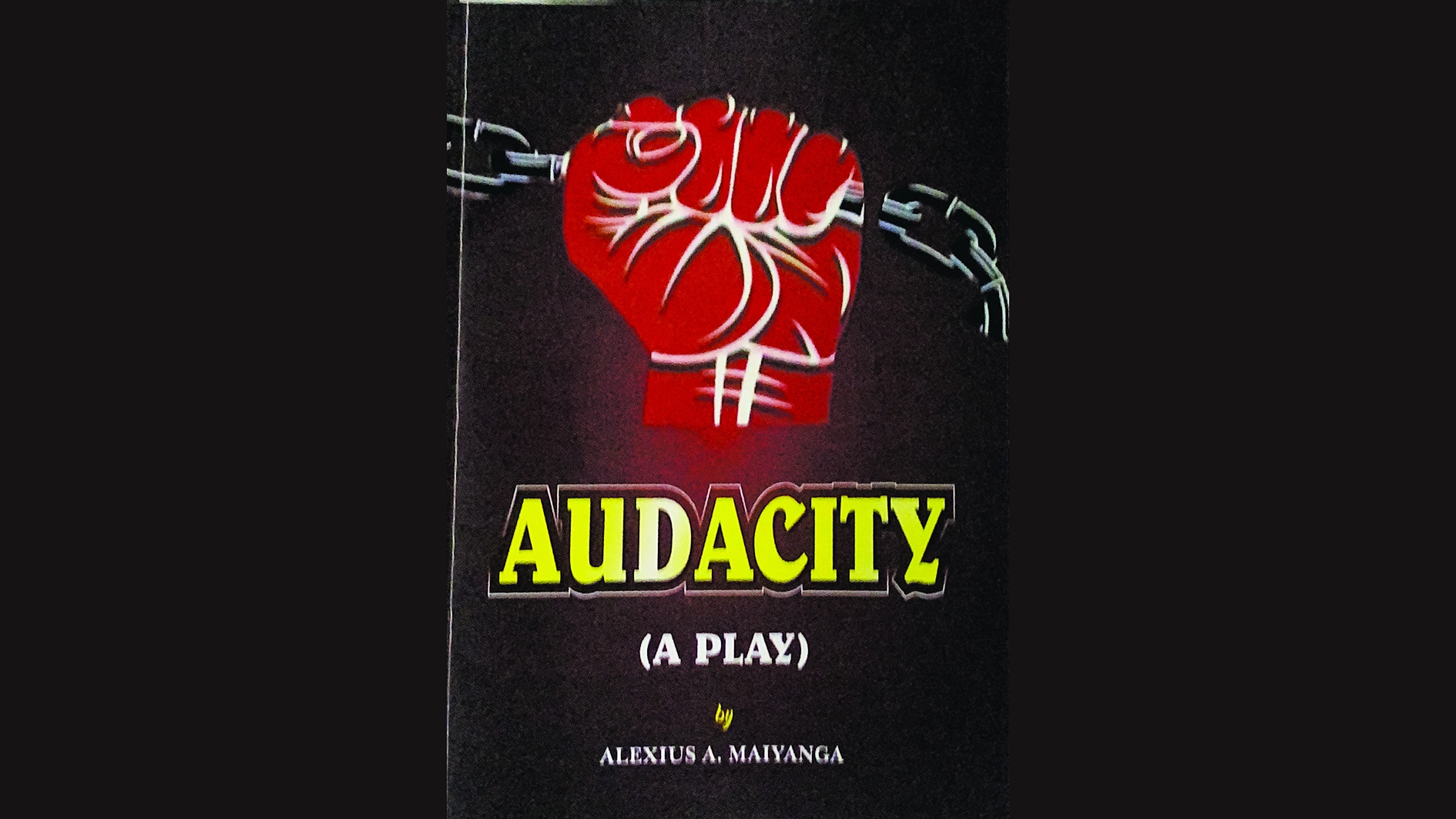
Beyond education and entertainment, another crucial function of a playwright is to birth an ideal society. While this may appear an illusion, an artist remains resolved in his drive to expose the ills of the society with a view to sensitizing the people against actions inimical to personal and national development.
Audacity, a-four Act (Movement) play authored by Dr Alexius A. Maiyanga, attempts to highlight the rot in Nigerian society, focusing majorly on some institutions of government.
The alarming state of docility, inertia, corruption, mismanagement of public time and resources in the fictitious Obochi nation are vividly captured by a non-conformist character – Aku, who is not just a radical but a social reformer, resilient and resolute in his advocacy for a change.
However, to give insight into the sequent of events, the author opens each Movement with excerpts from the world’s influential people, including Williams Shakespeare, Mahatma Gandhi, Martin Luther King Jr and a quote from Assassin’s Creed.
For instance, the first Movement opens with a quote from Shakespeare’s Julius Ceaser. The playwright, through the main character, Aku, boasted that “Cowards die many times before their deaths but valiant never taste of death but once”, a statement that best describes the near suicide mission he personally chooses to undertake.
For an average student of Epic Theatre propounded by the highly influential German Playwright, Bertolt Brecht, the role of introduction at the opening of each Movement, which serves same purpose as that of a narrator in a stage performance goes beyond a bird’s-eye view of the coming events. Its aim is to eradicate suspense, surprises or fear and replace same with the audience critical think, having been made aware of coming actions.

The author engages the tool to stabilise the minds of his audience to make a good judgment of his message, a method that was born out of the believe that theatre should not be a place for emotional outburst.
Going through the play, one concludes from the author’s description that Aku is actually not financially influential but intellectually enthusiastic endowed judging from the volumes of books about Africa and Europe that takes more space than furniture in his one-room apartment.
Agitated by regular news of police brutality, Aku decides to expose some corrupt, unpatriotic government officials through direct confrontation.
From the conversation that ensues between him and his friend, Adoji, he desires to create a new world of sanity, “where the executives will not demand for 10 per cent gratification for contracts awarded to people, where roadblocks will not turn into legalised tolling points, where honourables and not horrible and where distinguished are not extinguishers.”
The character shares optimism that sacking a decayed system through the power of pen and non-violent revolution is possible.
He says: “No! Life cannot just go on like that. That is the reason I am thinking of creating a new world – a world of sanity. I feel like picking a woman and a man from each tribe of this land and forming a new world.”
In his curiosity, Aku decides to study the police protection strategies by going to accost them in a deserted make-shift market street. Ironically, his journey only reveals the plight of an average police officer through a conversation among officers Igagwu, Okwu and Okwo.
Their interactions centre on issues of poor welfare, equipment deficit and nepotism, and how they contribute largely to extortion and other criminal activities perpetrated by some officers.
“You see, after the next two years, I will retire to my village. I have been in this service for onward of 30 years and the highest I have reached is a mere Sergeant”, said Igahwu.
“Me, I no go waste time for police too much. I just de pray make dem post me go road block. If I dey there for two years, I go make money and retire to start trade”, replied Okwu.
While the author frowns at the nefarious activities of some police officers, he objectively x-rays the failure of the government to build a viable governance structure that encourages efficiency and maintains workers’ integrity.
Unfortunately for Aku, his first encounter in his search for sanity was met with resistance as he was beaten to a state of unconsciousness for wondering at odd hours.
Yet, he continues his quest at a National Provident Fund to process his late father’s file, where he equally encounters a lady typist typical of Nigerian civil servant, complaisant to duty and rude.
Rather than sanctioned for her unruly conduct, Aku was tagged a lunatic for insisting that the workers adopt the right attitude to work.
In another development, Aku observes another failure of the society at the convocation ceremony of a University of Technology, where the Vice Chancellor struggles with a malfunctioning public address system. Again, Aku blames the embarrassment on both the school authority and students, for failing to live up to expectations in their distinct positions.
The final Movement presents the true life of a politician, who attempts to frustrating the system. He fails due to the resistant power of Aku’s pen, an indication that change is possible if citizens can hold politicians accountable. The fact that his assignation attempt on Aku fails shows that evil doesn’t prevail over justice and truth.
Although the playwright leaves the resolution open to readers, there are indications that Aku may not have succeeded in his journey to birth a new dawn but his bravery and survival amidst threat is the author’s call for collective actions against socio-political ills.
Aku escapes with a new manuscript of his coming publication – Political Sanity and the Third World. Whether the title is fictitious or a peep into the author’s next effort, only the future can tell.
Yet, Maiyanga has in this single work, entertained as well as expose of the challenges confronting the nation. His sense of humour is visible and adds greatly to the beauty of the text.
Dedicated to the victims of EndSars movement, the 50-page play makes a good reading and will not pose any challenge in stage performance, especially with regards of the number of cast, costumes, props and other theatrical elements. Audacity speaks volume of the character of Aku, who chooses to be a valiant rather than coward.
Speaking, the author described the play as a non-spiritual prediction of unavoidable social upheavals in the country.
“If the failed system driven by acrid corruption is not reversed, a few audacious young adults, like the fictional Aku, can make that happen in Oboche country, where the play is set. In a land where people are packaged by the political system to control will likely be shattered by a conoclastic Aku and his likes.
“Thus, the motivation behind audacity is the desire to expose or depict the weird micro-behaviors in the country’s system, symbolized in Alaji Dangudugudu and the journalist Clark. 2.
“A new Nigeria is very possible if the systemic decay in our land is cleansed. Audacity is a call for reformation, a change of behavior of all the segments of our society. The play warns that if reforms are not done, a social revolution may be inevitable to cleanse the Ogyan’s table”, he said.

