 Follow Us on Google News
 Follow Us on Google Discover
Women’s financial inclusion remains a critical challenge globally. According to Women’s World Banking, over one billion women lack access to formal financial services, limiting their potential for economic empowerment.
The reality is no different in Nigeria. The EFInA Access to Financial Services (A2F) 2023 survey highlights a significant gender disparity in Nigeria: 30% of adult women are completely excluded from both formal and informal financial services, compared to 21% of men. This means that out of Nigeria’s 57 million adult women, approximately 17 million remain financially isolated.
To bridge this gap, PalmPay has been actively investing in grassroots women’s empowerment by dismantling the knowledge barriers that hinder financial growth. Last year, the fintech platform took this mission directly to the commercial heart of Northern Nigeria: Sabon Gari Market in Kano and Central Market in Kaduna.
In these markets, thousands of women set up their stalls to deal in spices, textiles, grains, and consumer goods. They are the undeniable backbones of the economy, working around the clock to provide for their families.
While these female entrepreneurs possess immense business acumen, a staggering number have historically been left behind by the formal financial sector. For a market woman, being unbanked means trading entirely in cash. Without basic financial literacy or the right digital infrastructure, hard work alone isn’t enough to scale a business.
Recognising this gap, PalmPay stepped away from traditional banking boardrooms and went directly to the market. PalmPay launched a targeted financial inclusion and capacity-building initiative across Kano and Kaduna states. The core mission was straightforward: take the mystery out of digital banking and equip thousands of women entrepreneurs with the exact knowledge and tools required to thrive in a digital economy.
Backed by the royal endorsement of the Emir of Kano, Dr Muhammadu Sanusi II, the solution was delivered through:
PalmPay team members conducted hands-on financial literacy workshops right inside the markets, teaching women how to separate personal expenses from shop revenue, calculate true profit margins, and budget for Women opened digital bank accounts on the spot and were equipped with reliable PalmPay POS terminals and mobile app tools.
Micro-business branding support, including storefront branding, transactional merchandise, and market umbrellas to shield them from the elements.
The true impact of this initiative is best seen through the eyes of the market women themselves. Consider the transformation of a typical trader in Sabon Gari Market who spent years operating strictly with cash-box accounting.
Before the intervention, she faced the constant anxiety of missing cash, unverified bank transfers, and untracked inventory purchases. Today, with a PalmPay POS terminal on her counter and instant payment notifications triggering seamlessly on her phone, the chaos has been replaced by complete financial control.
When you empower a market woman, you don’t just improve a single business; you stabilise an entire household and uplift a community. By transitioning over 2,000 women in Kano and Kaduna from the vulnerabilities of an all-cash system to the security of digital banking, PalmPay has helped convert everyday survival into scalable success.
As these newly banked entrepreneurs continue to master cash-flow management and leverage instant digital settlements, they are proving that with the right partner, grassroots commerce can become a powerful engine for national economic growth.
PalmPay empowers over 2,000 women in Kano, others to bank smarter
Date: 21 May 2026 3:33am WAT
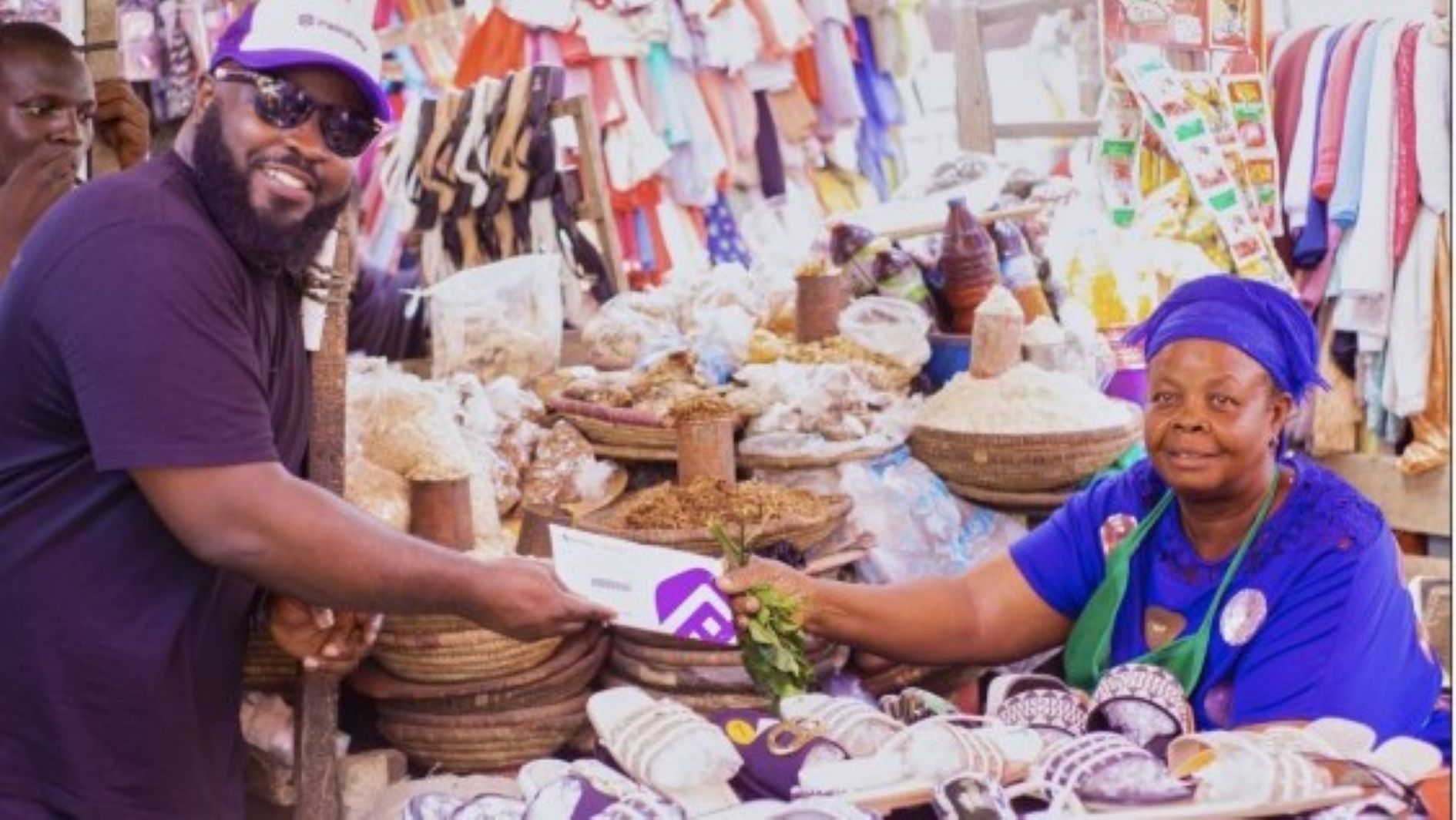
Head, Marketing and Communications at PalmPay (l),Olorunfemi Hanson (left):presenting PalmPay ATM card to a market woman
Head, Marketing and Communications at PalmPay (l),Olorunfemi Hanson (left):presenting PalmPay ATM card to a market woman

