 Follow Us on Google News
 Follow Us on Google Discover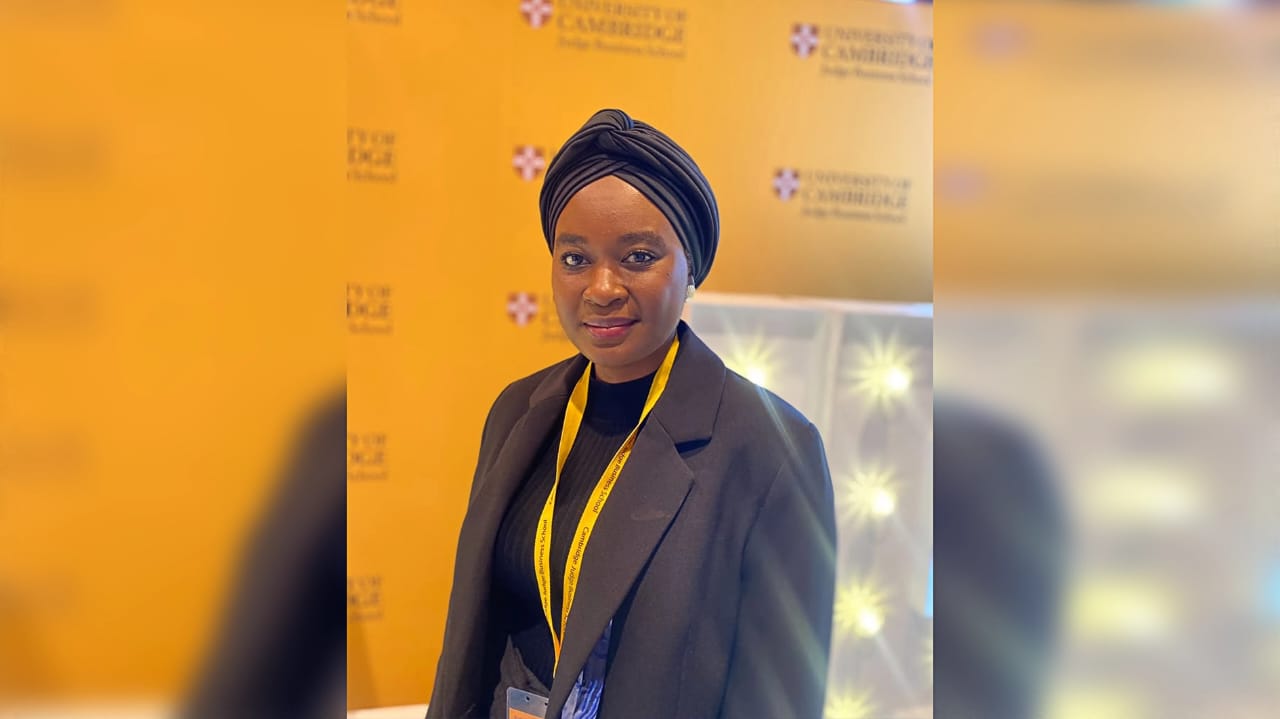
There is a particular kind of professional who is known more by the impact of their work than by their own visibility. Fatimah Bamisedun is one of those people. She opened up about her upbringing and cross-sector innovation in this interview with Priscilla Iwedike
You recently spoke at the Business Innovation and Tech Expo at the London Olympia Conference. What was your key message to the audience, and why does it matter right now?
That is correct, I spoke at the Business Innovation and Future Tech Expo at Olympia London on how cross- sector innovation is increasingly constrained not by technology itself, but by how well systems connect.
My focus was on the practical challenge of interoperability across industrial and digital environments, and why integration between systems is now a key driver of productivity. It was lovely seeing the audience pay very close attention to the new area I am working in.
You have referenced work connected to the World Economic Forum’s Global Shaper’s Community on digital skills. How have you continued your work in that space and what impact has it had in the UK specifically?
It’s an interesting fact that I was the Regional Community Champion from 2022 to 2023 before handing over to Andrew Banigo from the Port Harcourt Hub. While I did a lot beyond digital skills transformation at the local economic level, it was focused on translating WEF digital skills frameworks into practical implementation contexts for the Global Shapers Community in Nigeria and particularly Lagos.

I have applied the same lens within the UK to move from strategy and policy into actual impact at a national level.
What you’re working on right now with ANRE, and what is the problem you’re actually trying to solve?
I am currently working on ANRE Solutions Ltd, which is focused on addressing fragmentation across industrial and digital systems. The work looks at how data and processes can be structured so that systems across different sectors can interoperate more effectively rather than operating in isolation. Cross-sector innovation and interoperability is the future we are building at ANRE Solutions.
Is that Blockchain? Cross-sector interoperability. What does it mean in practice or principle, for ordinary businesses?
In this context, interoperability refers to the ability of different systems and organisations to exchange and use data in a consistent way without manual translation or friction. It matters because most inefficiencies in modern industry come from disconnected systems rather than lack of technology.
The most advanced implementations of this intelligence layer are already moving beyond matching and into regulatory classification infrastructure, generating the compliance documentation that transforms an industrial by-product from a disposal cost into a tradable commodity with a verified market pathway.
What is your background? What did you study?
Industrial Chemistry
And later worked at KPMG, correct? How did that path lead you into digital and systems work?
I studied Industrial Chemistry, which gave me a foundation in understanding complex, structured systems in physical environments. I then moved into KPMG, where I worked on large-scale organisational transformation in Energy and FMCG sectors and gained exposure to how enterprises implement change across complex structures in Technology and IT Enablement.
I then studied International Business with a focus on Strategic Partnerships and Sustainability. Well, and a lot in between those themes for my decade long career.
My current work sits at the intersection of those experiences, combining understanding of physical systems with how organisations and digital infrastructure operate at scale.
You seem to span multiple sectors. How do you explain that breadth, and what connects it all for you?
The breadth of it all reflects the nature of the problem space I work in, rather than deliberate movement across unrelated sectors. My focus has consistently been systems-level challenges, how different components within industry, data, and organisations connect and operate together.
How has access to industry shaped this?
I love going on factory excursions. I have been exposed to advanced manufacturing environments such as UKBIC and conversations about EV, Renewable Energy and Materials Technology.
All of which provides insight into how industrial systems are actually implemented at scale. This is important because it ensures that the work I do remains grounded in real-world deployment conditions rather than purely conceptual models.
Where do you see the future of work and industry heading over the next 5–10 years?
Industry is moving towards a phase where intelligence, through AI, automation, and data systems, becomes embedded across both physical and digital infrastructure. The key challenge will be how effectively organisations can connect these systems so they function as coherent, integrated networks rather than isolated tools.
Listening to the former Vice President of Ghana, Muhammad Bawumia talk about interoperability in Ghana at the University of Cambridge Africa Business Summit in 2025, that acknowledgment, reassures me I’m headed in the right direction despite this being a new area.
What would you say to someone getting into tech?
Start with a real problem, technology is a facilitator and then focus on leverage. Be serious with the problem you want to solve and take your time.
Fatimah Bamisedun is the founder and CEO of ANRE Solutions Ltd, a UK-registered digital technology company building cross-sector interoperability infrastructure for industrial and commercial systems.
With a background spanning Industrial Chemistry, KPMG Advisory Services, and the World Economic Forum Global Shapers Community, where she served as Regional Community Champion for Nigeria, she has spent over a decade working at the intersection of physical systems, organisational transformation, and digital infrastructure. She holds certification in the European Interoperability Framework and has delivered national-scale digital programmes reaching over 7,500 beneficiaries across the UK. ANRE Solutions is based at a Lab in the East Midlands and she spoke at the Business Innovation and Future Tech Expo at London Olympia on cross-sector interoperability and industrial systems integration.

