 Follow Us on Google News
 Follow Us on Google Discover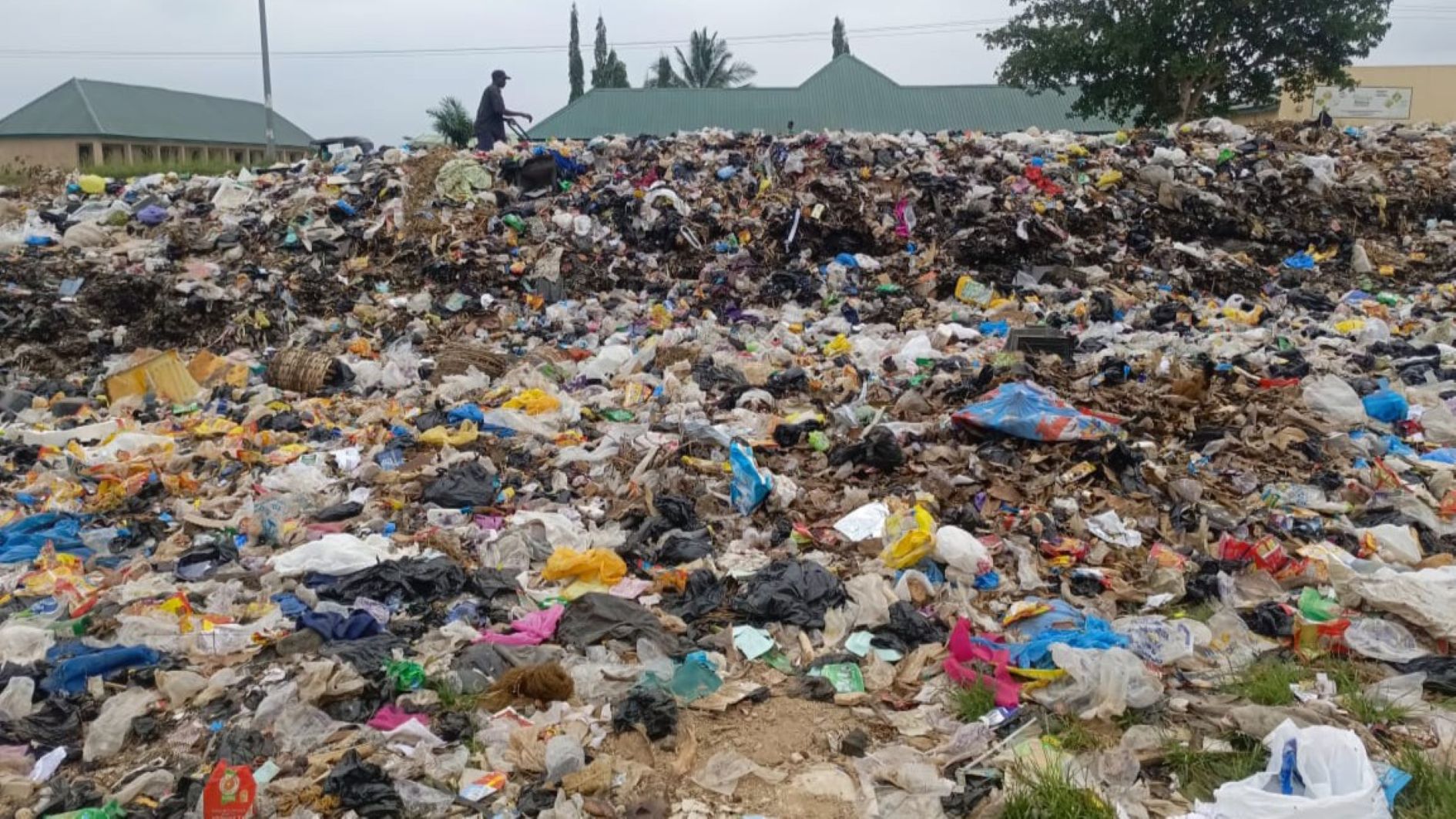
The absence of effective waste management mechanisms in Lagos and Abuja has led errant residents and some corporate entities to resort to unregulated waste disposal with attendant health risks. With a combined population estimated at 27 million and over 20,000 tonnes of waste generated daily in both cities, proper infrastructure and behavioural acculturation can turn the albatross of waste management efforts into multi-billion-naira revenue, BERTRAM NWANNEKANMA, TERHEMBA DAKA, and ANDREW OOTA report.
For daily commuters on the Karu-Karshi Expressway, what should be a smooth ride into Abuja has become a test of patience, nerves, and even health.
The once-vital artery linking the capital city and its bustling satellite towns is currently lined up with heaps of household and commercial waste.
Consequently, vehicular lanes are narrowed, traffic crawls, and the stench of rotting refuse pervades the air, pungently reminding us that the country’s urban waste crisis has a human face.
The situation worsens during the rainy season as runoff carries trash into clogged drains, forming stagnant puddles that breed mosquitoes, harbour flies, and other disease vectors.
“This road was supposed to connect us effectively to Abuja Central Area, but every trip now feels like a gamble with traffic, dirt, and disease,” said a commuter, Gabriel Ukah.
Another resident of the FCT, Otasowie Isibor, a legal practitioner, lamented the increasing presence of waste along
major roads and within residential communities, including Gwarinpa, Maitama and other parts of the capital city, stressing that recent downpours further compounded the problem, with refuse clogging drainage channels, overflowing onto roads and creating environmental hazards.
“There is refuse everywhere on the road. Which other parts of Abuja can you go to now without encountering this problem of refuse dumps everywhere?” he asked.
Isibor expressed concern that the growing number of refuse dumps was not only affecting the city’s aesthetics but also creating conditions that could trigger serious public health challenges.
A Director in the Ministry of Defence, who also resides in the FCT, but craved anonymity, while also commending the ongoing infrastructure development initiatives, maintained that environmental sanitation deserves equal attention.
“The FCT Administration is doing very well on infrastructure. Nobody can deny that. However, more attention needs to be paid to the city’s cleanliness and waste evacuation,” he said.
“For effective sanitation, waste can be evacuated at least twice a week. In fact, in some locations, it can even be cleared daily. Such operations can be carried out very early in the morning before residents begin their daily activities or even at night, as is done in many cities around the world,” he stated.
For traders, residents, and transport operators, the blame should be apportioned to inconsistent waste collection, poor infrastructure, and weak enforcement of regulations.
Although the Federal Capital Territory Administration (FCTA) has responded to the crisis by setting up a task force to clear dumps, manage traffic, and re-award stalled road contracts, many people feel that this was only a partial solution, as no visible improvement has been recorded since this step was taken, a development that has forced experts to caution the authorities that this is a systemic issue that runs deeper.
While Abuja generates thousands of tonnes of waste monthly, functional recycling plants are virtually non-existent in the country’s capital.
The absence of an effective waste management mechanism has therefore led errant residents to adopt an unregulated culture of dumping refuse in unauthorised areas, and the crisis is simply expanding.
This ugly habit, sustained by necessity and neglect, has both immediate and serious implications, especially health concerns and longer-term consequences. Specifically, there are also higher accident risks, worsening air and water quality, and an imminent spike in diseases such as malaria and cholera.
An environmental scientist, Dr Said Mustapha, agrees that much still needs to be done, as without sufficient collection infrastructure, recycling facilities, and public awareness, the cycle of residents dumping refuse on motorways will continue.
He, however, emphasised that the situation was not limited to the FCT, but a clarion call for all rapidly growing cities across the country.
Also, the Abuja Environmental Protection Board (AEPB), which is tasked with environmental management and waste disposal in the Federal Capital Territory, appears overwhelmed as reflected in the incessant sprouting up of refuse heaps littering the city, leading to pong and health consequences.
When contacted, officials of the AEPB declined to comment on the matter, while the Senior Special Assistant on Public Communication and Social Media to the FCT Minister, Olalere Olayinka, had yet to respond to enquiries on the issue as of the time of filing this report.
The situation in the country’s commercial nerve centre is no different, as the state appears to be getting more confused by the sheer magnitude of waste by the day.
According to experts, with such a population and volume of waste in both Nigeria’s commercial and administrative headquarters, the waste burden could be transformed into a multi-billion-naira revenue stream if effectively managed with strong infrastructure.
In Lagos, inadequate infrastructure and human factors have proven to be an albatross for waste management efforts.
Consequently, complaints of overflowing bins, illegal waste disposal in unauthorised areas, and the gross inefficiency of PSP operators engaged by the Lagos Waste Management Authority (LAWMA), a regulator and system manager of municipal solid waste in Lagos State, have posed a significant challenge.
This challenge is amplified by both structure and behaviour. The city operates a PSP model with about 450 operators, while households are expected to pay monthly waste collection fees.
These payments vary widely, from about N1,000 in some communities to N20,000 and above in places like Banana Island. In principle, the system is simple: residents pay for waste collection and safe disposal.
In practice, however, compliance remains the weakest link. Bauhbon Environmental Services is one of the 450 operators that have failed to deliver services for which payment has been made. In parts of Mushin Local Council where it services, refuse bins, which ought to be emptied weekly, have been emptied only three times in the last 12 weeks.
To remedy worsening sanitation conditions in the state, Lagos State reintroduced a monthly environmental sanitation exercise held on the last Saturday of each month between 6:30 a.m. and 8:30 a.m. The second edition was held last Saturday.
Governor Babajide Sanwo-Olu, during the “Symbolic Flag-Off “ of the exercise, said the observance would be held on the last Saturday of every month and would be monitored by state officials, with appropriate sanctions meted out to sanitation offenders.
He added that the culture of environmental responsibility must become deeply embedded in residents’ lifestyles and all communities across the state.
However, residents are concerned that reintroducing the monthly sanitation without proper arrangements for the immediate removal of generated waste may make an already bad situation worse.
But LAWMA’s Director of Public Affairs, Mukaila Sanusi, said the agency has perfected the strategy for the statewide deployment of operations, including LAWMA trucks and personnel, to remove waste generated during the environmental sanitation exercise.
He said: “Our personnel in the various operational districts will be fully mobilised for the exercise.”
The Guardian also gathered that LAWMA is currently engaging with the Lagos State House of Assembly on the review and reform of its enabling law to modernise the legal framework governing waste management in the state.
The objective of this engagement is to strengthen compliance mechanisms, address operational gaps within the PSP system, institutionalise sustainable waste-to-resource models, and align Lagos with global best practices in circular waste management.
As part of efforts to address the waste challenge, the government has also initiated a sweeping 10-year waste management development plan. Under this plan, the state will procure 100 new CNG-powered compactor trucks this year.
The plan to introduce 100 CNG trucks, followed by 200 to 250 trucks each year, signals a rare long-term approach in public service.
The Managing Director of LAWMA, Dr Muyiwa Gbadegesin, explained that the agency has proposed a statewide enumeration and automated billing system. Under this model, households will be formally captured, billed by the state, and PSP operators will be paid only after service delivery is confirmed.
Gbadegesin reiterated LAWMA’s commitment to transparency and accountability in the system, adding: “We believe that Lagos residents are ready to pay for waste collection if they will get good service, and that is what we will ensure, going forward.”
He also stated that, as part of measures to sanitise the waste collection and disposal system and ensure standards, the agency terminated the contracts of about 22 PSP waste operators for underperformance this year and has gone ahead to give the slots to new ones that are ready to do business.
He announced that the state plans to acquire 500 mobile compactor tricycles by the middle of the year to address the surging waste burden.
Gbadegesin reiterated that adopting the new mobile compactor tricycle could also absorb some of the cart-pushers. “The PSP operators can buy some, engage cart-pushers, and put them on a salary. We can now have a more efficient system for Lagos.”
Giving perspectives on how Lagos can overcome its waste management challenge, executives at Polysmart Group, a powerhouse in the global recycling market, said that with an estimated 13,000 metric tonnes of waste generated every day, Lagos appears poised for a transformative waste revolution if ongoing reforms, partnerships, and awareness campaigns succeed.
According to them, the city could soon turn its waste crisis into one of Africa’s most lucrative sustainability models, a $2.5 billion yearly industry that cleans the environment while creating prosperity.
In raw numbers, that daily waste generation translates into roughly 13 million tonnes per year (when projected over 365 days), a figure industry analysts use to estimate a potential revenue ceiling of $2.5 billion per year from recycling, composting, energy conversion, and upcycling.
For instance, Polysmart Group projects that PET plastics, which represent about 10 per cent of the waste stream, could alone contribute between N39 billion and N58.5 billion yearly at current market rates, before processing and overheads.
Head of Operations at Polysmart Group, Ikenna Abanonu, told The Guardian that the market potential of Lagos waste is massive, even by conservative estimates.
Using 2024 local market rates, he projected as follows: Material Recovery Share Price/Tonne (N), Revenue Potential (N). He noted that PET Plastics account for 10 per cent of the waste, accumulating between N120,000–N150,000 daily and N39 billion and N58.5 billion yearly. Similarly, Scrap Metals (Alu, Fe) accounts for five per cent, netting between N200,000 and N250,000 in revenue daily and N32.5 billion–N48.75 billion yearly.
Abanonu noted that while these are gross market values, they remain impressive even after accounting for logistics, processing, and overhead costs.

