 Follow Us on Google News
 Follow Us on Google Discover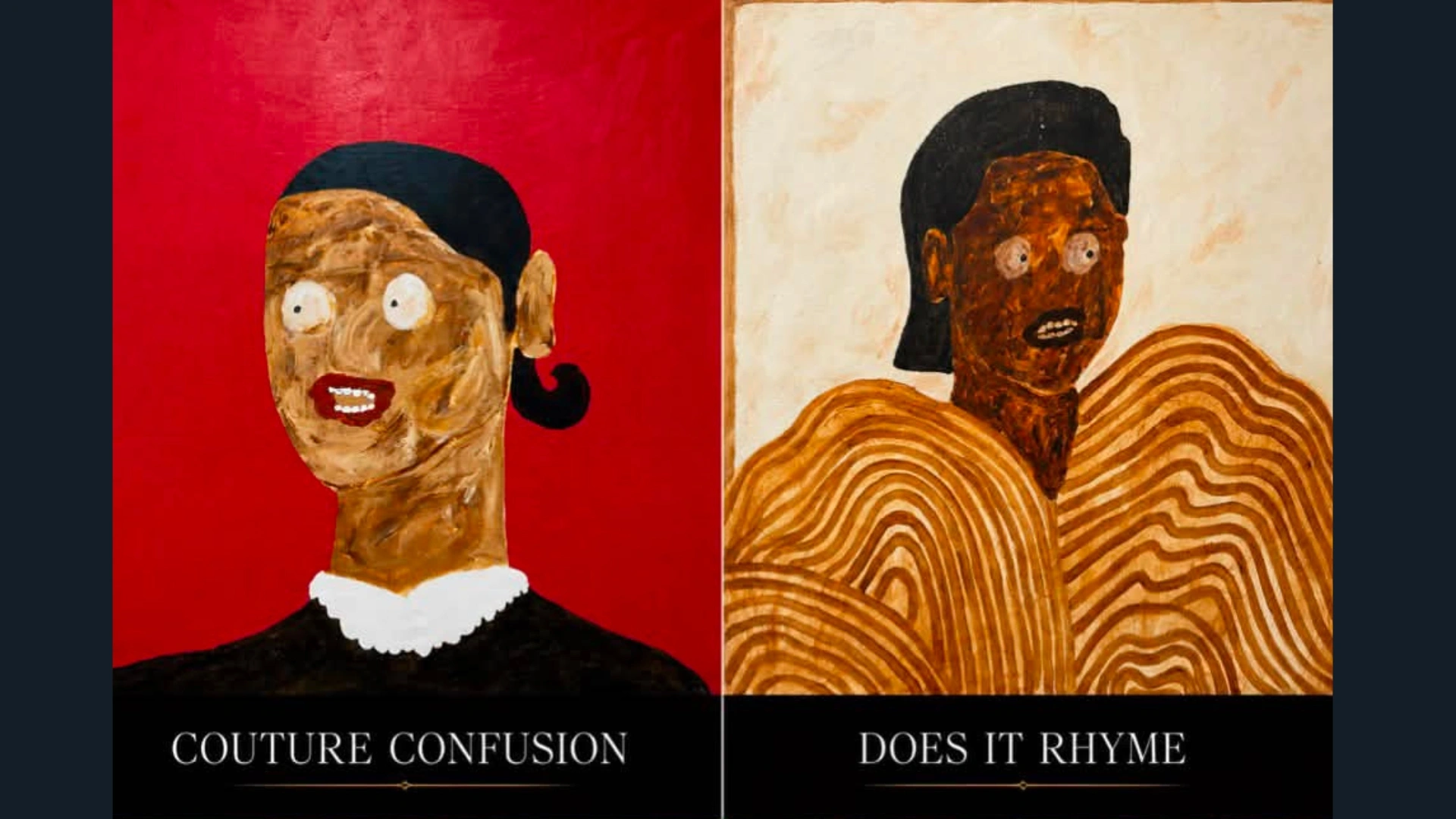
In Couture Confusion and Does It Rhyme, Ayobami Adelaye extends his exploration of portraiture as a space of ambiguity rather than certainty. His figures are neither strictly realistic nor conventionally symbolic. Instead, they occupy a territory between observation and imagination, where expression, gesture and colour become instruments for examining how identity is perceived, constructed and interpreted.
Couture Confusion immediately commands attention through its saturated red background, a chromatic choice that intensifies the psychological atmosphere of the portrait. The figure’s enlarged eyes, asymmetrical smile and deliberately simplified facial features create a delicate tension between confidence and vulnerability. Although the title evokes fashion, elegance and outward refinement, the painting quietly resists these associations, suggesting that appearance often conceals uncertainty rather than resolving it. Adelaye’s visible brushwork reinforces this reading, leaving the surface energetic, tactile and intentionally unresolved.

Does It Rhyme shifts the emotional register. A muted, neutral background allows the rhythmic brown forms surrounding the sitter to assume greater prominence. These layered marks evoke fabric, hair or even fragments of landscape, generating movement that simultaneously embraces and overwhelms the figure. The title itself offers no explanation. Instead, it poses a question, inviting viewers to consider whether appearance, emotion and identity can ever fully correspond with one another.
Across both paintings, Adelaye demonstrates remarkable confidence in reducing portraiture to its essential visual language. Exaggerated features, expressive brushstrokes and flattened forms replace conventional realism, allowing emotional truth to emerge through distortion rather than precision. Humour is present throughout the works, but never as an end in itself. Instead, it serves as a gentle point of entry, encouraging viewers into portraits that gradually reveal themselves to be psychologically layered and deliberately unresolved.
The artist also resists the temptation to provide definitive answers. Instead of prescribing meaning, Couture Confusion and Does It Rhyme invite sustained interpretation, rewarding repeated viewing with new emotional and conceptual possibilities. Their openness reflects an understanding that identity itself is rarely fixed, but constantly shaped by memory, performance, perception and contradiction.
Taken together, the two works reaffirm Adelaye’s growing confidence as a contemporary portrait painter interested less in recording physical likeness than in exploring the shifting emotional terrain beneath it. They remind us that portraiture is not simply an act of representation, but an invitation to reflect on the complexities, tensions and quiet performances that define what it means to be human.

