 Follow Us on Google News
 Follow Us on Google Discover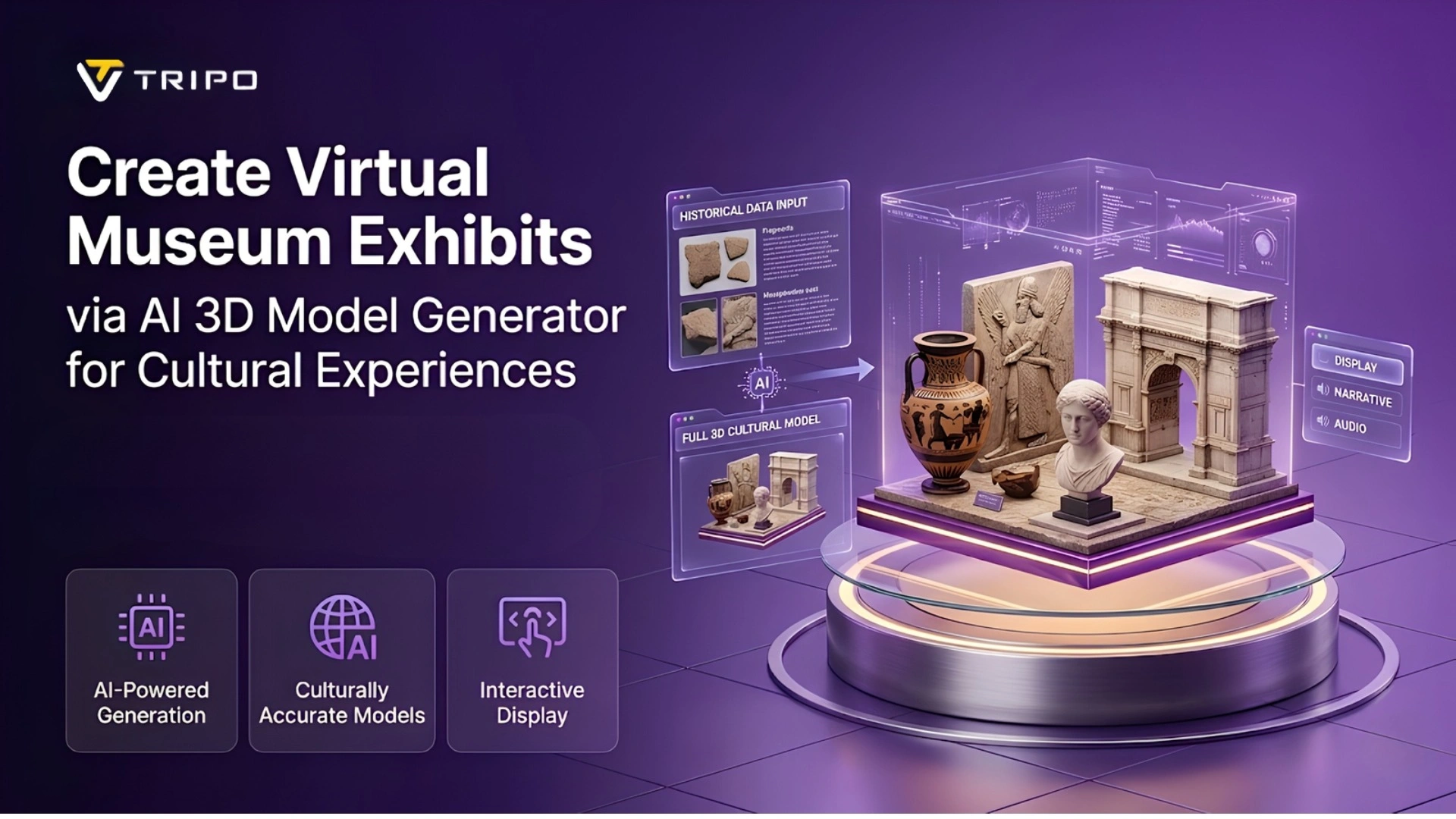
Digital preservation has now become an integral part of the protection of cultural heritage. Virtual museums are becoming increasingly common in educational, historical, and research environments. They provide broader access to significant collections around the world. Tripo 3D provides tools that support the creation of detailed digital exhibits through AI-based visualisation for artefact preservation, reconstruction, and presentation. As technology advances, virtual cultural experiences are becoming more accessible and immersive.
The Evolution of Virtual Museums and Digital Heritage
Virtual museums have revolutionised the way that audiences engage with cultural collections. More online exhibitions are being organised by museums, reducing geographical limitations for visitors. Visitors can explore artefacts from any place with an Internet connection. Digital preservation also helps to minimise the handling of fragile items. While original artefacts still require conservation, historical collections remain accessible. Interactive environments support learning through exploration and discovery. Virtual exhibits are used in educational institutions for research and teaching purposes. Cultural organisations can reach audiences beyond the museum environment. Tripo 3D contributes to this shift by simplifying digital asset development. This can make cultural heritage more accessible, engaging, and sustainable.
AI 3D Model Generators as Tools for Exhibit Development
In modern museums, the use of AI 3d model generator technology for creating digital exhibits is becoming increasingly common. These tools transform photographs into very precise 3-D objects. Historical objects can be reconstructed even when physical examples are unavailable. There are numerous model-related tasks that were once performed manually that are now automated with the help of AI. Institutions can digitise more collections efficiently through streamlined workflows. Detailed visualisations allow researchers to examine artefacts from various angles. Interactive displays can provide a more engaging experience than static images. Tripo 3D provides tools for creating digital assets while maintaining visual quality. It supports sustainable preservation and presentation of cultural resources for exhibition.
Tripo 3D Features That Support Museum Exhibit Creation
Tripo 3D offers powerful capabilities for developing virtual museum content. Moreover, its image to 3d model reconstruction technology generates detailed digital assets from images. Text-based generation supports conceptual heritage visualisations and exhibit planning. Detailed textures improve realism and enhance historical representation. Clean topology produces structured meshes that are easier to edit and optimise for animation, visualisation, and interactive use. There are flexible export options, which allow the integration of many exhibition platforms. These features can assist museums in creating professional digital collections with limited modelling experience.
Steps to Create Virtual Museum Exhibits via an AI 3d model generator for Cultural Experiences
Step 1: Gather exhibit references and upload assets
- First, you need to access Tripo 3D and sign up. Next, go to the “Model” tab present in the vertical left menu bar.
- Under the menu, click on the “HD Model”. You can recreate exhibits through text prompts or image uploads.
- Drag and drop files or use the “Upload” tab to import images from your device.
- If no image is available, use the “Text to model” tab and describe the exhibit.
Step 2: Adjust settings for heritage visualisation
- Under the “General settings” tab, enable “AI complete” for automatic generation. You can also activate textures and choose “Texture Quality” settings like 2K, 4K, or 8K.
- Turn on “PBR” to obtain accurate material reflective properties.
- Select either “Quad” or “Triangle” topology for better topology characteristics.
- You can also define a custom polycount.
- Later choose the model from the list, including v3.1 best quality, v3.0 fast and balanced, or v2.5 legacy.
- Members can access “Generate in Parts”, “8K Texture”, and “Privacy” options.
- Finally, click on “Generate Model” to create the exhibit.
Step 3: Present and export immersive exhibits
- Tripo 3D allows different display styles, including “Solid View”, “Cartoon Style”, “Sketch Style”, “Hologram Style”, and “Unlit” form. You can also “Refine” the exhibit through the bottom menu.
- Adjust the “Environment Settings” and use “Reset Camera” to change viewing angles.
- You can print or share the exhibit directly through “3D Print”.
- Finally, click on the “Export” tab from the bottom menu. Select the resolution, format, and file name, then click “Export” again to save the model.
Building Immersive Cultural Experiences Through 3D Assets
Combined with interactive assets, digital museum environments can be more engaging. Key benefits include:
- Interactive artefact exploration encourages more involvement with the artefacts.
- Detailed historical reconstruction can significantly enhance contextual understanding.
- Virtual exhibition halls extend beyond physical locations.
- Educational visual storytelling enhances the learning process of culture.
- Support for multi-device compatibility means that more people can use it.
- Preservation-focused digitisation supports the long-term preservation of cultural heritage representations.
These competencies are applied for institutions to develop meaningful learning experiences. Tripo 3D is used to produce assets that enhance audience interaction. Visitors can actively explore exhibits rather than simply viewing them passively. These experiences help to enhance knowledge retention and cultural appreciation.
Types of Museum Exhibits Suitable for AI 3D Generation
AI-based digital reconstruction can support a variety of exhibit types. Tools, weaponry, pottery, and household items are frequently found in historical artefacts. Historical instruments can be digitally preserved for educational use. Artistic details are often important elements of cultural sculpture. Traditional ceremonial items can be documented for future generations. Another benefit of architectural heritage elements is that they can be transferred to digital environments. Historic buildings, monuments, and decorative structures can be documented and made accessible online. Tripo 3D supports the creation of diverse heritage resources for interactive digital exhibits. This versatility benefits museums with collections spanning multiple historical periods.
Optimising 3D Assets for Virtual Exhibition Platforms
A well-optimised system can support smooth performance in exhibition environments based on platform requirements and asset settings. Geometry should be optimised carefully to maintain important artefact details while balancing polycount for performance and usability. High-quality textures can add realism while helping manage file size efficiently. During optimisation processes, maintaining authenticity remains important. All decisions regarding adjustments and refinements should be guided by historical accuracy. Real-time rendering compatibility improves the browsing experience across different devices. Export settings need to be similar to the requirements of the platform and technical limitations. Tripo 3D offers structured outputs that can simplify optimisation workflows. With proper preparation, exhibits can perform effectively in both visual and technical aspects.
Future of AI-Powered Cultural Visualisation
In the future, cultural visualisation will be able to do even more. AI reconstruction technologies are continually improving to make them more detailed and representative. More detailed digital restoration may be possible for lost or damaged artefacts. Interactive experiences will likely get more immersive with the introduction of new technologies. Advanced visualisation tools can be used to develop more effective educational experiences in museums. Cultural resources and heritage collections may become more widely accessible worldwide. Scalable digitisation processes can support larger preservation efforts. Conceptual reconstruction of historical scenes could also be supported by a text to 3d model model workflow. Tripo 3D provides institutions with tools that can support these ongoing advancements. Digital heritage experiences may become more engaging, accessible, and informative.
Conclusion
Virtual Museums are a very powerful tool of cultural preservation and of public involvement. AI workflows can simplify the development of comprehensive digital exhibits. Tripo 3D provides tools for modelling, texturing, optimisation, and export. These capabilities can assist institutions in conserving valuable heritage resources. As visualisation technologies continue to develop, digital cultural experiences may become increasingly immersive. Future projects may help expand access to history, education, and cultural understanding globally.

