 Follow Us on Google News


 Follow Us on Google Discover
By RFLD
On the afternoon of Wednesday 24 June, RFLD led the Gender Mainstreaming in NAFASI Programming session at the first annual consortium meeting in Harare — setting out the methodology, tools, and accountability framework that will carry gender equality and social inclusion across the remaining 31 months of implementation.
RFLD was represented in Harare by a three-person delegation — Heuleche Tognonmegni, Abigael Olaleye, and Ashifie Gogo — and the Gender Mainstreaming session was the moment at which RFLD set out the consortium’s operational approach to its Gender Mainstreaming Lead mandate for the year ahead. The placement on the programme was deliberate: the session came immediately after the mock shutdown crisis coordination drill, an exercise that had just demonstrated, in concrete operational terms, why the threats NAFASI exists to counter are never gender-neutral. Internet shutdowns, surveillance technology, and disinformation campaigns are deployed differently against women in public life. They are amplified by Technology-Facilitated Gender-Based Violence — deepfake pornography, doxxing, image-based abuse — that the political analysis of digital repression too often treats as a separate problem.
 The premise RFLD opened with was simple: in NAFASI, gender mainstreaming is not a cross-cutting principle that everyone agrees to and no-one operationalises. It is a set of tools, a measurement architecture, and a line item — applied to every activity the consortium delivers.
Gender mainstreaming is not an add-on. It is a methodology, a measurement framework, and a budget line — applied to every NAFASI activity, in every country, across all three years.
RFLD’s presentation set out the four instruments through which it will deliver its Gender Mainstreaming Lead mandate across the consortium. Each had been developed within RFLD’s existing programmes and is now being adapted for NAFASI:
• The Gender Mainstreaming Tool, adapted from RFLD’s in-house methodology, applied across all NAFASI activities to surface gendered risk and design responses.

• Threat-assessment matrices for gender-responsive risk modelling — used to score how digital threats land differently on women, journalists, environmental defenders, and other intersectional profiles.
• Gender-disaggregated registration and survey instruments across every training, dialogue, and helpline interaction the consortium runs, so that the data feeding into learning systems is never gender-blind.
• Quarterly GESI accountability dashboards, published to the consortium and to Sida — a public record of whether the consortium’s aspirations match its delivery.
Three workplan commitments anchor RFLD’s gender mainstreaming work over the 36 months of NAFASI. First, more than 50% women’s participation across all NAFASI activities, training cohorts, and convenings. Second, 12 gender accountability reports — one per quarter — published over the three-year cycle. Third, at least 40% of budget directed to women-led organisations, women human rights defenders, and gender-responsive interventions. These targets are not aspirations; they are reportable indicators inside the consortium’s monitoring framework.
RFLD also took the opportunity to walk consortium partners through the live monitoring system it will operate for Technology-Facilitated Gender-Based Violence. The system tracks incident type — deepfake pornography, doxxing, image-based abuse, coordinated harassment — by country, by adversary type, and by the profile of the targeted person. Data from the system feeds into RFLD’s diplomatic advocacy work and into the technical dossiers RFLD prepares for the African Commission on Human and Peoples’ Rights and the United Nations.
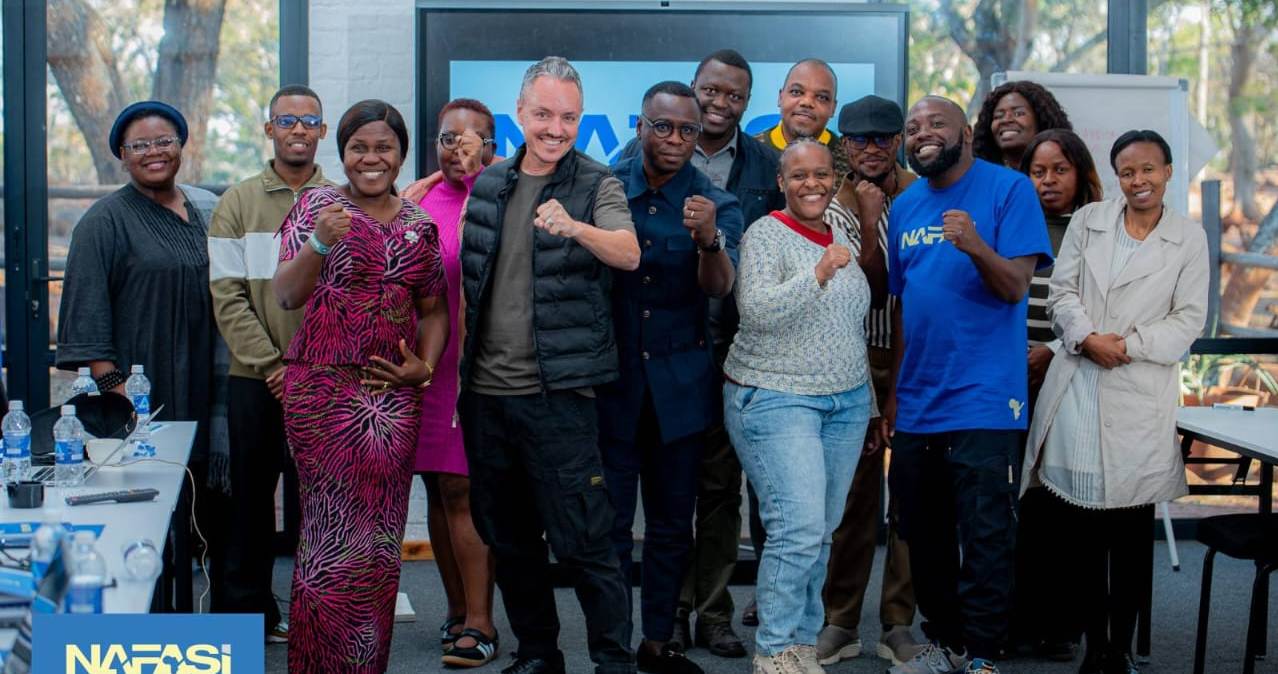 The conversation that followed RFLD’s presentation made clear that gender mainstreaming will not sit on the shoulders of one partner. Magamba Network and Defenders engaged directly with how the tools would integrate into their own workstreams — from the SafeSisters training cohort to News Factory and the Civic Cloud. The session closed with a shared understanding that every NAFASI activity, in every country, will be measured against the GESI architecture RFLD presented.
The conviction that runs through RFLD’s session is not a thematic add-on; it is what the organisation is. RFLD is a pan-African afro feminist network — its methodology was built inside African feminist political thought, refined across years of pan-African organising, and codified in the proprietary Gender Mainstreaming Tool. That distinction matters in NAFASI because gender-aware programming and afrofeminist programming are not the same thing, and the consortium’s continental-scale measurement architecture has to be carried by an Implementing Partner that owns the methodology rather than borrows it.
The force underwriting that identity is institutional. Four registered country offices in Porto-Novo, Dakar, Accra, and Banjul. A member network of 670 civil-society organisations across 35+ African countries. Active programme delivery in 15+ countries. ACHPR Observer Status No. 553/2017, which lifts the gender-mainstreaming work into continental diplomatic engagement through shadow reports and Special Rapporteur dossiers. Continental policy reach via the DƆNÙESÈ Data Center, the Maputo Protocol Hub, and the ACDEG Hub, which extends to all 55 African Union member states. And the Women Human Rights Defender protection mandate, which ensures the Gender Mainstreaming Tool does not stop at the dashboard but reaches the women whose work makes them targets.
The articulation between RFLD’s gender mainstreaming work and the rest of NAFASI was made explicit by Aurra Nicole during the Harvesting the Day reflection that followed: gender is not an additional layer applied over the work, but a lens through which the work is designed in the first place. The consortium walked out of the session with that lens in place.

