 Follow Us on Google News


 Follow Us on Google Discover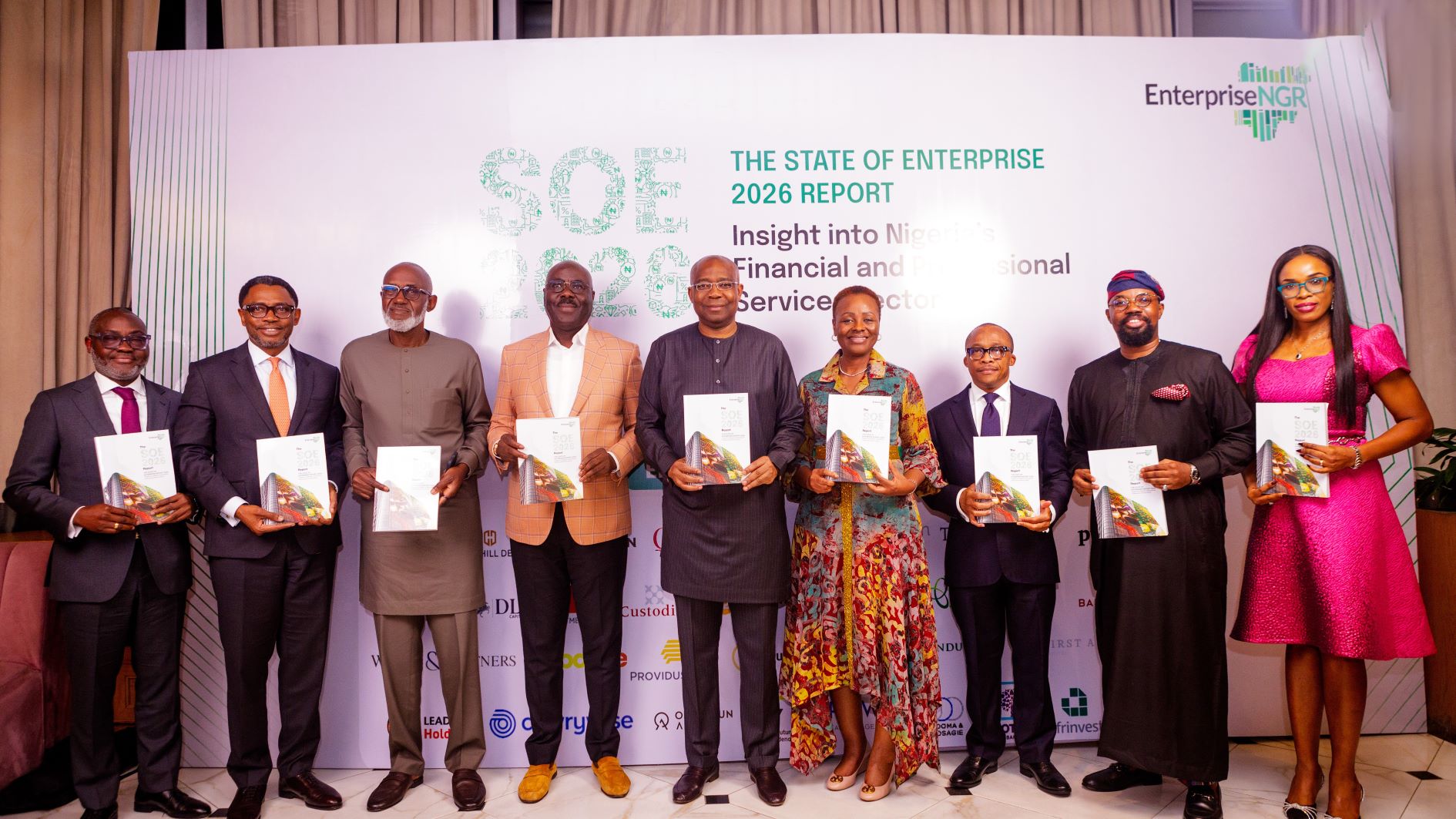
Nigeria’s financial and professional services (FPS) sector contributed N1.5 trillion, representing 30 per cent of total company income tax (CIT) collections in 2025, underscoring its growing role in government revenue generation and economic activity.
This was contained in the State of Enterprise (SOE) Report 2026, unveiled by EnterpriseNGR at its Members’ Night in Lagos.
According to the report, financial and insurance activities emerged as the country’s largest source of company income tax during the year, while also generating N421 billion in value added tax (VAT), raising total contribution to the two taxes to N1.92 trillion.
Beyond its fiscal contribution, the report described the sector as a key driver of reform-led growth, capital mobilisation and enterprise development, providing an assessment of performance across banking, insurance, capital markets, pensions, asset management, non-interest finance, fintech, professional services and sustainable finance.
The report showed that the total assests deposit money Banks rose to N180.37 trillion, equivalent to 41.8 per cent of nominal gross domestic product (GDP), despite persistent inflationary pressures, tight monetary policy, exchange rate adjustments and ongoing structural reforms.
Nigeria’s capital market also recorded one of its strongest performances in recent years. The Nigerian Exchange Group’s All-Share Index advanced 51.19 per cent in 2025 and extended its gains in the first quarter of 2026. Market capitalisation increased by 58.3 per cent to N99.38 trillion in 2025 before rising further to N129.21 trillion in the first quarter of 2026, while total market transactions more than doubled to N11.92 trillion, driven largely by domestic investors.

Other segments of the industry also posted robust growth. Gross premiums written by insurance companies rose 47.3 per cent to N2.30 trillion, while total insurance assets increased 24.2 per cent to N4.79 trillion. Pension assets climbed 21.9 per cent to N27.45 trillion and expanded further to N29.52 trillion in the first quarter of 2026.
The report also reaffirmed Nigeria’s position as Africa’s leading fintech hub, with more than 500 fintech companies collectively valued at over $10.6 billion. Electronic payment transactions reached N384 trillion across 4.12 billion transactions by July 2025.
Speaking at the launch, the Chief Executive Officer of EnterpriseNGR, Obi Ibekwe, said the report was developed to help business leaders shift from instinct-based decisions to evidence-driven strategies in an increasingly dynamic economic environment.
She said the publication goes beyond reviewing sector performance to identify where investor confidence is improving, where capital is flowing, where reforms are yielding results and where additional policy action is required to unlock the sector’s full potential.
According to her, data across banking, capital markets, insurance, pensions, fintech and professional services show that the sector remains central to enterprise development, investment and Nigeria’s competitiveness, adding that the challenge is to translate current momentum into broader financial inclusion, stronger institutions, improved regulation and sustainable economic growth.
Despite the positive performance, the report highlighted several structural constraints, including low financial inclusion, weak insurance penetration, shallow capital market liquidity, limited pension coverage in the informal sector, data and skills gaps, as well as the need for stronger governance and innovation across the financial and professional services ecosystem.
EnterpriseNGR said the report is intended to serve as a reference for chief executives, investors, policymakers, regulators, researchers and development partners by combining official data, market intelligence and sector analysis to provide insights into the outlook for Nigeria’s financial services industry.

