 Follow Us on Google News
 Follow Us on Google Discover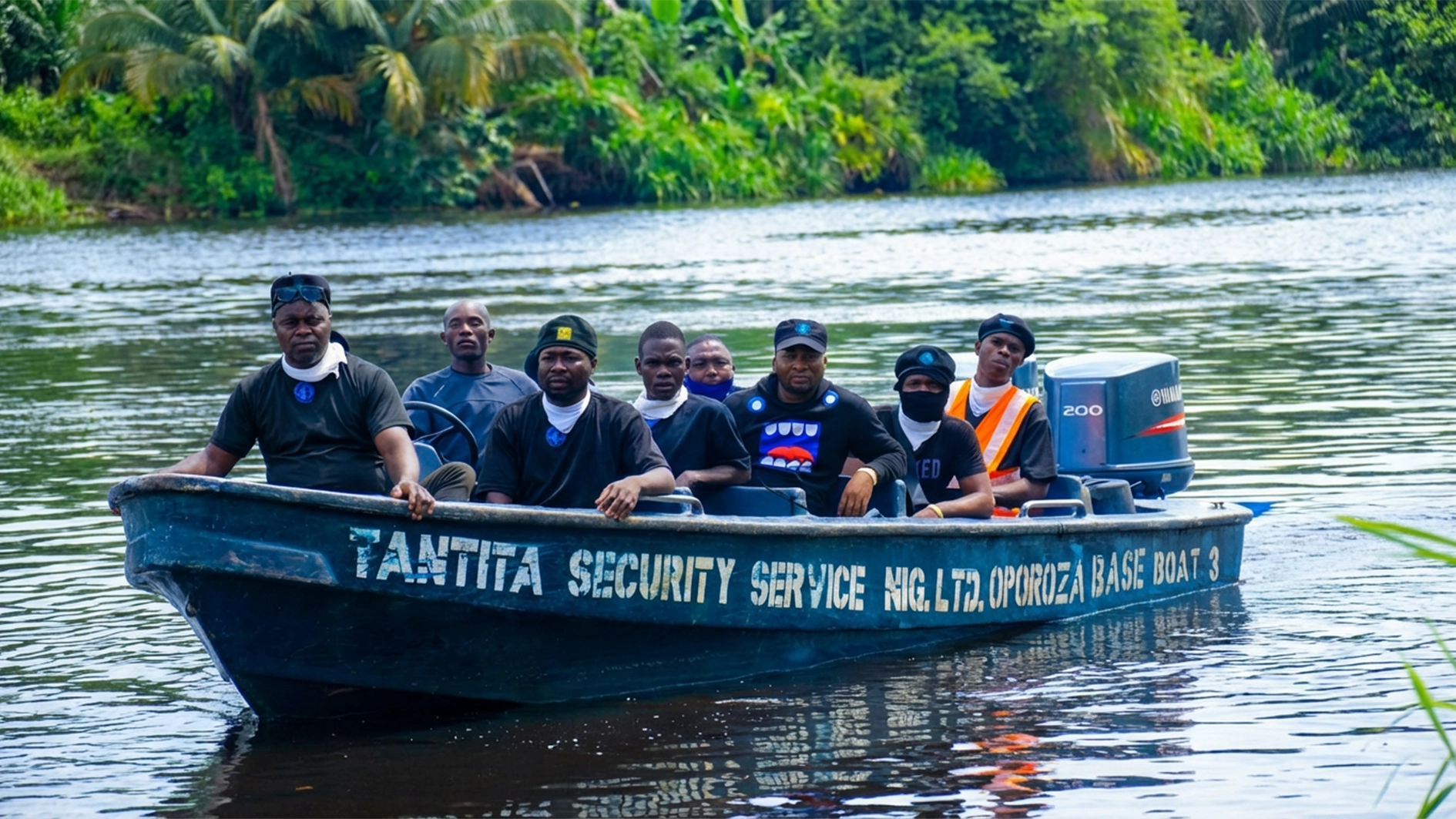
By Steven Okon
The battle against oil theft requires not only robust security measures. It extends to assigning criritcal surveillance roles to institutiuons with tested expertise and commitment to taming the scourge.
That was what the Federal Government of Nigeria did when it appointed Tantita Security Services Nigeria Ltd (TSSNL) to protect oil assets and ensure peace and stability in the Niger Delta.
Tantita Security Services Nigeria Ltd (TSSNL’s) operations in safeguarding national infrastructure, especially oil pipelines, are strategic for the Niger Delta region and national economy. Its operations ensured the security of oil pipelines, uninterrupted flow of petroleum resources, and migration of Nigeria from a position of constant revenue loss management to stability, planning, growth and development.
The effectiveness TSSNL’s operations and deployment of hi-tech facilities have earned it commendations and applauses from stakeholders, eliciting strong calls for operational continutity.
President Bola Ahmed Tinubu had appointed Tantita Security Services Nigeria Limited (TSSNL) led by High Chief, Dr Government Oweizide Ekpemupolo, alias Tompolo, to protect Nigeria’s oil assets in the Niger Delta region.

The appointment was to enable TSSNL, through its security operations, support the national economy in getting the full benefits of oil resources. The TSSNL works in collaboration with other security outfits to achieve its goals of securing oil assets and ensuring peace and stability in the Niger Delta region. Its track record in mitigating risks associated with oil pipelines has positioned it as a reliable partner in preserving Nigeria’s economic backbone.
As stakeholders advocate for the continued collaboration with TSSNL, the imperative of securing oil infrastructure remains at the forefront of efforts to ensure the nation’s sustainable development.
In the development process of any society, certain assets contribute to the advancement of society and its people. These assets ensure economic or monetary benefits for the people. These assets could be regarded as operating assets, non-operating assets or leased assets, among others.
It is not surprising that forensic experts and key stakeholders have applauded the Federal Government and Tantita Security Services Nigeria Limited for their collaborative efforts in strengthening pipeline security, which has driven higher crude oil production and boosted national revenue.
The commendation came at the end of a two-day National Dialogue on Pipeline Security in Abuja, where participants linked recent gains in oil output to coordinated surveillance.
The Forum of Forensic Civil Society Groups in Nigeria, in collaboration with the Centre for Social Justice, Equity and Transparency, convened the dialogue.
Participants noted that Nigeria’s oil pipelines remain the backbone of the economy, with improved security directly enhancing revenue generation and the government’s ability to deliver on public obligations.
They attributed recent rises in production levels and the decline in pipeline vandalism to structured surveillance, warning against any disruptive changes that could reverse these gains.
“The dialogue observed that recent improvements in crude oil production levels and the relative decline in pipeline vandalism are closely tied to more coordinated and structured surveillance frameworks.
These gains, participants agreed, must be preserved and strengthened rather than subjected to disruptive experimentation,” the communique by Dr Opialu Fabian said.
“The Forum expressed concern over increasing calls to fragment pipeline surveillance arrangements under the guise of inclusion, warning that such approaches risk undermining operational coherence, weakening accountability mechanisms, and creating vulnerabilities that could be exploited by criminal networks.
“Participants emphasised that pipeline protection is not a routine contractual engagement but a sensitive national security function requiring discipline, trust, intelligence coordination, and a clear chain of command. As such, it cannot be treated as an avenue for political accommodation or patronage distribution.”
Stakeholders at the dialogue stressed that introducing unvetted actors into surveillance operations could compromise intelligence and embolden oil theft syndicates, which have previously caused billions in lost revenue. While acknowledging the need for host community involvement, they insisted that inclusivity must come through structured engagement and capacity-building without sacrificing efficiency or security.
The forum highlighted that breaches in pipeline security affect the entire nation through reduced public spending, economic instability, and stalled development, urging that protection of national assets rise above sectional interests.
They also cautioned against politicising the debate, saying inflammatory narratives could heighten tensions in the Niger Delta and divert attention from core security goals.
“While recognising the legitimate concerns of host communities and the need for inclusivity, the Forum stressed that inclusion must be pursued through structured engagement, capacity-building, and clearly defined roles that do not compromise efficiency or security outcomes.
“Participants agreed that the protection of national assets must transcend sectional interests, as the consequences of pipeline breaches are borne collectively through reduced public spending, economic instability, and weakened national development.
“The Forum also cautioned against the politicisation of pipeline security debates, noting that inflammatory narratives around entitlement risk aggravating tensions in the Niger Delta and distracting from the primary objective of safeguarding national infrastructure.”
In their resolutions, the forum called for consolidation of current gains by sustaining effective coordinated surveillance models. They urged that any reforms be evidence-based, prioritising national interest and rigorous security assessments over pressures from interest groups, while strengthening oversight, transparency, and accountability in existing frameworks.
Stakeholders were encouraged to use constructive channels for concerns to avoid disrupting operations, alongside continuous civic education to foster collective responsibility in protecting national assets.
The dialogue emphasised deepening collaboration between government, communities, and credible security actors to improve intelligence sharing without undermining operational integrity.
Chairman of the House Committee on Host Communities, Dekor Dumnamene Robinson had said the contributions of Tantita and its leadership to national security deserve appreciation.
Also, in one of the strongest endorsements yet of the firm’s operations, lawmakers under the Joint Committee of the House of Representatives on Host Communities and Public Petitions and other stakeholders also commended Tantita for what they described as effective and patriotic service in safeguarding Nigeria’s critical oil infrastructure.
They specifically cited the recovery of crude oil production, reduction in pipeline vandalism and restoration of relative peace in oil-producing communities as major achievements recorded under the leadership of High Chief Government Ekpemupolo, popularly known as Government Ekpemupolo.
The Joint Committee subsequently passed a unanimous vote of confidence on the company and called on the Federal Government and NNPCL to approve a long-term renewal of the surveillance contract to consolidate gains already achieved in the fight against crude oil theft and illegal bunkering.
“Tompolo and his team have served this country at great personal risk. They have kept the economic lifeline of the nation running and restored peace to communities that had not experienced peace in decades,” he said.
The National Chairman of Host Communities of Nigeria Producing Oil and Gas (HOSTCOM), His Highness Benjamin Style Tamaranebi JP had further commended President Bola Ahmed Tinubu for the confidence he has reposed in Tantita as a critical part of the security apparatus for protecting oil assets in the Niger Delta.
“Let us be clear: Destroying our oil assets is economic suicide. It’s a direct attack on the very lifeline of our communities. Our host communities have endured environmental degradation, economic hardship, and neglect for decades. The passage of the Petroleum Industry Act (PIA) was a turning point, ensuring that our communities finally receive direct benefits from the resources extracted from our land,” he said.
A Lagos-based social analyst, Jamiu Idris, said to appreciate the current stability in the Niger Delta region, one must recall the state of near-collapse that defined Nigeria’s oil industry just a few years ago.
“Before the implementation of the Tantita Security Services Nigeria Limited (TSSNL) framework in late 2022, the nation faced an existential threat. Oil production had cratered to a historic low of 1.015 million barrels per day (bpd) in September 2022-a staggering decline that jeopardised the federal budget, weakened the naira, and pushed the economy toward the brink of insolvency,” he stated.
Tantita, recently contracted a hi- tech security company, Textron Systems, to deliver three uncrewed aircraft that would enhance the company’s capacity to carry out its surveillance operations on Nigeria’ s oil. The system has conducted operations across the globe and currently operates on over 10 U.S. Navy ships. The system is equipped for multiple payload configurations with both VTOL and fixed-wing options.
Okon, an industrialist, wrote from Port Harcourt, Rivers State.

