 Follow Us on Google News
 Follow Us on Google Discover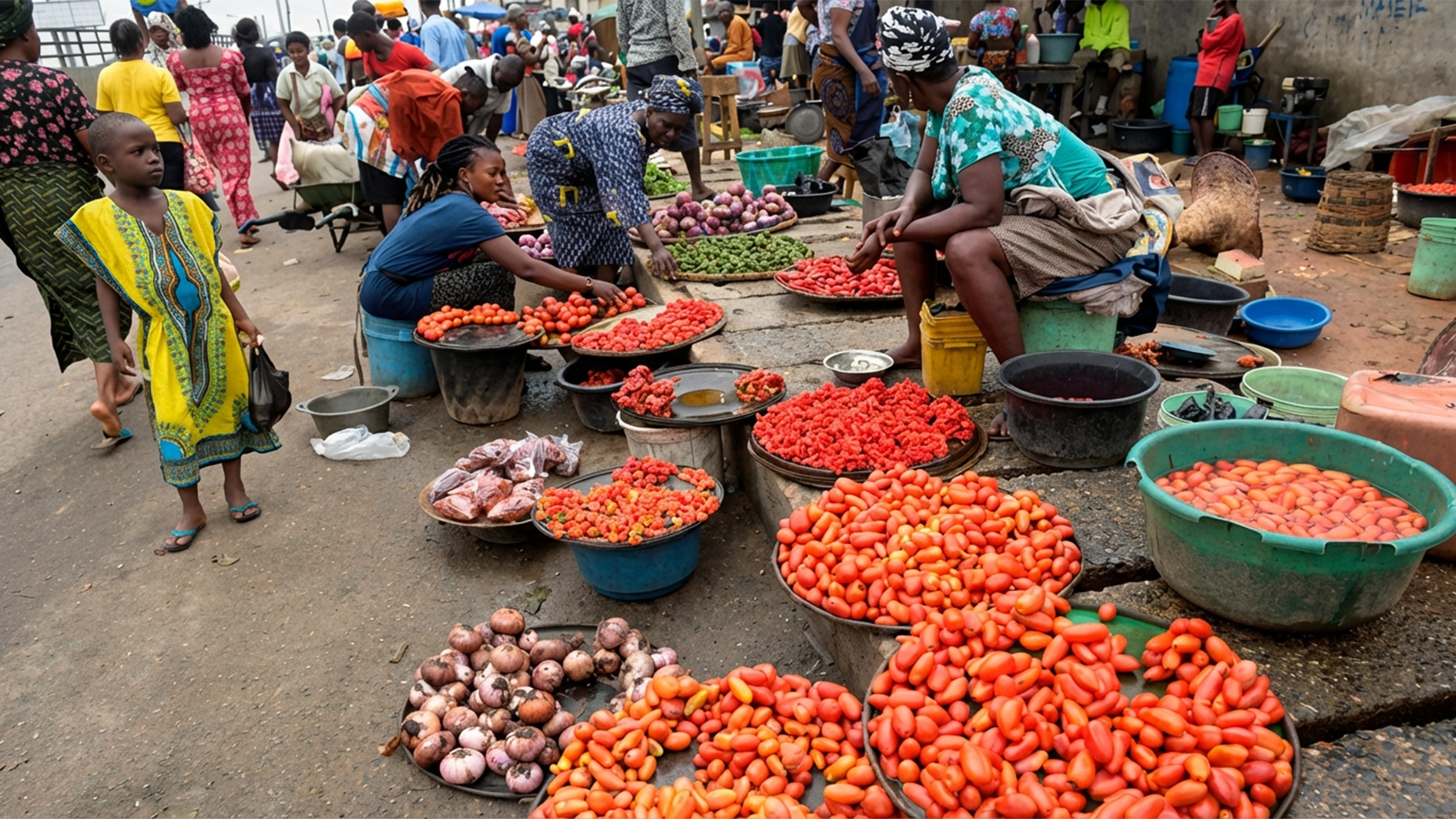
Nigerians are facing a complex situation of easing headline inflation amid spiking food prices, thus denying citizens the relief they should enjoy from the easing inflation and worsening the hunger crisis now ravaging some parts of the country, especially the north.
The National Bureau of Statistics in its June 2026 consumer price index (CPI) report published yesterday showed that headline inflation eased to 15.91 per cent from 15.93 per cent recorded in May 2026, a reduction of 0.02 per cent on a month-on-month basis.
The report also shows that food inflation rose sharply on a month-on-month basis from 2.98 per cent in May to 3.75 per cent in June, a 0.77 per cent increase and the fastest monthly increase in recent months.
According to the NBS, the increase was driven by fresh tomatoes, peppers, beef, crayfish, garri, yam, potatoes, bananas and cowpea. The very staple food of the people.
The report also shows that Core inflation slowed from 1.94 per cent to 1.66 per cent month-on-month, suggesting non-food inflationary pressures are easing.
The report also shows that state disparities are becoming alarming as inflation is highest in Niger State with 42.23 per cent, Kogi with 41.59 per cent and the Federal Capital Territory (FCT) Abuja with 39.91 per cent.

It was however lowest in Imo at 19.47 per cent, Ebonyi at 20.79 per cent and Katsina at 21.87 per cent.
An interesting part of the report is that rural inflation is now lower than urban inflation. According to the report, on a year-on-year basis, the urban inflation rate in June 2026 was 16.08 per cent, while on a month-on-month basis, was 2.13 per cent in June 2026, up by 0.14 per cent compared to May 2026 which was 1.99 per cent.
On the other hand the rural inflation rate in June 2026 was 15.48 per cent on a year-on-year basis, while on a month-on-month basis, the rural inflation rate in June 2026 was 0.52 per cent, down by 0.64 per cent compared to May 2026, which was 1.17 per cent.
Analysis of the report shows that although headline inflation appears stable, household budgets are under increasing pressure because food accounts for the largest share of consumer spending.
The World Food Programme (WFP) recently warned that about 35 million Nigerians are projected to face acute and severe food insecurity during the 2026 lean season.
WFP said in northern Nigeria alone, over 17 million people across nine conflict-affected states are in crisis, emergency or catastrophic levels of hunger.
Reacting to the rising food inflation, the president of Nigeria Agro Business Group (NABG), Arc. Kabir Ibrahim, said Nigerians have not seen anything yet. According to him, the situation will get worse in the coming months and more people will be plunged into abject poverty.
He said when the government went into massive food importation to force down prices, it did not consider the effect it would have on local food production.
Ibrahim said, “The imported food forced the prices down, while the cost farmers incur to produce locally was rising at a level that stripped the farmers of all the profit they would have made. That discouraged many of them and they have stopped farming. Now prices are rising because the government has realized that it cannot continue to import food.”
Ibrahim, who is the immediate past President of the All Farmers Association of Nigeria (AFAN), said it is heart warming that the government has started distributing free fertilizers to farmers. “Even though it is coming late, it is better than when nothing was done at all”, he said.
He also blamed insecurity for the considerable drop in local food production and warned that until the insecurity challenge was solved, Nigerians will continue to face high food costs.

