 Follow Us on Google News
 Follow Us on Google Discover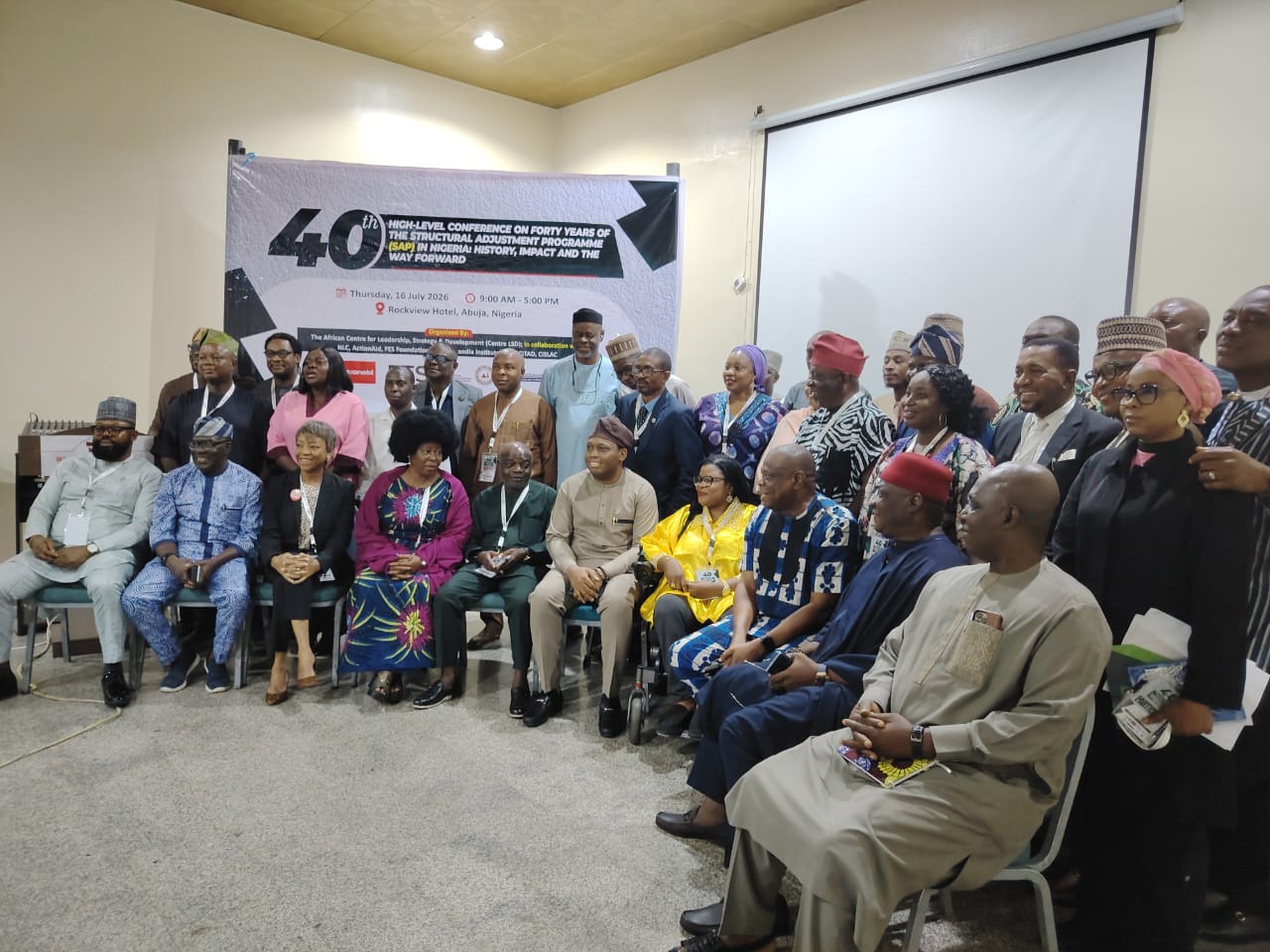
Forty years after Nigeria adopted the Structural Adjustment Programme (SAP), leading economists, labour leaders, development experts and civil society organisations have declared that the controversial economic reform programme bears significant responsibility for the country’s deepening poverty, mass unemployment, weak industrial base and decades of stalled development.
The verdict emerged on Thursday at a high-level conference in Abuja themed “Forty Years of Structural Adjustment Programme (SAP) in Nigeria: History, Impact and the Way Forward,” where participants argued that the market-driven reforms introduced in 1986 fundamentally altered Nigeria’s economic direction but failed to deliver the industrialisation, broad-based prosperity and structural transformation they promised.

Organised by the African Centre for Leadership, Strategy and Development (Centre LSD) in collaboration with ActionAid Nigeria, the Centre for Democracy and Development (CDD), the Nigeria Labour Congress (NLC), Friedrich Ebert Foundation (FES), CITAD, CISLAC and other partners, the conference concluded that SAP shifted Nigeria from a developmental state to a market-oriented economy without building the productive capacity needed for sustainable growth.
Participants argued that instead of creating a competitive industrial economy, the reforms weakened manufacturing, increased dependence on imports, entrenched reliance on crude oil exports and exposed millions of Nigerians to worsening poverty and unemployment.
Delivering the welcome address, the Founding Executive Director of Centre LSD, Dr. Otive Igbuzor, said the conference was convened to critically assess the impact of SAP four decades after its introduction and draw lessons for Nigeria’s current economic reforms.
He noted that many of today’s policies—including exchange-rate liberalisation, fuel subsidy removal, fiscal consolidation and public sector restructuring—closely resemble the prescriptions introduced under SAP in 1986.
“Whether one regards SAP as a necessary response to an economic crisis or as the beginning of many of our developmental challenges, there is no doubt that it fundamentally altered the direction of Nigeria’s economy and society,” Igbuzor said.
He stressed that economic reforms should not be judged solely by macroeconomic indicators but by their ability to generate employment, reduce poverty, strengthen institutions, improve education and healthcare, expand industrial production and improve citizens’ quality of life.
According to him, Nigeria must move beyond decades of adjustment policies and embrace a democratic developmental state that actively supports industrialisation while working in partnership with the private sector and civil society.
Igbuzor pointed to countries including China, Japan, Singapore, the United States and Rwanda as examples where strategic state intervention, rather than market forces alone, drove economic transformation.
Delivering the keynote address on behalf of renowned political economist Prof. Adebayo Olukoshi, Director of Operations at AIPCTA, Egghead Odewale, described SAP as perhaps the most influential economic reform programme in Nigeria’s post-independence history.
He argued that contemporary debates surrounding exchange-rate reforms, fuel subsidy removal, privatisation and debt sustainability cannot be understood without appreciating SAP’s legacy, noting that many current reforms remain rooted in the same Washington Consensus promoted by the International Monetary Fund and the World Bank.
ActionAid Nigeria’s Head of Programmes and Policy, Celestine Odo, described SAP as an austerity programme that imposed severe social and economic hardship across Nigeria and much of Africa.
Representing the Country Director, he said the programme’s emphasis on reducing public expenditure and expanding market forces weakened access to healthcare, education and other essential public services, leaving millions of vulnerable Nigerians without adequate protection.
Drawing from ActionAid’s assessments following the removal of fuel subsidy in 2023, Odo said many Nigerian households now struggle to afford three meals a day, while children increasingly attend school hungry and families adopt desperate coping mechanisms to survive.
“The economy may be growing on paper, but poverty and inequality are increasing. That kind of growth has no human face,” he said.
Odo rejected suggestions that SAP merely required stronger social safety nets, insisting that the ideology itself places markets above people.
“No serious country abandons its citizens to the market. Governments in Europe, America and Scandinavia invest heavily in social protection because governance is about service, not profit,” he added.
Director of the Centre for Democracy and Development, Dauda Garuba, similarly faulted the ideological foundation of SAP, arguing that the reforms steadily weakened the Nigerian state by reducing its responsibility for providing essential public services.
He linked the commercialisation of education and healthcare to SAP-era reforms, saying public institutions deteriorated as private alternatives expanded.
“Markets are driven by profit, while governance is driven by service. Government cannot be run with the ethics of the market,” Garuba said.
He urged Nigeria to rebuild state capacity and restore government’s central role in driving national development.
“If you discover that you are on the wrong road, no matter how far you have travelled, the right thing is to retrace your steps. Nigeria must return to building a developmental state that works for all its citizens,” he said.
Other participants, including Prof. Sam Edwi, Ms. Ayo Obe, Prof. Dung Pam Sha, Prof. Salamatu Idris Isa and Dr. Hussaini Abdu, acknowledged that while SAP expanded private sector participation and liberalised sectors such as telecommunications, it failed to strengthen manufacturing, modernise agriculture or diversify Nigeria’s export base.
They observed that decades after the reforms, Nigeria continues to grapple with poor infrastructure, exchange-rate instability, weak industrial capacity, rising youth unemployment and overwhelming dependence on crude oil revenues.
Participants also examined SAP’s1986 social consequences, concluding that while macroeconomic stability was prioritised, social protection suffered significantly. Poverty deepened, inequality widened, real wages declined, youth unemployment increased, public education and healthcare weakened, and brain drain accelerated, with women bearing a disproportionate share of the burden through unpaid care work and low-income informal employment.
To reverse the trend, the conference called for a new development model centred on industrialisation, technology-driven agriculture, infrastructure development, quality education, healthcare investment, stronger public institutions, expanded social protection, democratic participation and improved domestic resource mobilisation.
Participants also identified the African Continental Free Trade Area (AfCFTA) as an opportunity to boost industrial production, strengthen regional value chains and reduce Nigeria’s dependence on imports.
The conference concluded that four decades after SAP, Nigeria’s persistent poverty, unemployment, de-industrialisation and economic underdevelopment demonstrate the limitations of market-only reforms. It urged policymakers to abandon the false choice between state control and unfettered markets and instead adopt a nationally driven development strategy that combines strategic government intervention with private enterprise while placing citizens’ welfare at the centre of economic policy.

