 Follow Us on Google News
 Follow Us on Google Discover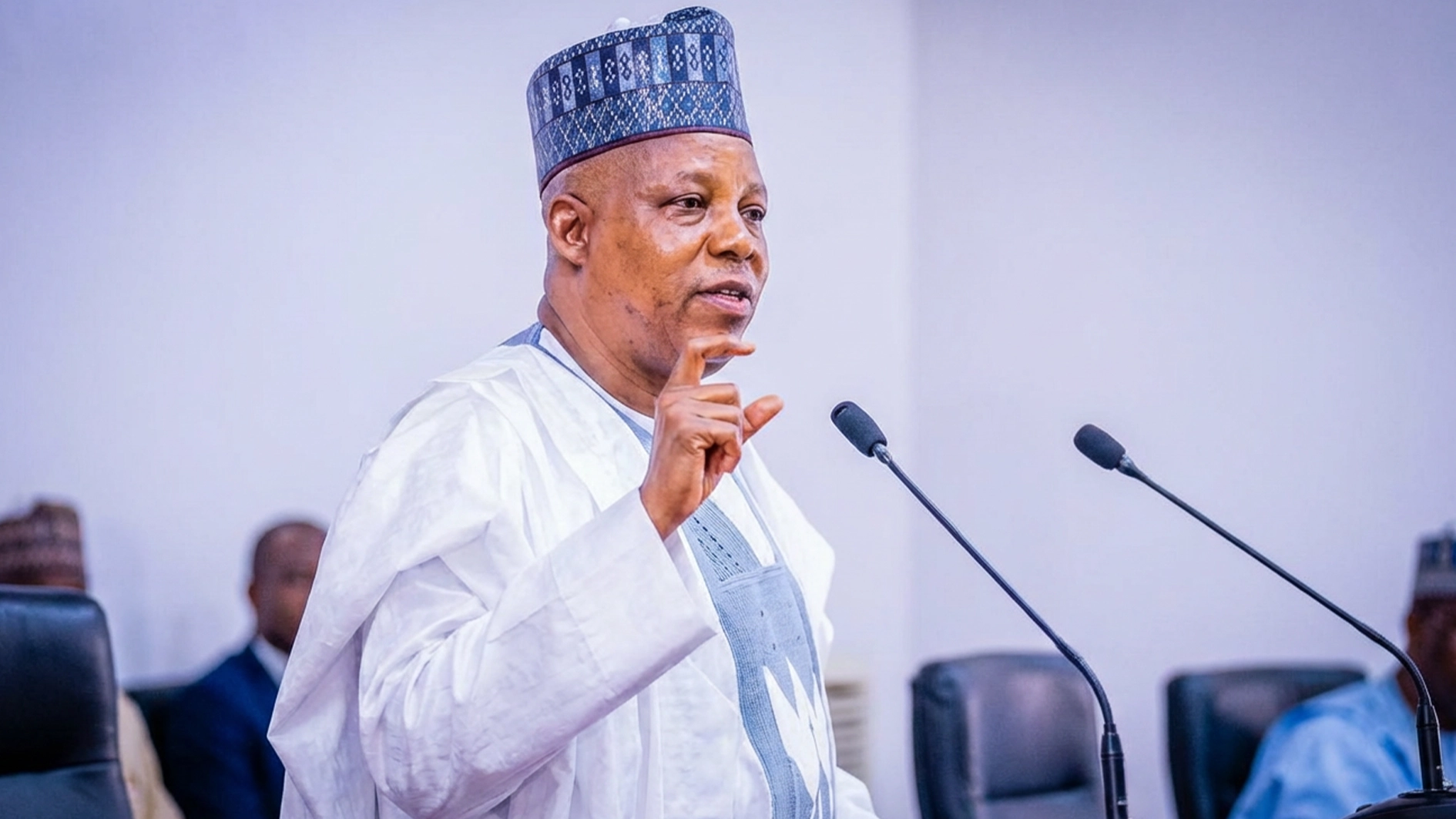
• Says programme puts farmers at centre of economic planning
The Federal Government yesterday moved a step closer to implementing the World Bank-supported $500 million Sustainable Agricultural Value Chains for Growth (AGROW) Programme after receiving the final report of the National Technical Working Group (NTWG), formally ending the project’s design phase.
Vice President Kashim Shettima, who received the report at the Presidential Villa, Abuja, declared that the AGROW initiative represents a deliberate effort by the President Bola Tinubu administration to reconnect farmers with national economic planning and policymaking, describing the programme as a major step towards transforming agriculture from subsistence to a commercially driven sector.
He said the initiative seeks to close the long-standing disconnect between farmers who produce the nation’s food and the institutions that shape the value of their labour.
“Today marks the transition of AGROW from programme design to implementation,” the Vice President said, describing the report as “the conclusion of a design process that restores the farmer to the centre of our national economic reasoning, where he has always belonged.”
The $500 million World Bank-backed programme, developed through seven zonal consultations involving 32 states, is designed to strengthen agricultural productivity, rural infrastructure, extension services, value addition and market access while attracting greater private sector investment into Nigeria’s agricultural value chains.

Shettima stressed that agriculture, which contributes about 23 per cent of Nigeria’s Gross Domestic Product (GDP) and provides livelihoods for 34 per cent of the country’s workforce, must no longer be treated as a marginal sector.
“No other sector carries as many livelihoods or touches as many households as agriculture,” he stated. “When yields rise, food prices ease, rural incomes recover, industries receive raw materials, and pressure on our cities and foreign reserves begins to relax.
“When yields fall, the entire economy pays the price of hunger. Productivity on the farm is therefore a question of growth, employment, food security and poverty reduction. What we do to the farm, we do to the nation.”
The vice president noted that the participation of 32 states in the programme’s design demonstrated both the urgency of Nigeria’s agricultural challenges and the growing commitment of sub-national governments to driving agricultural development.
He disclosed that $355 million, which is about 71 per cent of the programme’s financing, will be implemented directly through participating states, placing them at the centre of project delivery.
According to him, while the level of interest shown by states is encouraging, the available funding remains insufficient to address decades of deficits in extension services, infrastructure, technology, processing and market access.
Meanwhile, Shettima commended members of the National Technical Working Group for producing what he described as an inclusive, evidence-based and technically rigorous framework developed through collaboration among the Federal Government, state governments, development partners and the private sector.
Formally accepting the report, he announced the dissolution of the Technical Working Group, saying its assignment had been completed.
He also praised the Presidential Food Systems Coordinating Unit (PFSCU) for coordinating the programme’s design process and serving as secretariat to the working group.
Earlier, Nasarawa State Governor, Abdullahi Sule, said governors across the federation were fully committed to the initiative, recalling that the Nigerian Governors’ Forum had earlier been briefed by the
World Bank on the programme.
Kaduna State Deputy Governor, Hadiza Balarabe, also pledged her state’s readiness to implement the programme, revealing that Kaduna already dedicates over 13 per cent of its annual budget to agriculture and would establish a state coordination mechanism to facilitate timely implementation.
On his part, the Minister of Finance and Coordinating Minister of the Economy, Taiwo Oyedele, said AGROW would contribute not only to food production but also to macroeconomic stability, job creation and Nigeria’s broader economic transformation.
Similarly, the Minister of Agriculture and Food Security, Senator Abubakar Kyari, described AGROW as a game-changing intervention capable of reshaping Nigeria’s agricultural landscape.
According to him, attention would now shift to concluding the borrowing plan, financing agreements and other legal processes required to move the programme into full implementation.
In the meantime, the World Bank Programme Leader for AGROW, Ms Bertine Kamphuis, reaffirmed the bank’s commitment to supporting Nigeria’s agricultural transformation, expressing confidence that the programme would strengthen food security and reduce poverty.
She called for stronger private sector participation across the agricultural value chain, stressing that institutions such as the Bank of Agriculture would play critical roles in delivering the programme’s objectives.

