 Follow Us on Google News
 Follow Us on Google Discover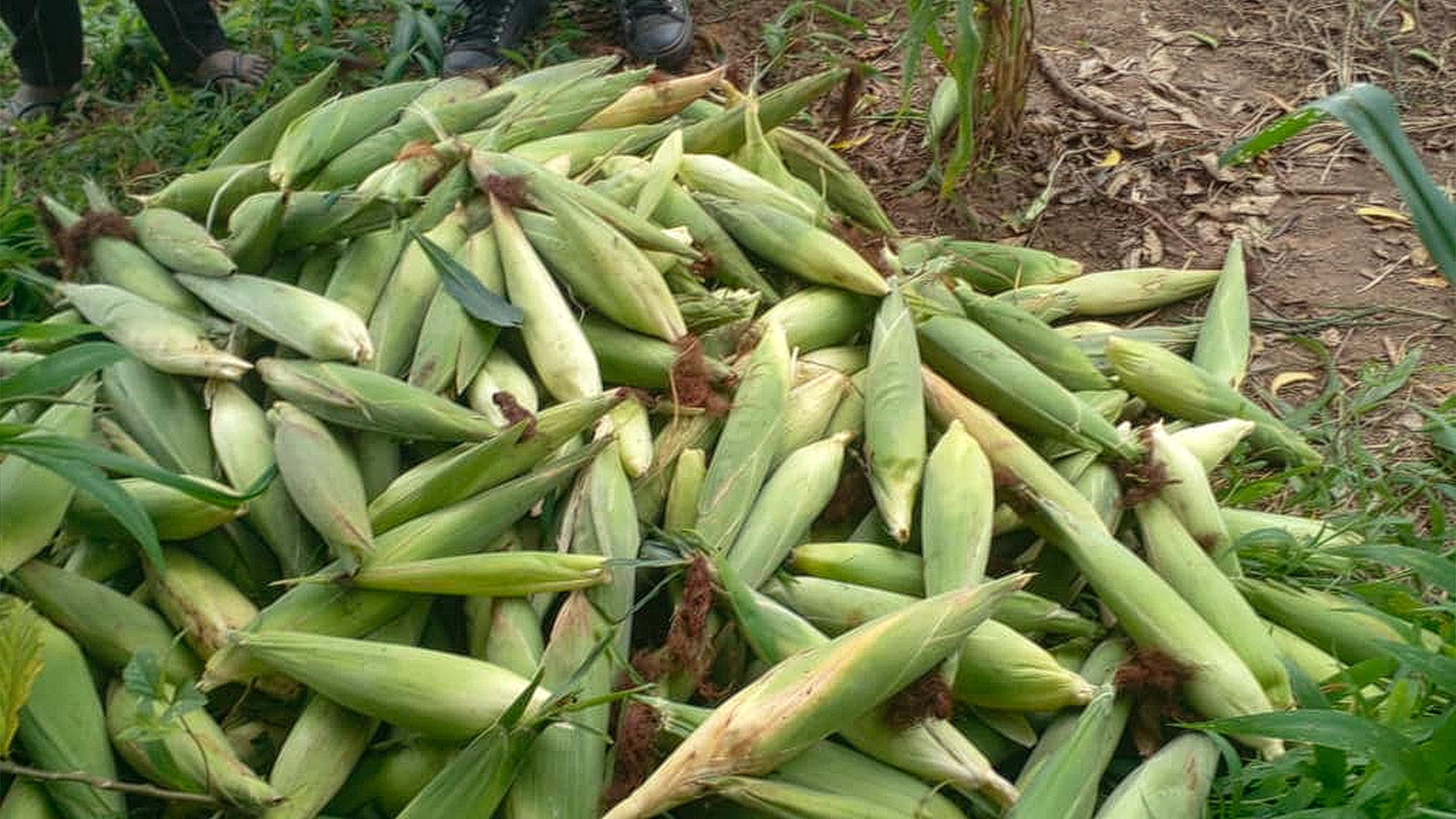
Hamisu Abubakar, going by local dynamics in his Kachia Local Council Area of Kaduna State, is a successful farmer. His local council is renowned for growing ginger and millet.
But Hamisu focuses on maize. Locally, known as masala, maize is a staple people in his area do not joke with as food from which different diet variants could be made. At times, some locals call him ‘Mai Masala’.
While he relishes the appellation, the actual source of that trade nomenclature is under threat as he has been battling Fall Army Worms in the last few years, which have been affecting his output lately.
“It is really affecting me,” Abubakar told local journalists who visited his farm in stuttering English when agricultural extension services officials came to his farm for inspection. “And I am not the only one being affected. Even in northern Kaduna, it is the same story.”
Fall Army Worms are not in Nigeria only. And perhaps, that is why farmers like Abubakar should be prepared to heave a sigh of relief going by the introduction of Sentinel X, a new agricultural technology developed in the United States of America. The sole aim of the technology is to fight Fall Army Worms and ensure that farmers do not have to rely on pesticides and insecticides alone any longer.
Speaking in Abuja, an agronomist and General Manager of Prexea Technologies Limited, Martha Solomon, the company distributing and applying the technology in Nigeria, said Sentinel X will not just fight Fall Army Worm, but also strengthen the immune system of the crops so that they can fight back on the own. She said the Sentinel X technology is not the traditional insecticide, which farmers are used to.

“It is an innovative agricultural technology developed by Informiton, our US partners who are the technical lead and owner of Sentinel X model. Sentinel X is an innovative crop protection technology to help farmers protect crops from Fall Armyworm (FAW) through early detection of crop stress and activation of the plant’s natural defense mechanisms.
“Unlike conventional approaches that rely heavily on repeated pesticide applications, Sentinel X supports healthier crop development by stimulating the plant’s own protective response, helping to reduce crop damage while lowering production costs and minimising environmental impact,” she explained.
Throwing light on the technology, she said it is photonic light rays with an AI tool deployed to activate these light rays and make the plant activate its own natural defense mechanisms to become resistant to Fall Army Worms. According to her, they are not applying anything nor using any synthetic or physical chemicals as we all know.
“What we do is that since the plants have their own physiological defensive mechanism, we are only activating them to become resistant to this Fall Army Worms,” Solomon threw further light on the technology.
Naturally, and perhaps unknown to many plants, just like human beings have their own defence mechanism, which could be boosted to resist attacks from foreign elements like the Fall Army Worms. The agronomist said that is exactly what Sentinel X does aside fighting the worms. She said the technology makes the crops resistant to the worm and also make the plants no longer palatable to the Fall Army Worm to feed on.
“This worm is also commonly called stem-borer and it affects both the crop vegetative state, as well as the cobs. But Sentinel X makes the plants resistant to its attack from the vegetative state to the harvest stage.”
In actual fact, findings showed that while Sentinel X is the overall technology, it is actually two products in one. One is the Sentinel X Pest Control, which is meant to replace insecticides; which is actually the alternative for insecticides. Solomon said they had done trials for both of them. So apart from Sentinel X Pest Control, there is also Sentinel X Crop Booster; which is more or less like a fertiliser.
“People think it is just one technology. No it is not. When we get to the commercialisation stage, we would be selling both but in three different packages. In other words, farmers can buy the Sentinel X Pest Control alone, buy the Sentinel X Crop Booster alone or buy both. So it is three packages. Though naturally, we will always advise our farmers buy the two together,” she explained.
The reason for this is that while the Sentinel X is primarily for Fall Army Worms in maize, the Sentinel X Crop Booster can be used for any agricultural produce. And because of the massive success of the pilot scheme, she said they have been getting a lot of calls from the ministry, and farmers that they should make it available.
And talking about trial, the company recently carried out a pilot trial of this technology in Kano and Kaduna states and the result was breathtaking. They were fully aware that such technology could not just be brought to the country without the approval of authorities and the buy-in of stakeholders.
Even while the technology had been deployed in other African countries like Kenya, for a country, whose farmers are used to applying insecticides and pesticides, it would never be a stroll in the park pushing such technology into them no matter its avowed positive effect.
“Before we go ahead to do anything, what we did was to carry out a trial in Nigeria even though the technology had been deployed in Kenya and it was working. So in the agricultural sector, seeing is believing. You can’t just bring a model or product in which you have not confirmed to be working. So we decided to carry out a trial in two states: Kaduna and Kano to see the effect of this Sentinel X. Over time the monitoring and evaluation report showed this technology works and the effect was so glaring.”
What they did was to go through the community-leaders who introduced them to the farmers. In the same vein, according to Solomon, they also went through agricultural agencies like the State Ministry of Agriculture, Kaduna State Agricultural Development agency (KADA) and also agricultural extension services agents. They helped in the monitoring and they also used National Agricultural Extension and Research Liaison Services (NAERLS) and the Ahmadu Bello University, Zaria Research Institute.
“So we didn’t just go on our own. We brought in farmers, locals and stakeholders across different agencies and the Ministry as well,” she added.
On the real level of government involvement, the Cross River State-born agronomist said the Fall Army Worms has been a major source of concern for the government. According to her, government was ready to do anything to ensure that these worms don’t affect farmers again.
“Like I mentioned, this Fall Army Worm has really been a concern to the government, smallholder farmers and commercial farmers. So they followed us to the trial and along the line, these government agencies visited the site of the trial with us and they confirmed that this model evidently worked. When they heard the testimonies from the farmers, they were very impressed. They could see that Sentinel X cuts down extensive costs and manual labour as compared to the use of pesticides and therefore, rather than relying solely on repeated pesticide application, Sentinel X just clears the pest infestation.”
As enticing as this latest agricultural technology is, the question is how it would be applied considering the fact that most of these farmers are illiterates? Solomon said that should not be an issue. According to her, all a farmer needs to do is just to provide the coordinates of the farm and
“there are field agents and agricultural extension workers in the area who will help them in applying the technology.” She said they are the ones that will handle it since most of the farmers are not educated.
“Once we get the coordinates, we can apply no matter the number of hectares. It is like magic from heaven,” she enthused.
The beauty of Sentinel X, if the words on the technology are to be taken, is that it is a one-off application. Compared to the use of pesticides which a farmer has to apply severally before he can get results with even a considerable percentage of loss, Sentinel X is just a one-off payment for the planting season.
And that is why farmers like Hamisu Abubakar can begin to heave a sigh of total relief and be sure that Fall Army Worms won’t come close to his farm again.

