 Follow Us on Google News
 Follow Us on Google Discover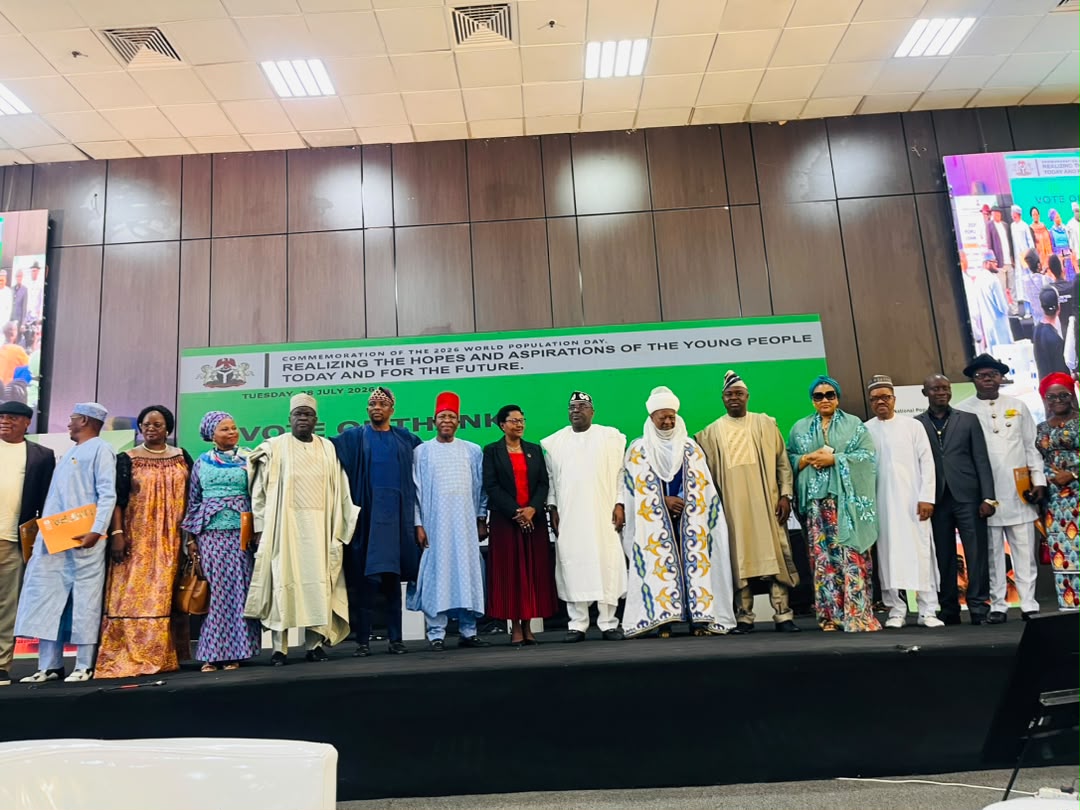
…As Senate seeks constitution amendment for periodic national census
…Report puts adolescent birth rate at 77 per 1,000 girls, says NP
THE United Nations Population Fund (UNFPA), has called for sustained investment in the health, education, skills, decent work and meaningful participation of Nigerian youths in national development.
This was as 2024 Nigeria Demographic and Health Survey recorded an adolescent birth rate of 77 births per 1,000 girls aged 15 to 19.
The report added that mordern contraceptive prevalence among young women remains critically low at 3.3 per cent while an estimated 15.8 per cent of sexually active adolescents both married and unmarried have an unmet need for family planning.
Speaking Tuesday in Abuja at the occasion to commemorate the 2026 World Population Day, the Executive Director, UNFPA, Ms Diene Keita, described Nigeria as a youthful country with young people between the ages of 10 and 24 years accounting for 31.7 per cent of the population.
Represented by the Nigeria Resident Representative, Ms. Muriel Mafico, she warned that as the world is confronted with profound demographic change, realising the demographic dividends of the youths requires intentional investment in them.

“Today, fragile labour markets, widening inequalities and protracted conflict leave many young people struggling to imagine how they can build the families and futures they want.
“ This reality resonates in Nigeria, where many young people face unemployment and underemployment, rising living and housing costs, insecurity and unequal access to quality education and healthcare, including sexual and reproductive health services. These conditions can limit their choices and make it difficult for them to plan confidently for their future.”
Keita also expressed worries over the rapidly surging number of older adults in the country, stressing that though the figure might be drowned by the huge country’s population, such small percentage translates to millions of aged individuals, creating a massive demographic shift in absolute numbers.
While the aged population soars, UNFPA feared that economic factors are on the other hand, drastically constraining the younger generation from procreating.
“Some people assume that younger generations have given up on marriage and children altogether. Our survey tells a different story. Most respondents say their ideal relationship involves marriage. Yet among those who want a partner, many are single and not dating.
Economic and housing constraintsEconomic and housing constraints were the most commonly cited barriers to partnership. Most of those surveyed also want children and across most regions, two is the most common ideal family size. But many questioned whether they will have the stability and security to house and care for them.
“ In short, it is uncertainty, not unwillingness, that has young people questioning whether they can start the families they want.
“In response to changing demographic trends, including ageing and low fertility, governments are exploring a wide range of policies. However, policies will not succeed if they pressure people into particular choices or fail to address the barriers that young people themselves identify”
The ED said that In Nigeria, implementation of policies and programmes must be grounded in the country’s demographic realities and in the voices and lived experiences of its diverse young population.
“Such efforts must protect the right of every person to decide freely and responsibly whether, when and with whom to form a family, and how many children to have without coercion, discrimination or violence.”
With this year’s theme as, ‘Realizing the Hopes and Aspirations of Young People – Today and for the Future’, UNFPA reaffirms commitment to working with the Nigerian Government, National Population Commission and other partners to strengthen systems and build a society, where young persons can realize their hopes and aspirations.
In his opening remarks, the Chairman, National Population Commission, Dr Aminu Yusuf, emphasised noted that population issues are central to development as the size, structure, distribution and characteristics of a population influence virtually every aspect of national planning – from the number of schools and hospitals required to the demand for jobs, housing, social protection, infrastructure, and other essential services.
Speaking on Nigeria’s population profile, the Chairman disclosed that the country is home to an estimated population of over 238 million people, making it Africa’s most populous country and the sixth most populous nation in the world.
He however held that what truly defines Nigeria’s demography is its structure, stressing that approximately 70 per cent of the population is below 30 years.
“The size of our youth population presents immense opportunities for innovation, productivity, entrepreneurship, technological advancement, social transformatio and economic growth. It makes our young people one of our greatest national assets and one of the most important determinants of our future development trajectory. But we must be clear about the fact that a youthful population does not automatically translate into a demographic dividend”, he said.
Adding: “The data is a reminder of the urgency of the challenge. According to the 2024 Nigeria Demographic and Health Survey, Nigeria records an adolescent birth rate of 77 births per 1,000 girls aged 15 to 19, while approximately 15 per cent of adolescent girls in this age group have already begun childbearing.
“Modern contraceptive prevalence among young women remains critically low at 3.3 per cent, while an estimated 15.8 per cent of sexually active adolescents both married and unmarried have an unmet need for family planning.
“These are not merely statistics. They represent young lives. They represent educational opportunities that may be interrupted. They represent choices that may be constrained. They represent the need for stronger systems of information, healthcare, protection, education, and opportunity.
“This is why investing in young people must be understood as both a development imperative and a demographic imperative. If we want to harness the demographic dividend, we must ensure that young people are equipped to participate productively in the economy and society.”
He chairman held that in the new demographic setting, the voices of the young ones must inform policies and their experiences must inform programme design. According to him, their ideas must inform innovation while their participation be reflected in the decisions that shape their present and their future.
“The national commemoration of World Population Day provides us with an important platform to strengthen this dialogue. Through the participation of government, development partners, civil society, academia, the media, the private sector and young people, we can move from discussion to action.
“Our challenge is to ensure that the optimism of Nigeria’s young people is matched by real opportunity. We must ensure that their aspirations are not met with barriers that could have been removed through better policies, stronger institutions, and more deliberate investment. We must ensure that every young person everywhere has a fair opportunity to develop his or her potential”, the chairman said.
Meanwhile, Chairman, Senate Committee on National Identity and Population, Senator Victor Umeh, has assured that his committee will champion a bill to constitutionally guarantee a fixed time interval for the conduct of national population censuses in Nigeria.
According to him, such step will help to eliminate decades of demographic uncertainty and ad-hoc planning considering that the last census in the country was conducted in 2006.
Umeh, who was responding to demand made by the Chairman, National Population Commission, NPC on the need for entrenching terminal conduct of census in the constitution, argued that while elections for the presidency, governorships and legislative seats are strictly enshrined in the constitution every four years, national population counts, which dictate resource distribution, infrastructure development and social welfare have been left to administrative discretion and funding uncertainties.
He felt it was absurd to rely on 2006 baseline statistics to manage a rapidly expanding 2026 population, stressing that millions have been born and passed away without accurate statutory documentation.
“There is no way you can plan for your people if you don’t know how many they are. You cannot plan for anybody whether children, young people, middle-aged, or the elderly without accurate numbers. Every segment of the population has special needs and the government must know their distribution to ensure precise resource allocation.”
He therefore assured management and staff of NP that the National Assembly will push through a constitutional amendment bill upon resumption on September 15 to make a 10-year census interval mandatory.

