 Follow Us on Google News
 Follow Us on Google Discover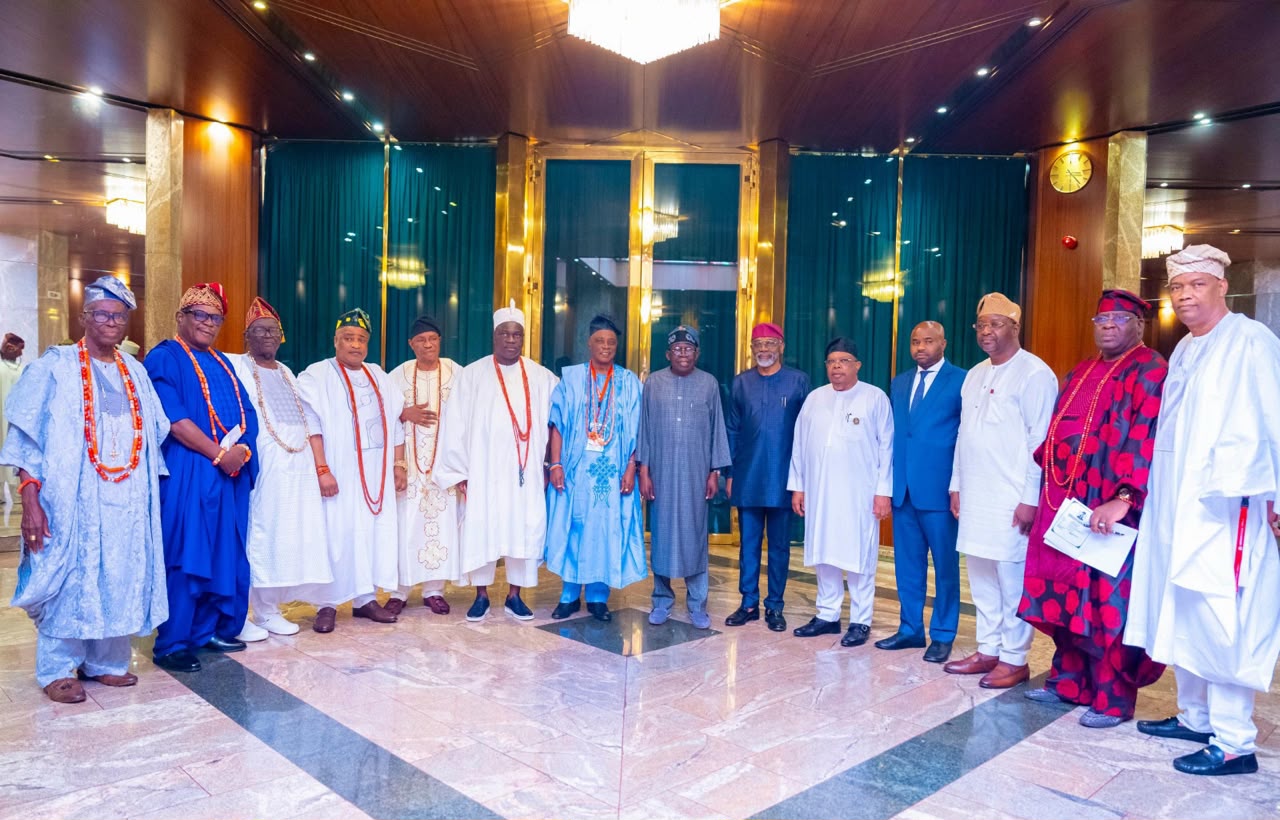
…As President unveils state police, army expansion
Traditional rulers from Oyo State on Thursday threw their weight behind President Bola Tinubu’s hardline stance against kidnapping, declaring that his refusal to negotiate with abductors or pay ransom had marked a turning point in Nigeria’s fight against the crime.
The endorsement came as President Tinubu unveiled a new phase of his administration’s security reforms, announcing plans to expand the Nigerian Army from eight to 12 divisions, establish state police with safeguards against abuse, strengthen the Forest Guard and deepen intelligence gathering to confront terrorism, banditry and other violent crimes.
Speaking during a courtesy visit to the Presidential Villa by members of the Oyo State Council of Obas and Chiefs, led by the Olubadan of Ibadanland, Oba Rashidi Adewolu Ladoja, the President maintained that his administration would never negotiate with criminals, regardless of the pressure.
He disclosed that kidnappers involved in a recent abduction demanded not only ransom but also the release of members of their gang already in detention.
“We said no deal. We will not negotiate with criminals,” Tinubu declared, insisting that conceding to such demands would embolden criminal networks and undermine the country’s security.

The President said the government had drawn critical lessons from recent security operations, prompting a review of operational strategy and military deployment across the country.
According to him, expanding the Army from eight to 12 divisions will significantly reduce response time and improve the military’s capacity to respond swiftly to terrorist and bandit attacks.
He also confirmed that the Federal Government was pushing ahead with the establishment of state police to strengthen grassroots security.
“There will be state police, and there will be guardrails against abuse. Traditional rulers will equally have important roles to play in making the system effective,” he said.
Tinubu added that the Forest Guard would be transformed into a frontline security outfit equipped to pursue criminal gangs operating in forest reserves across the country.
“They are no longer there merely to protect wildlife. We are enhancing their capacity to pursue criminals and deny them safe havens in our forests,” he stated.
He called on traditional rulers to strengthen community intelligence by encouraging residents to identify suspicious activities and promptly report them to security agencies.
The President also linked the country’s security challenges to the worsening instability in Mali, Burkina Faso and the Niger Republic, noting that cross-border criminal activities had increased pressure on Nigeria’s security system.
Earlier, the Olubadan said the delegation came to express appreciation for what he described as the President’s courageous handling of Oyo State’s recent kidnapping incident.
Recalling the anxiety that gripped residents when the abduction occurred, the monarch said many feared the incident could spiral into a prolonged national crisis similar to previous mass kidnappings.
He, however, said Tinubu’s firm refusal to pay ransom or succumb to the kidnappers’ conditions fundamentally altered the trajectory of the crisis.
“The fact that you refused to pay ransom and stood your ground shows that Nigeria now has a government that knows what it is is doing. It has become a turning point in the fight against kidnapping because Nigerians now know they have a President who will not negotiate from a position of weakness with criminals,” Oba Ladoja said.
While commending the operation, the Olubadan appealed to the Federal Government to maintain a permanent security presence in the expansive forest corridor linking Oyo, Kwara and Niger states to prevent criminal groups from returning.
He described the forest reserve stretching through Iseyin, Igboho, Kishi and Baruten as a strategic security belt whose continued protection would guarantee lasting peace across the region.
The monarch also lauded the Tinubu administration’s infrastructure drive in Oyo State, noting that about 10 ongoing federal projects worth over N2 trillion were transforming the state’s economy.
He particularly praised the reconstruction of the Ibadan-Ife highway and adjoining road corridors, describing them as projects that would permanently address decades of infrastructure challenges in the South-West.
Responding, Tinubu urged state governors to match the Federal Government’s investments by deploying increased Federation Account allocations to projects that directly improve security, economic productivity and the welfare of citizens.
Rather than embarking on what he described as white elephant projects, the President urged governors to prioritise road networks and strategic infrastructure capable of opening up rural communities, accelerating economic activity and enabling faster deployment of security personnel.
“The resources going to the states today are four to five times higher than before. Instead of constructing flyovers where traffic hardly exists, governors should build roads and arterial networks that improve accessibility, enhance the quality of life of the people and enable security agencies to respond quickly whenever the need arises,” Tinubu said.
He also announced plans to hold periodic consultations with traditional rulers nationwide, describing them as indispensable partners in intelligence gathering, conflict prevention and the country’s broader security architecture.

