 Follow Us on Google News
 Follow Us on Google Discover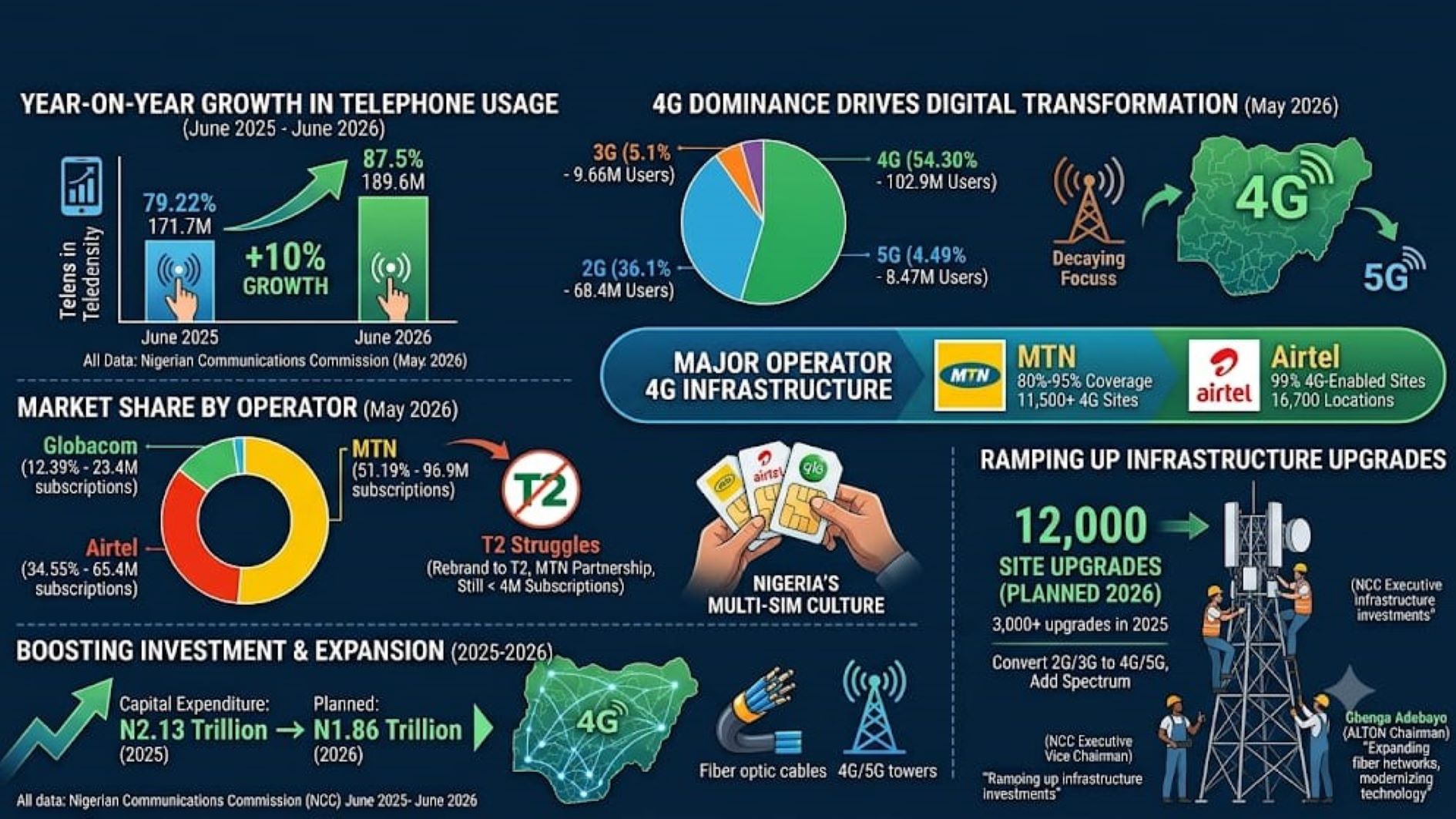
Nigeria’s telecommunications sector has recorded a remarkable surge, with telephone usage rising by 10 per cent in one year, driven by the dominance of the 4G network.
This growth underscores the country’s perceived digital transformation, driven by increasing demand for faster connectivity, broader coverage and improved service quality. The expansion of 4G infrastructure has not only boosted subscriber numbers but also positioned Nigeria as one of Africa’s leading mobile markets, reflecting the country’s appetite for advanced communication technologies.
Analysis of data by the Nigerian Communications Commission (NCC) showed that as of June 2025, teledensity (telephone density), which was 79.22 per cent (171.7 million), grew by 10 per cent to 87.5 per cent (189.6 million).
Teledensity is the number of active telephone connections per 100 people in a specific area, usually shown as a percentage. It measures how easy it is for people to use a phone and shows how well a region’s telecom network has grown.
The expansion of telephone lines, largely in the country’s cosmopolitan areas, rides on the dominance of 4G networks.
As of May 2026, and based on NCC data, 4G networks have 54.30 per cent penetration, which means that some 102.9 million telephone users are currently on the technology. While 2G users are 68.4 million, 3G network, which is fading away across countries, currently has 9.66 million subscribers on it.
5G, which is in its fourth year in Nigeria, with 4.49 per cent, is enjoyed by some 8.47 million users.
Indeed, the dominance of 4G networks has reshaped consumer behaviour, enabling millions of Nigerians to access high-speed Internet for education, business, entertainment, and social interaction.
Further checks showed that there is between 80 per cent and 95 per cent 4G population coverage on MTN, across all states, with over 11,500 sites nationwide, while 99 per cent of sites on Airtel are 4G-enabled in about 16,700 locations.
Further analysis of the latest subscriber data from the telecom regulator showed that MTN is now close to the 100 million active subscriptions mark as its database hit 96.9 million in May.
Based on the May subscriptions figure, MTN accounted for 51.19 per cent of the country’s mobile market, underscoring its dominant position in the industry.
Airtel Nigeria, the second operator by subscriber number, closed May with 65.4 million active subscriptions, accounting for 34.55 per cent of the market share. Globacom maintained its third position with 23.4 million active subscriptions as of May, representing 12.39 per cent share of the market.
But the growth of T2, formerly 9mobile, has not been as progressive as expected, especially with its rebranding about a year ago and its partnership with MTN. The telecommunications operator remained at a distant 4th position with 3.5 million subscriptions as of the end. NCC’s data revealed that T2 has remained below the three-million subscription threshold since September 2025.
The telco, which once had over 22 million subscribers, has continued to struggle to attract more customers despite an infrastructure-sharing deal signed with MTN in July last year.
It must be emphasised that, due to Nigeria’s multi-SIM nature, there are subscribers who use the services of at least two or three operators at once to keep their telephone service afloat.
Meanwhile, teledensity is fueling more sector investments and expansion. The NCC recently disclosed that telecom operators have committed to upgrading 12,000 sites this year to improve service quality nationwide.
According to the Executive Vice Chairman of the Commission, Dr Aminu Maida, operators carried out just over 3000 site upgrades for coverage and capacity in 2025, but with a commitment to 12,000 in 2026, they are now ramping up infrastructure investments and network expansion.
He explained that the upgrades include additional spectrum deployment at 4G sites, as well as converting older 2G and 3G sites to 4G and 5G infrastructure.
On his part, the Chairman of the Association of Licensed Telecom Operators of Nigeria (ALTON), Gbenga
Adebayo, said that in 2025, the industry invested approximately N2.13 trillion in capital expenditure, while an additional N1.86 trillion is planned for this year.
Adebayo, an engineer, said the funds will expand fibre networks, modernise technology, enhance resilience, and improve service quality nationwide. The ALTON chairman credited the Federal Government’s 2025 tariff adjustment policy for restoring industry sustainability and enabling renewed reinvestment.

