 Follow Us on Google News
 Follow Us on Google Discover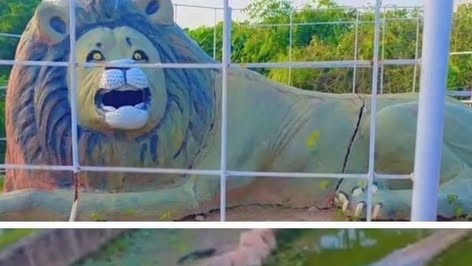
Adamawa State Government has reacted following a viral video, which showed a woman expressing disappointment that she had paid to use the recreational centre in Yola, but saw ‘statue animals’ instead of living ones.
Her video sparked a public debate after a video of her visit went viral on social media.
In the video, the woman, who was accompanied by her children, said she paid a N500 entrance fee expecting to see live animals, only to discover that some of the attractions at the facility were statues.
Her comments, which were later aired by Arise TV, generated reactions from members of the public who questioned the state of recreational facilities in Adamawa State.
However, the Adamawa State Government has clarified that the facility featured in the video is not owned or managed by the state government.
The Commissioner for Information and Strategy, Leader Leneke, said in a statement that the facility is the Wet Land Recreational Park and Garden, located along the Yola Bypass.
According to Leneke, the recreational centre is privately owned by Hajiya Maisaratu Ahmed Bello, a former Permanent Secretary in the state’s Ministry of Women Affairs and Social Development.
He said the confusion may have arisen because members of the public could have mistaken the private facility for the state-owned Jimeta Amusement Park.
Leneke explained that the Jimeta Amusement Park is currently undergoing reconstruction and transformation and is not the facility shown in the viral video.
“The old facility has been completely demolished to give way to a modern recreational and amusement centre designed to meet contemporary and international standards,” he said.
The commissioner said the reconstruction was expected to be completed around October 2026, after which the centre would be equipped with facilities and attractions intended to make it one of Nigeria’s leading amusement and recreational centres.
The government’s clarification followed growing public interest in the woman’s account, particularly after the video was broadcast on television and circulated widely online.
Leneke urged media organisations, social media influencers, commentators and other public communicators to verify claims before publishing or broadcasting them, especially when such reports could affect the reputation of individuals or institutions.
He stressed that responsible journalism required establishing the facts before giving publicity to potentially misleading claims.
“Where a story has the potential to create public misunderstanding or damage the reputation of individuals, institutions or governments, the minimum obligation is to establish the facts before publication or broadcast,” he said.
The commissioner added that the media had an important role to play not only in informing the public but also in promoting peace, unity, responsible citizenship and development.

