 Follow Us on Google News
 Follow Us on Google Discover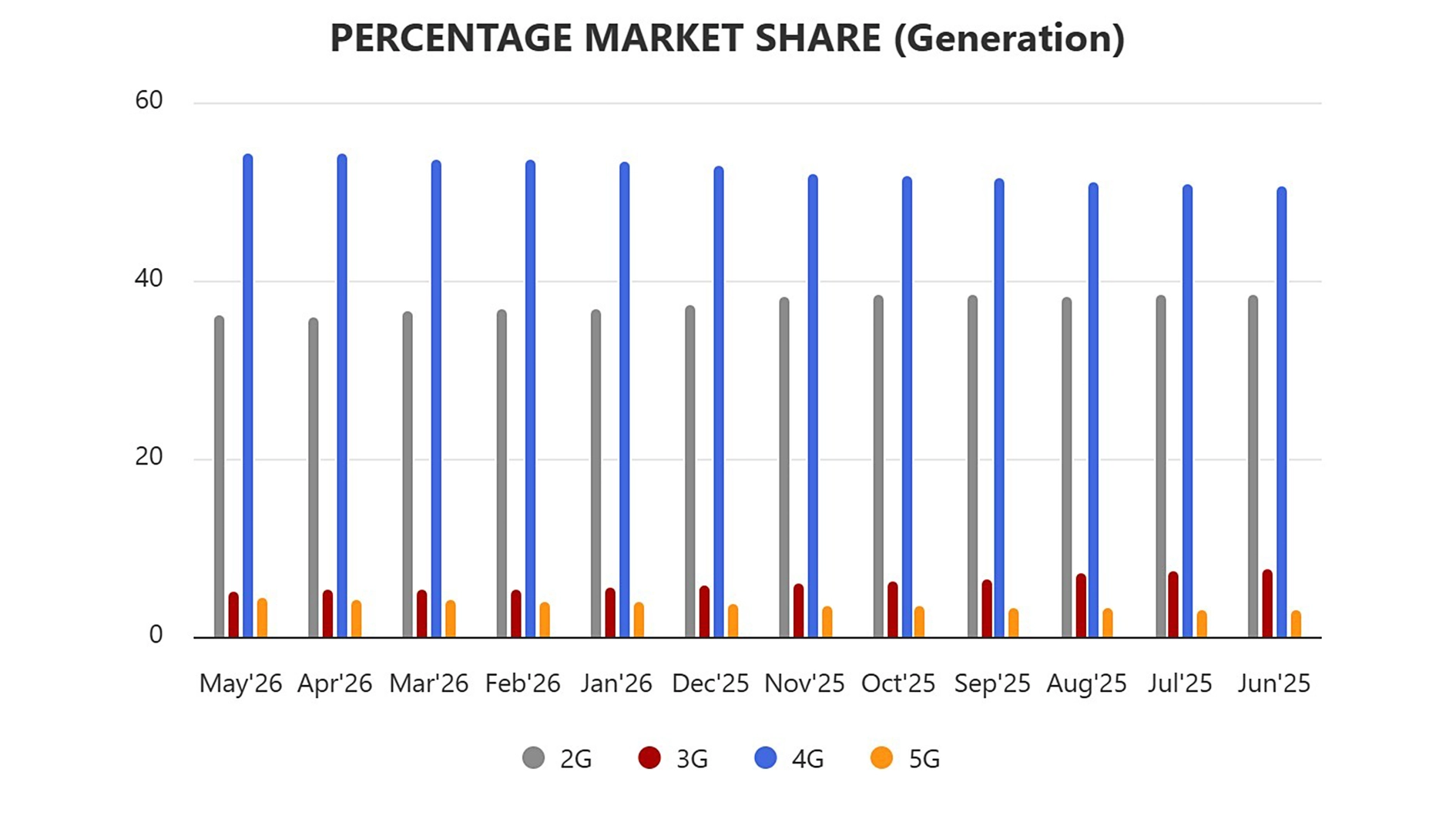
Of the 189 million active telephone users in Nigeria as of May 2026, some 68.5 million subscribers are still on the 2G network.
2G technology refers to the second generation, which is based on GSM. It was launched in Finland in 1991. It uses digital signals. Its data speed was up to 64kbps.
Data from the Nigerian Communications Commission (NCC) showed that four technologies currently dominate the network. These are 2G, 3G, 4G and 5G. It is, however, possible that a subscriber can be on all the networks.
Today, 4G is Nigeria’s leading mobile technology (accounting for over 54 per cent of total connections), but 2G remains the second-largest generation due to legacy feature-phone usage and voice-only rural coverage.
The proportion of 2G subscribers has steadily declined from over 57 per cent in early 2024 to 36.12 per cent in mid-2026 as operators expand 4G and 5G coverage and smartphone access improves.
For emphasis, 2G is the second generation of wireless networks designed to improve on analogue with digital circuit-switched solutions.
Meanwhile, a leading operator in the country has disclosed plans to phase out 3G technology.
Speaking with The Guardian, a very senior official of the telco said: “5G is the future. It is part of the present and immediate future because of the speed it brings for broadband services. Luckily, MTN became the first operator to embrace 5G and went for its license. We have the highest number of 5G rollouts in the country today and we shall continue to invest in the infrastructure. I know that it is imminent that networks, especially those in the 3G areas, might decommission them soon to concentrate on 4G and 5G networks; this move will boost quality of experience.
“If you read our half-year report, you will find out that data has overtaken voice in terms of revenue generation. We expect that to continue. Embedded in data is also voice because when you are making your calls by using WhatsApp, it is actually data. That is voice riding on data. So, it is all coming together; at the end of the day, 5G will continue as we plan more expansion for the technology.”
Checks showed that nations adopting 5G are dismantling older mobile networks, with many carriers already dropping 3G and planning to retire 2G over the next decade, while keeping 4G in place as a bridge to 5G.
The U.S. shut down 3G nationwide in 2022, and most major carriers ended 2G by 2025, clearing spectrum for faster services. Canada wound down 2G already and closed 3G in 2025.
Several European countries are moving on similar timelines but with differing priorities. The UK plans to turn off both 2G and 3G by 2033 to focus fully on 5G.
Germany, one of Europe’s largest mobile markets, ended 3G in 2021 and will drop 2G by 2028. Due to its widespread coverage and low power consumption, countries like Germany opted to discontinue their 2G services later than 3G. France will keep 2G until the end of 2026 and 3G until the end of 2029.
Elsewhere in Europe, carriers in Czechia, Denmark, the Netherlands, Italy, Greece, and Hungary have already shut down large parts of their 3G networks, with most European nations targeting full 2G closures by 2030.
Japan, an early adopter, ended 2G in 2012 and is phasing out 3G, with some carriers expected to switch off remaining 3G coverage by the end of 2026. China, the world’s biggest mobile market with over 1.3 billion users, is steadily dismantling 2G and 3G, which now account for less than one per cent of subscribers.

