 Follow Us on Google News
 Follow Us on Google Discover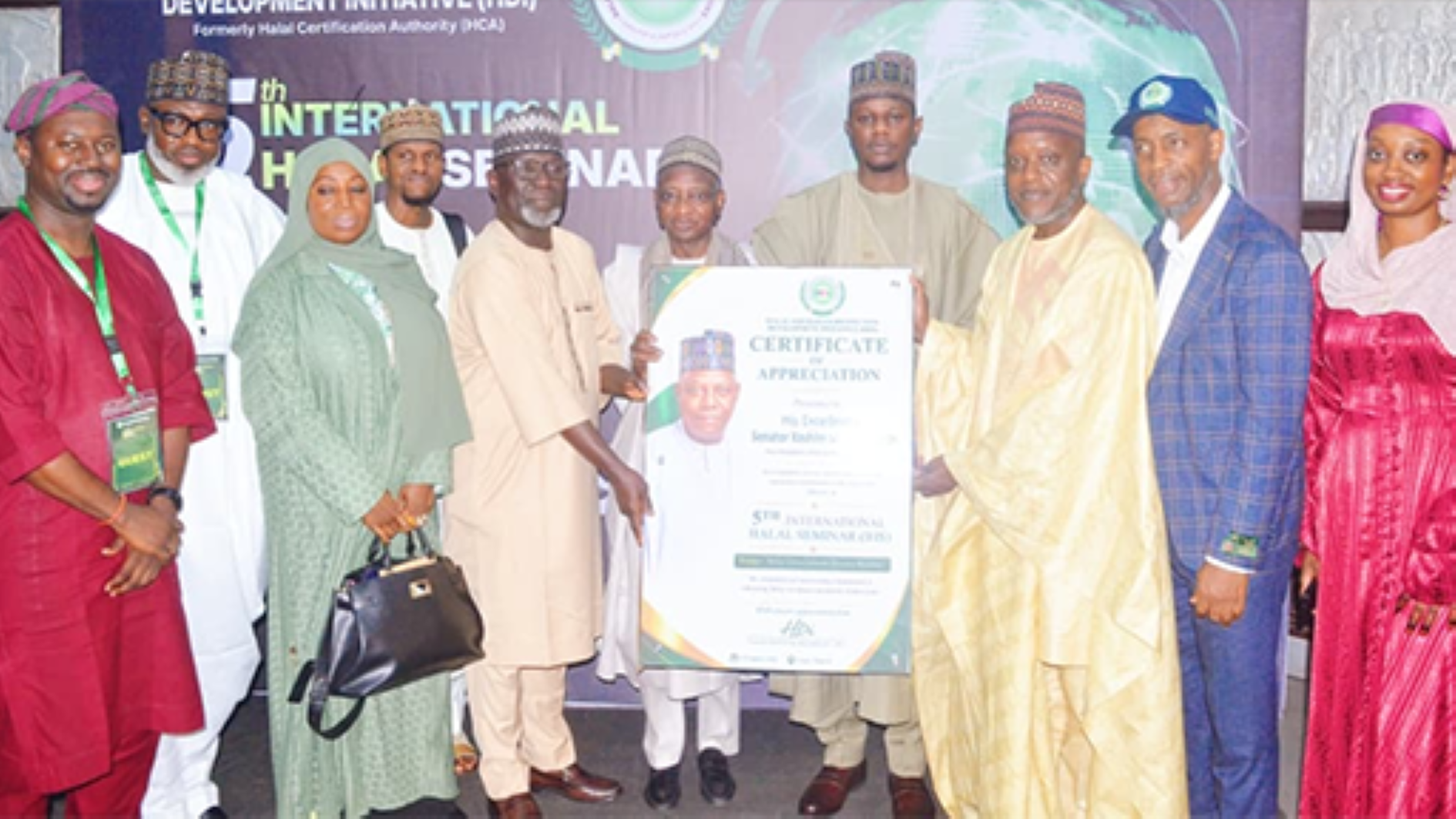
Vice President Senator Kashim Shettima has called for concerted efforts to transform Nigeria’s domestic Halal market valued at over $100 billion into a robust driver of exports, foreign direct investment, job creation and foreign exchange earnings.
Speaking at the 5th International Halal Seminar held at NECA House, Alausa, Ikeja, Lagos, Shettima decried Nigeria’s status as the world’s seventh-largest Halal economy, yet the country currently accounts for less than one per cent of the global Halal market.
Represented by his Special Assistant on Export Expansion, Mr. Aliyu Bunu Sheriff, the Vice President noted that while Nigeria possesses the population, natural resources and growing consumer demand to become a dominant player, structural deficits continue to bottleneck its potential. He highlighted the urgent need to strengthen production, certification, financing, infrastructure and international market access.
The event, organised by the Halal and Haram Distinction Development Initiative (HDI) under the theme “Halal Development Beyond Borders,” drew government officials, financial institutions, academics and international experts to chart a strategy for expanding Nigeria’s global footprint.
Delivering the Vice President’s address, Mr. Sheriff observed that much of Nigeria’s Halal economic activity remains informal and confined within domestic borders.
“Most of our activities are informal. So now we’re trying to see how we can capture a greater share of this burgeoning market,” Sheriff said, stressing that the country’s current market share is vastly disproportionate to its internal capacity.

He identified the African Continental Free Trade Area (AfCFTA) as a pivotal vehicle for Nigerian producers to capture regional value chains and establish the nation as a commercial gateway. Under the National Halal Economy Strategy launched on February 5, 2026, the Federal Government aims to link local businesses with international buyers, particularly across the Gulf Cooperation Council (GCC) countries.
To scale the sector, the presidential aide advocated for organised industrial clusters and affordable capital. He revealed that 13 industrial clusters have been identified for implementation, supported by planned logistics corridors connecting production hubs to seaports and airports.
“The SMEs need cheap capital, either grants or even interest-free loans,” Sheriff added, urging stakeholders to look beyond food to high-yield sectors such as Islamic finance, agriculture, livestock, fashion, tourism and aviation.
In his opening remarks, the Chairman of HDI, Professor Ibrahim Oreagba, commended the Federal Government’s establishment of the National Halal Economy Strategy Implementation Committee.
Marking the organization’s 10th anniversary as a certifying body, Prof. Oreagba announced the strategic rebranding of the Halal Certification Authority (HCA) to the Halal and Haram Distinction Development Initiative (HDI). To date, the body has certified over 130 companies and 600 products spanning pharmaceuticals, cosmetics, logistics, and food processing.
Addressing common misconceptions, Oreagba emphasised that Halal extends beyond religious compliance to encompass universal standards of safety and quality. “Halal is not only about religion. It is also about hygiene. It is also about wholesomeness of food materials. So, it is a double guarantee of quality,” he said, citing non-Muslim majority nations like Brazil and India that currently lead global Halal meat exports.
Contributing to a panel discussion, the Vice Chancellor of Summit University, Offa, Professor Abiodun Musa Aibinu, urged Small and Medium Enterprises (SMEs) to diversify beyond agro-processing into technology, digital services, education and finance.
He also advocated for incorporating Halal literacy into academic curricula and leveraging indigenous languages alongside digital platforms to engage younger demographics.
The Special Guest and Chairman of the Bank of Industry (BOI), Dr. Mansur Mukhtar, praised HDI for fostering institutional dialogue aimed at export readiness and capacity building. Similarly, Mrs. Olutope Adetona, Compliance and Ethics Manager at Rite Foods Limited, noted that rigorous Halal certification provides a vital badge of consumer confidence and regulatory compliance for manufacturers targeting international expansion.

