 Follow Us on Google News
 Follow Us on Google Discover
After building a fast-growing cross-border financial app used across African markets and the United States, Spendin is opening its underlying payment infrastructure to banks, fintechs, remittance companies and mobile money operators.
Spendin Africa has launched Spendin Alpha API 1.0, opening the infrastructure behind its cross-border payments ecosystem to financial companies looking to move money across Africa and globally through a single integration. The launch comes just 11 months into Spendin’s consumer journey, during which the fintech has grown to thousands of users across Nigeria, South Africa, Kenya, Ghana, other African markets and the United States.
Often described by users and industry observers as an emerging “Revolut of Africa,” Spendin is now widening its ambition beyond building a consumer financial app. It wants other financial companies to build on the same infrastructure.
One integration for moving money across markets
Cross-border payments remain notoriously fragmented across Africa. A fintech company expanding into multiple markets may need to integrate separate providers, prefund different accounts, manage FX and liquidity independently, and maintain different payout infrastructure in each country.
Spendin Alpha API is designed to hide much of that complexity. Through a single integration, banks, fintechs, remittance companies and mobile money operators can initiate cross-border payouts into local bank accounts and mobile money wallets, settle using USDT or NGN and access liquidity without maintaining a prefunded Spendin balance.
Spendin handles the FX and local payment infrastructure underneath while also automating the payout lifecycle, including transaction processing, retries, status updates and webhooks.

Co-founder and Chief Operating Officer of Spendin, Heritage Falodun, said financial companies often face fresh payment challenges whenever they expand into another country.
“Financial companies should not have to rebuild payment infrastructure every time they enter a new African market,” Falodun said.
“We have spent the past 11 months building and operating these rails through our own consumer product. Spendin Alpha API is us beginning to make that infrastructure programmable for other companies.”
The API is only the first version of a much broader infrastructure strategy. Spendin says future releases will expand into Treasury, Collections, Disbursements and Wallet Infrastructure, giving businesses additional rails for building and scaling financial products across African markets while connecting into global financial networks.
Eleven months of building around real payment problems
Spendin’s rapid expansion may appear unusual for a company less than a year into its consumer journey, but its founders did not enter financial technology for the first time with Spendin. The founding team brings more than 14 years of combined experience across finance, digital currencies, payments, financial technology and technology product development.
That experience is increasingly visible in the pace at which Spendin has approached problems that remain difficult across African payments: fragmented currencies, cross-border settlement, stablecoin liquidity, local payouts and the challenge of making money usable across different markets without forcing customers to understand the infrastructure underneath. Rather than building isolated features, Spendin has focused on solving problems emerging directly from how its customers use money.
That approach is also shaping its consumer application. Spendin recently introduced Payment Links and Invoice features for users in Nigeria, South Africa, Kenya and Ghana following feedback from customers who wanted simpler ways to pay or receive money when interacting with supermarkets, merchants, stores and businesses.
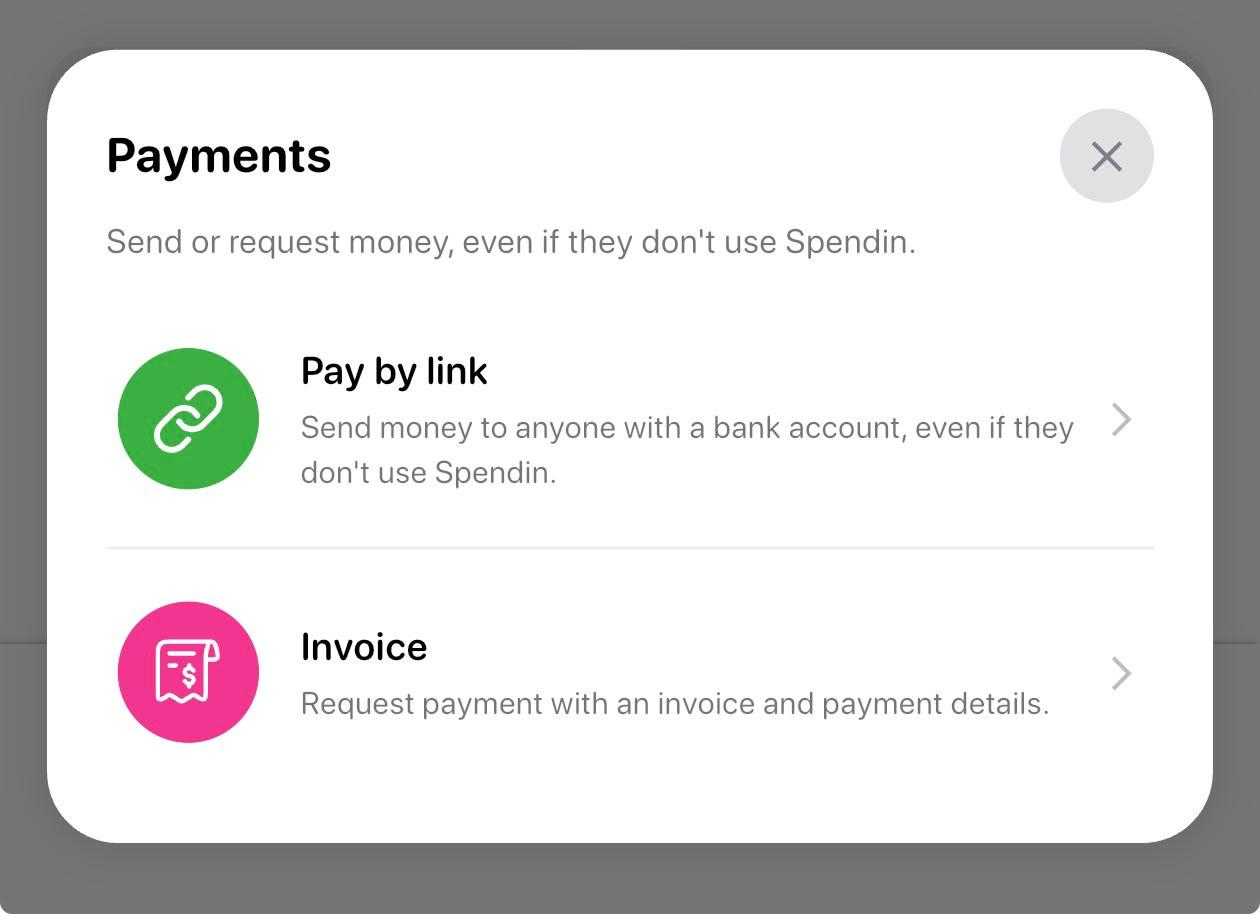
The addition reflects a recurring pattern in Spendin’s development: customer behaviour identifies the problem, while the company’s infrastructure is expanded to solve it at scale.
The consumer app and API are becoming two sides of the same company
Spendin’s strategy increasingly resembles a two-layer financial platform. On one side is the consumer product, giving users access to cross-border payments, local currencies, stablecoins and other financial services through a single experience. On the other is Spendin Alpha API, which makes parts of the infrastructure underneath that experience available to other financial companies.
A customer moving funds across markets through Spendin exposes the company to many of the same underlying problems a remittance company or fintech faces: sourcing liquidity, calculating FX, selecting payment rails, completing the local payout, handling transaction failures and reconciling settlement. Spendin’s consumer application therefore acts not only as a product but also as a proving ground for the infrastructure it is now opening to businesses.
Why the “Revolut of Africa” comparison is getting louder
Revolut began by simplifying foreign exchange and international spending before expanding into a much broader global financial platform spanning banking, payments, cards, investments and business financial services. Spendin is pursuing a similarly expansive direction, but from the realities of African financial markets. In just 11 months, it has moved from a cross-border consumer product toward a wider ecosystem covering multi-currency transactions, stablecoin settlement, African payout infrastructure, merchant payment tools and now programmable B2B payment rails.
The comparison is not about suggesting that an 11-month-old African fintech company has already reached Revolut’s global scale. It is about the product direction: bringing financial services that are usually fragmented across several providers into one connected platform.
Its co-founder and Chief Executive Officer, Timilehin Kayode, said the company planned to build a wider financial system beyond its consumer payment application.
“Our goal is bigger than building another payment application,” Kayode said.
“We are building a financial infrastructure layer that can understand liquidity, FX, local payment methods and settlement across markets, while making all of that complexity feel simple to the company or consumer using Spendin.”
From moving money for users to powering companies that move money
Africa remains one of the world’s most fragmented financial environments, with dozens of currencies, banking systems, mobile money networks, liquidity markets and regulatory regimes operating across borders. Spendin sees that fragmentation not simply as a payment problem, but as an infrastructure opportunity. For consumers, its ambition is to make spending and moving money across markets feel increasingly local. For businesses, Spendin Alpha API is designed to reduce the number of integrations, settlement relationships and infrastructure decisions required to launch financial products across multiple markets.
And for Spendin, the API represents an important transition. The company that began by helping people spend and move money across Africa now wants to become part of the infrastructure through which other companies move it. With thousands of users, an expanding African footprint, customers in the United States and more than 14 years of combined experience behind its founding team, Spendin is attempting to compress years of fintech expansion into its early stage.
Eleven months in, its ambition is becoming difficult to miss: build the financial product Africans want to use and the infrastructure other financial companies want to build on.

