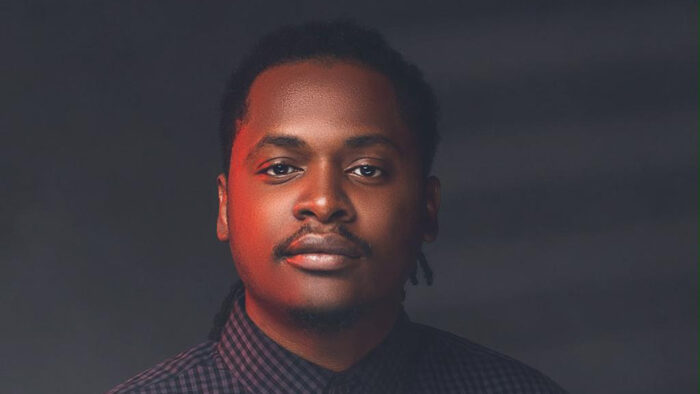

Caleboniel entered the world enveloped by sound, navigating an environment that operated as a bustling breeding ground for entertainment talent where stepping outdoors meant walking directly into a wall of music emitting from roadside speakers.
“Imagine me stepping out of my parents house and I’m on the road and every shop, almost every shop has speakers,” he recalls, noting how early exposure laid the foundation for his sonic awareness. “I wake up in the morning, there’s music. I’m stepping on this music, you know. On Saturdays too, I used to follow my siblings for choir practice before church on Sunday so they minister or sing for the congregation. That’s where the exposure started from.”
While attending church services with his family, his attention consistently drifted away from vocal ministry and toward the rhythm section. A steady fascination with percussion led him to create his own informal setup at home whenever church leaders prohibited him from touching the formal kit.
“I just had a weird obsession with the drums for some reason. I don’t know why I was always making drum sounds in my mouth. They wouldn’t let me play the drums when I was young in church. I’ll go back home and turn the buckets upside down and just play drums. I’ll break the cane in the house and just use it for drumsticks,” he said.
His musical background expanded when his family relocated to Ikorodu, putting him in close proximity to a community of emerging creators, including a young Zlatan who frequently visited to share early tracks. Formal education provided structured outlets through saxophone training, though he actively pushed himself to learn additional instruments independently.
“I learned to play the saxophone. Then I learned the keyboard by myself. Like I told myself I’m self taught on that aspect then the guitar as well,” he says.
The end of high school brought an extended period of solitary reflection that proved crucial to his creative development.
“I spent a lot of time by myself. I’m of the opinion that when you spend so much time by yourself, you know what works for you and what doesn’t.”
During this phase, he began writing songs to give voice to his personal experiences, relying heavily on radio broadcasts like Douglas Jekan’s PGM show on Beat FM while studying artists like Nonso Amadi, John Bellion, Johnny Drille and Miguel. Early attempts to collaborate with local musicians proved difficult, as peers struggled to play key patterns that matched the vocal melodies he constructed.
“I just knew at that point in time if at all I was going to do this, I knew that I was not going to be the same with every other person that makes music. Because people try to play what I’m singing and they cannot. After secondary school, I started nurturing this talent. I didn’t even think about it as a professional thing. I was just writing just to cover some songs, nothing serious.”
The transition from casual songwriting to a dedicated career path required time and intentionality. “I decided to pursue it professionally in 2020, but I was not really serious. I was just recording music just to see what I can do with it. But in 2023, I decided to pursue it professionally. But before then I was just writing songs for people.”
His behind-the-scenes contributions included work with PDSTRN on the Souls in EP.
His official debut as a primary artist arrived via the two-part single “Heart2Art,” following uncredited appearances on collective tapes. His output avoids rigid genre boundaries, reflecting a diverse palette that encompasses Afrobeats, Afro-pop, R&B, hip-hop, alternative R&B, and rock.
“It gave me room to fuse genres, actually. Because as much as you say, my sound is not Nigerian, the songs that I’ve been writing with people are not necessarily the genres I’m making. The exposure to every genre of music is actually equal. All these come out to play when I’m not making songs for myself and even when I’m making songs for myself.”
This fluid creative mindset directly influenced his single “Confessions,” a track born from spontaneous studio experimentation alongside his producer.
His process relies heavily on testing whether a melody can survive purely inside his memory before committing it to tape. “How I know I like a song that I’m writing is when I don’t record it. When there’s no record of me being able to remember it in any way aside from my mind; that’s how I know that song. I like it and I’m going to drop it.”
Influenced during that period by the R&B sound of Rags Original, “Confessions” allowed him address personal boundaries and interpersonal dynamics.
“I had some stories that I needed to say about friendship and relationships and that I needed to let off my chest. It’s just like someone makes it easy for me to say things that I don’t want to say. Those qualities and those values are what you can hear on the song.”
Following this single, his release strategy centers on a three-pack project that acts as an introductory bridge toward future long-form projects.
“The project is going to come afterwards, to be honest. But I wouldn’t say it’s really building. So it’s just giving people something to hold on to before the project comes,” he said, describing the drop as a layered compilation. “It’s a sandwich actually because like there’s so many things inside it, so many different genres. It screams focus on mission, you know, priorities to be honest and like values at the moment.”
While figures like Wizkid, John Mayer and Odunsi inspired him early on, his current writing draws primarily from his immediate surroundings rather than external musicians.
“Life as a Nigerian is enough to inspire you as a creative person. Messy and beautiful things are happening out there at the same time. But what keeps me grounded is just living life as a Nigerian man.”
Known as Caleboniel, the moniker ties directly to his personal history, derived from his full name, Toluwalase Oluwatomi Omoyeni, where the name merges his given name Caleb with the initials of his other names.
His stage delivery draws from over a decade of live performance experience, beginning at age eleven when he played saxophone in an orchestra in front of thousands.
As his perspective evolves, he aims to write for stars like Wizkid, Davido, and Burna Boy, aiming ‘to take them out of what they usually do,’ while targeting artistic collaborations with figures like Daniel Caesar, John Bellion and Lenny Kravitz based on shared creative philosophy.