 Follow Us on Google News
 Follow Us on Google Discover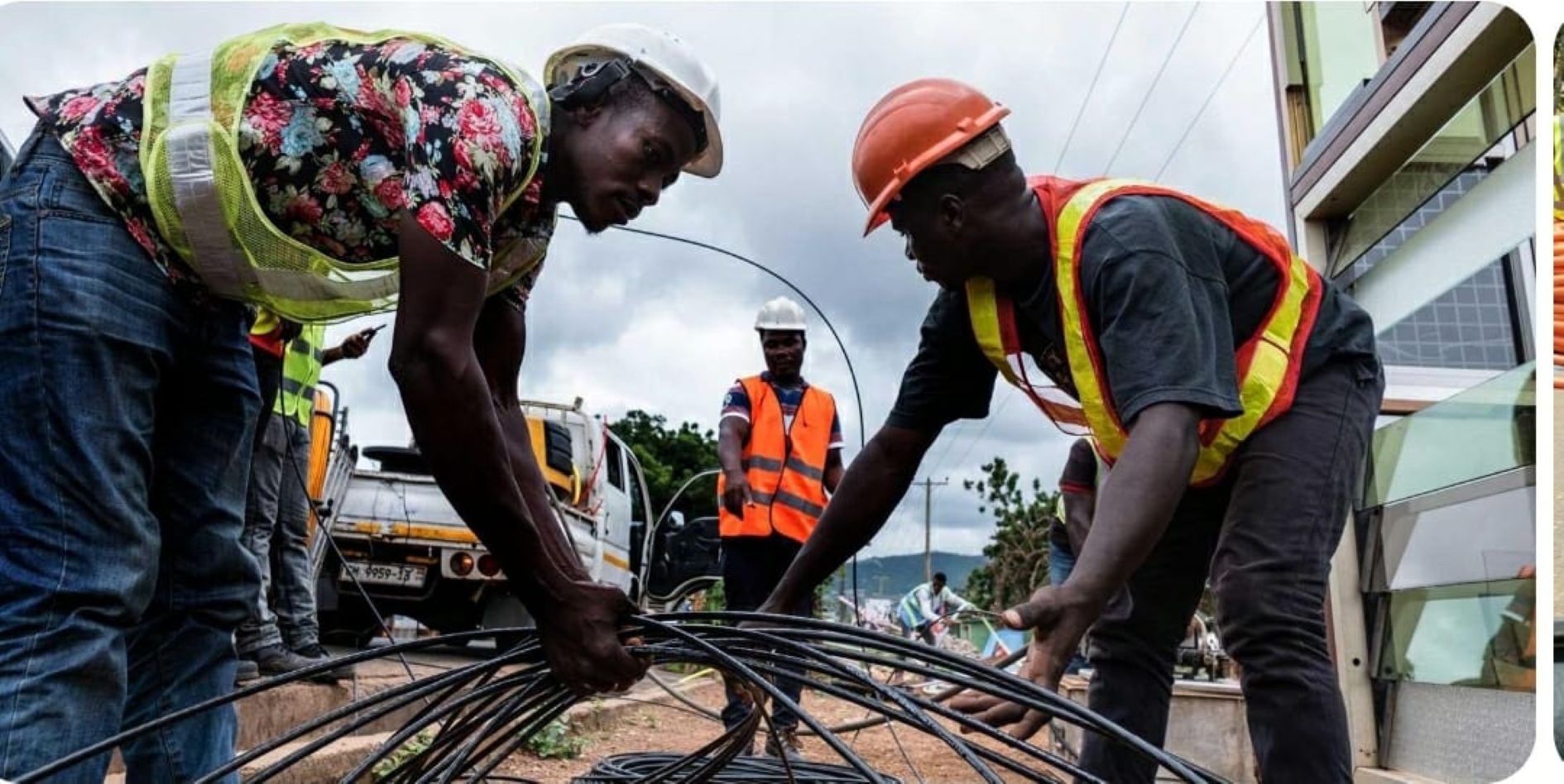
Nigeria has more than 192 million active telephone subscribers, its largest-ever recorded total and a figure the Nigerian Communications Commission confirmed in its July 2026 industry statistics. Operators added 12.8 million new SIM cards in the first seven months of 2026 alone. Yet fibre-to-the-home connections across the entire country stood at 319,735 at the end of the second quarter of 2026, according to the same NCC data. That means fewer than 320,000 households in Africa’s most populous nation have a fixed broadband cable running to their front door. The two numbers placed side by side describe not a digital economy but a digital dependency: an economy built almost entirely on mobile signals that, when disrupted, takes down banking, commerce, logistics and healthcare with it.
The data consumption figures make the scale of this structural imbalance vivid. Nigerians consumed 10.2 million terabytes of data in the first seven months of 2026, an average of more than 48,000 terabytes per day, driven by video streaming, mobile banking, remote work and fintech adoption. MTN Nigeria’s active data subscribers reached 55.7 million, with average monthly usage per subscriber climbing to 14.8 gigabytes. Airtel Nigeria reported a 30.8 percent increase in average customer data usage to 11 gigabytes per month, and data revenue grew 38 percent year on year to N691 billion, making Nigeria Airtel Africa’s most important single market. Together, MTN and Airtel generated N2.4 trillion in data revenue in the first half of 2026. This is demand that has long outpaced the physical infrastructure beneath it. The telecom sector contributed 9.72 percent of Nigeria’s real GDP in the second quarter of 2026, growing at 10.38 percent year on year, more than twice the pace of the broader economy.
Within the narrow fixed broadband market that does exist, concentration is extreme. MTN FibreX held 176,468 of the country’s 319,735 fibre connections in Q2 2026, representing 55.2 percent of the entire national FTTH market. FiberOne Broadband followed with 56,486 connections, and ipNX ranked third with 14,698. The three operators together controlled approximately 77.5 percent of all fibre subscriptions in the country. Airtel, which only recently entered the wired broadband segment, recorded 4,417 connections. MTN launched FibreX in April 2025 as a direct response to Starlink’s growing presence, and the product’s subscriber acquisition pace has since far exceeded any rival fixed operator. Despite that momentum, MTN’s total FTTH base of 176,468 connections, placed against the country’s estimated 45 million households, represents a residential penetration rate of well under one percent. The NCC’s executive vice chairman, Dr Aminu Maida, has acknowledged that Nigeria’s FTTH penetration remains below the African average of 2.6 percent and far behind global markets where FTTH penetration averages 47 percent.
The physical barriers to closing that gap are formidable and, in the view of operators, largely state- made. Nigeria’s National Economic Council established a harmonised right-of-way charge of N145 per linear metre in 2020 to replace the inconsistent cost structures that were adding up to 70 percent ofbtotal fibre deployment costs. Six years on, a BusinessDay investigation published on 26 August 2026 found that the policy has been routinely subverted. States including Kano charge N2,754 per linear metre, Delta N2,706, Rivers N2,256 and Ogun N6,600. Other states nominally adopted the N145 rate but layered application fees on top of it: Ekiti charges N700,000 in application fees, Taraba N350,000, Cross River N250,000 and Adamawa N100,000 even after waiving the per-metre charge entirely.
Gbenga Adebayo, chairman of the Association of Licensed Telecom Operators of Nigeria, said the problem has gone beyond headline rates. “Some states, for example, will tell us right-of-way is zero, but you have to pay a developmental levy per linear metre” he told BusinessDay.
“Some states have become commercially unattractive because of both the cost of right-of-way and the way approvals are handled”, Adebayo added that operators face a further layer of educational environmental, effluent discharge, capital deployment and application fees in some states that make the final cost of a single fibre route difficult to budget before work begins.

Even where operators clear the regulatory cost hurdles and successfully lay cable, the infrastructure faces destruction at rates that make sustained network expansion extremely difficult. The NCC disclosed in August 2026 that more than 5,000 fibre-optic cut incidents had been recorded across Nigeria in the first six months of 2026, the majority caused by road construction, excavation and civil works. Dr Aminu Maida of the NCC put the human meaning of each incident directly: “To a machine operator on a construction site, it may appear to be a simple buried cable. To the nation, it can mean failed calls, delayed payments, interrupted services and missed opportunities.” The industry-wide picture is starker still.
According to NCC data reported by Punch, operators recorded 155,397 fibre-cut incidents in April and May 2026 alone, with vandalism accounting for more than 54,000 of those incidents. In Q1 2026, operators logged 577 major network outages across 11 licensed entities, with fibre cuts causing 361 of them. MTN Nigeria’s chief technical officer, Yahaya Ibrahim, said the pace of destruction has no parallel in comparable markets: “In some countries, you can go a whole year without a single fibre cut. Here, we had nearly 400 in one month. It is completely unsustainable.”
The financial toll of this destruction is not abstract. Industry estimates place the combined annual cost of fibre-related disruptions at between N27 billion and N35.4 billion when direct repair costs, lost revenue and operational disruption are included. Direct repair costs alone exceed N14 billion every year. MTN budgets approximately N7 billion annually just for fibre relocation caused by road works and vandalism. In 2025, MTN recorded 452 incidents of site vandalism, an average of more than one telecom site attacked every day. Airtel Africa’s chief executive, Sunil Taldar, framed the power dimension directly: “We are delivering a network, but we are also becoming power generators. That’s not our core job.” Airtel runs most of its Nigerian sites on diesel, at nearly four times the operating cost of grid-connected sites. This is money being consumed by environmental disorder rather than directed toward the last-mile infrastructure that millions of Nigerians still cannot access.
MTN’s communications chief, Tobechukwu Okigbo, described the operating environment plainly: “We face Nigerian realities. Power infrastructure challenges, multiple taxation, vandalism, right-of-way issues, fibre cuts, security concerns and rapid population growth all affect how networks are built and maintained. ”The investment is, nonetheless, real and substantial. Major operators deployed over N1.6 trillion in capital expenditure in the first seven months of 2026 to strengthen tower capacity, expand fibre networks and relieve cell site congestion, according to Guardian Nigeria.
MTN Nigeria’s first-half capex, excluding right-of-use assets, reached N620.5 billion, representing capex intensity of 20.7 percent of revenue. Total service revenue grew 25.9 percent in the first half to N2.97 trillion, and EBITDA grew 39.2npercent. Airtel Africa has guided $1.1 billion in capex for its financial year 2027 across African operations, with Nigeria the primary focus. The paradox, as operators and analysts have repeatedly noted, is that a growing portion of that capital expenditure does not expand coverage. It restores what vandals, road contractors and power failures have already destroyed. Oluseyi Lala, divisional chief executive of ipNX Business, told the Lagos Chamber of Commerce and Industry ICTEL Expo on 7 September 2026 that the sector needs a structural rethink: “f one operator has already deployed fibre along a route, there is little value in having multiple operators excavate the same corridor to install parallel infrastructure” Obinna Adumike, head of converged digital infrastructure for Africa at Open Access Data Centres, went further at the same event: “We should not continue duplicating fibre infrastructure. Open-access and shared infrastructure models make network expansion easier, reduce costs, and improve access.”
The federal government has responded with its most ambitious fibre programme to date. Project BRIDGE, administered through the Federal Ministry of Communications, Innovation and Digital Economy, is designed to deploy at least 90,000 kilometres of fibre-optic cable across all 36 states and the Federal Capital Territory, connecting all 774 local governments and extending Nigeria’s national fibre backbone from roughly 30,000 kilometres to approximately 120,000 kilometres. The African Development Bank approved a $200 million loan to the Nigerian government for the project in April, 2026. The World Bank and the European Bank for Reconstruction and Development are also committed, bringing the sovereign lending component to approximately $800 million of a $2 billion total programme. The project will establish open-access infrastructure with cross-border links to benin, Cameroon, Niger and Chad. Communications Minister Bosun Tijani stepped back from his bid for the ITU Deputy Secretary-General role in September 2026, with BusinessDay reporting that his focus returns to the 90,000-kilometre plan. That decision was broadly read as a signal that the government considers the domestic fibre programme a higher immediate priority than multilateral positioning.
The urgency behind that programme is sharpened by what the connectivity deficit costs the economy in real time. Nigeria’s electronic payment system processed N1.07 quadrillion in transactions in 2024, a figure that divided by 365 yields approximately N2.93 trillion flowing through digital payment rails every single day. In Q1 2026, POS transaction values alone surged 79 percent year on year to N18.78 trillion.
There are 5.56 million deployed POS terminals across the country, every one of which requires a working network connection to function. In this context, Airtel Africa’s Sunil Taldar’s statement at a media roundtable carries weight beyond corporate communications: “Each time when a telecom network comes down, it’s not only the telecom network which is coming down in a particular area, it’s part of the economy which is coming down.” The Punch editorial board, in its 20 August 2026 analysis of the fibre-cut crisis, made the policy conclusion explicit: “Fibre is not optional infrastructure. It is the nervous system of a modern economy. Nigeria cannot build a digital future by repeatedly cutting the cables that make that future possible.”
The NCC introduced a consumer compensation framework in April 2026 for service failures that fall below prescribed key performance indicators, and updated its Quality of Service Business Rules in August 2026 with fines of up to N15 million for non-compliant operators. Meaningful as those steps are, they treat the consequences of disruption rather than itsbcauses, which lie upstream in construction coordination, vandalism prosecution rates, right-of-way enforcement and the grid power deficits that force every major operator to run its network on diesel.

