 Follow Us on Google News
 Follow Us on Google Discover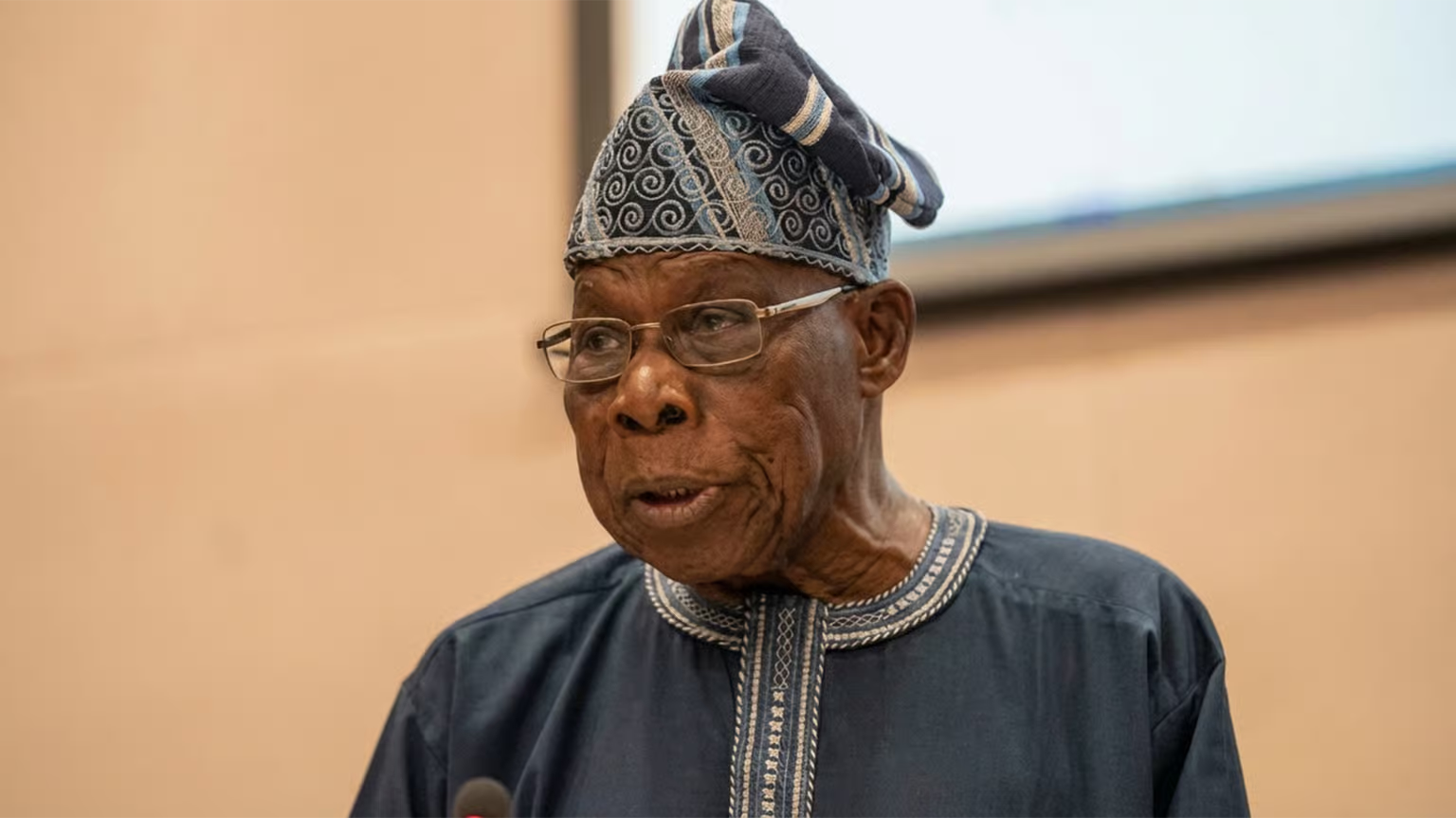
Former President Olusegun Obasanjo, the 15th Emir of Kano, Muhammadu Sanusi II, former Vice President Yemi Osinbajo, and other stakeholders on has called for sustained anti-corruption efforts and far-reaching institutional reforms to address unexplained wealth in Nigeria.
They spoke in Lagos at the public presentation of a three-volume book, Unexplained Wealth: A Trilogy of Nigerian Financial Law, authored by Dr. Wahab Shittu (SAN).
The event brought together legal practitioners, policymakers and stakeholders, who collectively underscored the need for stronger institutions, consistent enforcement of laws and sustained commitment to transparency and accountability in Nigeria.
Obasanjo, in his remarks, described corruption as one of the greatest impediments to national development, warning that no country can make meaningful progress if graft is allowed to thrive.
Tracing his involvement in the global anti-corruption movement, he said his commitment deepened through collaboration with German activist Peter Eigen, with whom he co-founded Transparency International in Germany.
According to him, the organisation was established to confront “grand corruption,” particularly in international financial transactions, adding that initial efforts included seeking support from global figures such as former World Bank president, Robert McNamara, who was initially sceptical about the initiative.

Obasanjo said the organisation later gained global credibility after pushing members of the Organisation for Economic Co-operation and Development (OECD) to abolish policies that allowed companies to claim tax deductions on bribes paid abroad.
“That success showed that corruption could be confronted at the global level.”
Reflecting on his presidency, Obasanjo disclosed that his administration drew from Transparency International’s model laws to establish the Independent Corrupt Practices Commission (ICPC), noting that the bill faced resistance in the National Assembly.
“They sat on the bill for about 18 months because they believed that if passed in its original form, many would end up in prison.”
He added that although the law was eventually diluted, his government strengthened the anti-corruption framework with the establishment of the Economic and Financial Crimes Commission (EFCC).
Obasanjo stressed that corruption disproportionately affects the poor and undermines governance, urging African governments not to allow corruption become a way of life.
“There are countries where corruption is not a way of life. We must not make corruption our way of life.”
Also speaking, Sanusi emphasised that legal reforms alone are insufficient to tackle unexplained wealth without strong political will and an independent judiciary.
He warned that laws would have limited impact if investigators, prosecutors and judges failed to act fairly and transparently.
“No matter how good laws are, they are implemented by institutions,” he said, adding that justice must not only be done but must be seen to be done.
Sanusi decried what he described as selective enforcement of anti-corruption laws, noting that political considerations often determine who is investigated or prosecuted.
“We live in a society where if you have unexplained wealth and the right political cover, nobody asks questions. But if you are on the wrong side of politics, you get into trouble. This must change.”
He commended the author for examining the complexity of illicit wealth, noting that it extends beyond bribery to include inflated contracts, subsidy abuses and other forms of rent-seeking.
Representing Osinbajo, his former Chief of Staff, Ade Ipaye, said Nigeria requires a constitutionally sound framework for recovering stolen assets without criminalising legitimate wealth.
Osinbajo stressed the need for fairness in enforcement, noting that anti-corruption measures must distinguish between illicit enrichment and lawfully acquired assets.
“What we need now most urgently is a clear, fair, and constitutionally sound approach that can recover what was stolen without threatening what was lawfully earned.”
In his review of the book, Prof. Olanrewaju Fagbohun (SAN) warned against treating lack of documentation as automatic proof of wrongdoing, particularly in a largely informal economy.
He said the enforcement of unexplained wealth laws must balance asset recovery with the protection of property rights.
“The absence of an orthodox paper trail does not necessarily establish that wealth was unlawfully acquired.”
Fagbohun noted that the book provides a comprehensive framework for understanding unexplained wealth, covering legal, economic and institutional dimensions, while also interrogating the constitutional limits of anti-corruption enforcement.
In his remarks, the author, Shittu, said the trilogy was designed to help build a system capable of distinguishing legitimate wealth from illicit enrichment.
He emphasised the importance of reliable documentation in combating corruption, warning that weak record-keeping could lead to wrongful suspicion.
“Making wealth, becoming rich, is not a crime. But becoming rich through dubious means is a crime.”
Shittu added that the goal is to create a system where honest citizens can demonstrate the legitimacy of their wealth without being presumed guilty.
“The fight against corruption is won not on the day the thief is convicted, but on the day the honest man is believed,” he said.

