 Follow Us on Google News
 Follow Us on Google Discover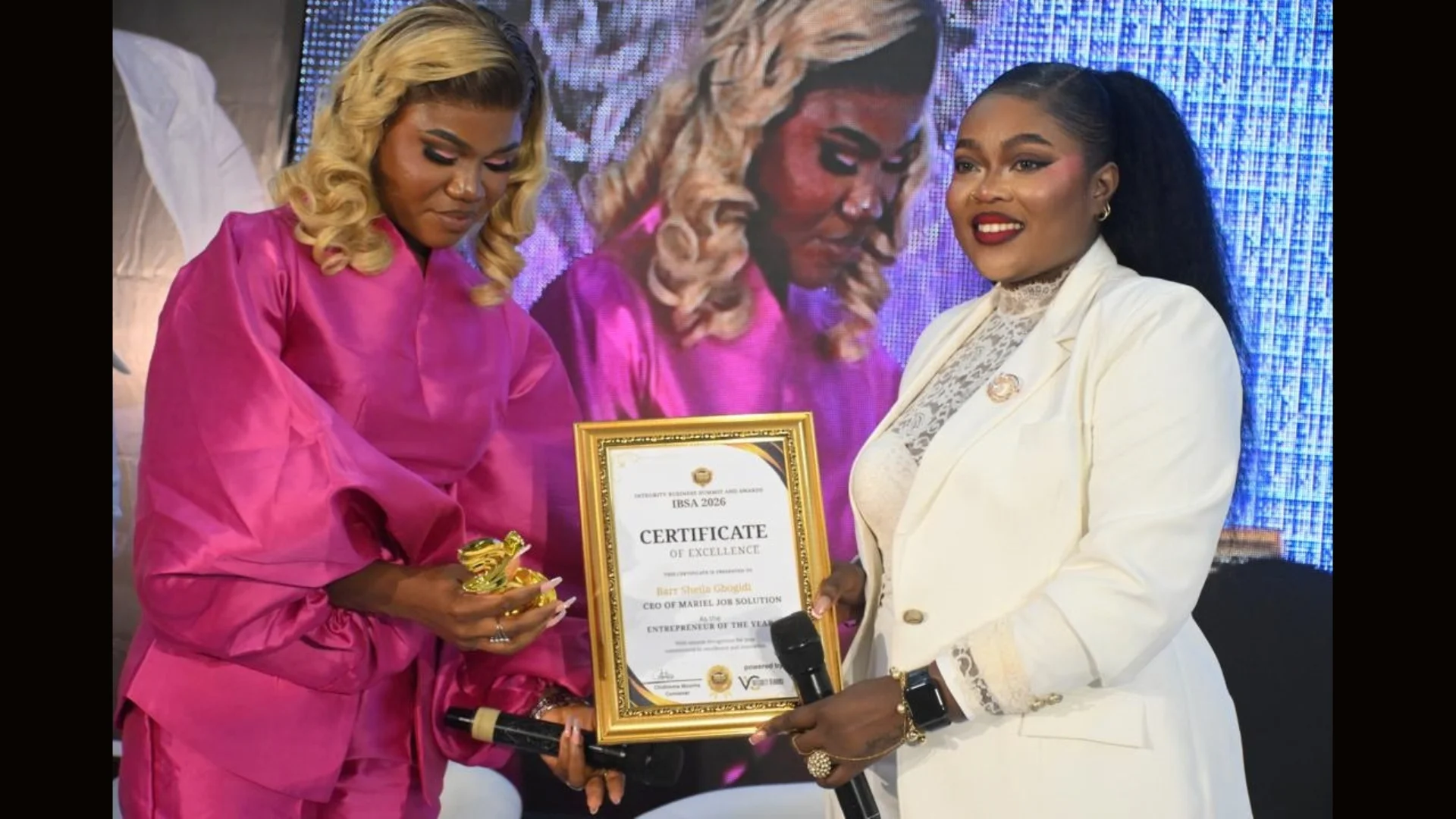
Barrister Sheila Gbogidi has been recognised at the third edition of the Integrity Business Summit and Awards (IBSA) 2026 for her contributions to entrepreneurship and business leadership.
The summit, held on September 19 at the FCT Exhibition Pavilion Centre in Garki, Abuja, brought together entrepreneurs and business leaders for discussions around ethical leadership, business resilience and sustainable growth.
The 2026 edition was held under the theme, “Integrity Under Pressure: Building Honest Businesses in Difficult Times.”
Gbogidi, who also participated as a panel speaker at the event, used the session to address some of the challenges confronting entrepreneurs, including changing consumer behaviour, technological disruption, business expansion, risk and the personal pressures associated with running an enterprise.
She argued that one of the biggest threats to the survival of a business is an unwillingness to change when its operating environment changes.
According to her, financial difficulties can sometimes be temporary, but businesses that consistently fail to respond to changing customers, technology, competition and market conditions risk becoming irrelevant.

Gbogidi said adaptation does not necessarily require significant additional capital.
For entrepreneurs, she explained, it could mean reviewing an existing strategy, acquiring new skills, paying closer attention to customers, adopting appropriate technology or accepting that an approach that previously delivered results may no longer be suitable.
Her comments focused particularly on the importance of building businesses capable of responding to difficult economic conditions without abandoning the foundations required for long-term sustainability.
Gbogidi also cautioned entrepreneurs against pursuing expansion without first developing the systems necessary to support it.
She said business owners should understand their numbers, establish effective processes and build teams capable of carrying increasing responsibilities as an organisation expands.
Rapid growth without those foundations, she argued, could create operational problems rather than sustainable businesses.
For Gbogidi, a successful enterprise should eventually be capable of functioning without its founder personally controlling every aspect of its operations.
The observation touches on a challenge confronting many founder-led businesses, particularly when an enterprise moves from its early stages into a period requiring more formal structures, delegation and management systems.
She encouraged entrepreneurs to think beyond the immediate objective of making a business larger and instead consider whether their organisations are becoming stronger as they grow.
Gbogidi also addressed the role of failure and setbacks in entrepreneurship.
She acknowledged that business owners can lose money and clients, make unsuccessful decisions or recruit people who ultimately prove unsuitable for their organisations.
Such experiences, she said, should become opportunities to reassess decisions rather than permanent definitions of an entrepreneur’s ability.
She identified the willingness to learn and adapt as an important distinction between entrepreneurs who remain trapped by setbacks and those who continue to make progress.
That process, according to her, includes recognising mistakes, adjusting strategies and seeking assistance when necessary.
Gbogidi also drew a distinction between calculated business risks and reckless decisions.
Entrepreneurship inevitably involves uncertainty, she said, but business owners should understand what they are putting at risk, conduct appropriate research and develop a plan before making consequential decisions.
Once those steps have been taken, she added, entrepreneurs must still be prepared to act.
Beyond strategy and business operations, Gbogidi addressed the psychological pressures entrepreneurs can experience as their responsibilities increase.
She spoke about self-doubt and imposter syndrome, noting that professional success does not necessarily eliminate uncertainty.
Entrepreneurs can find themselves questioning whether they are sufficiently capable of taking on a new opportunity even when other people regard them as successful, she said.
Her message to emerging entrepreneurs was that confidence does not always have to come before action.
In some circumstances, she argued, confidence develops after a person decides to act despite uncertainty and subsequently learns from the experience.
Gbogidi encouraged aspiring business owners not to wait until they believe they are completely prepared before taking meaningful steps towards their goals.
Instead, she said they should be prepared to learn, make mistakes and continue developing their abilities.
“Becoming unstoppable doesn’t mean you never experience fear, failure or doubt,” Gbogidi said.
“It means none of those things gets the final say in your story.”
Her participation at IBSA 2026 formed part of wider discussions at the summit about entrepreneurship and maintaining responsible business practices during periods of economic pressure.
The recognition presented to Gbogidi at the event also highlighted her involvement in conversations around entrepreneurship, business leadership and sustainable enterprise development.
Her central message to entrepreneurs was that resilience should not be confused with simply enduring difficult conditions.
For businesses operating in changing markets, she argued, survival and sustainable growth increasingly depend on the ability to learn, build appropriate systems and recognise when it is time to change.

