Follow Us on Google News
 Follow Us on Google Discover
The Head, Institutional Sales, Coronation Asset Management. Akinwale Babafemi, Institutional market perspective, September 2026
The Dangote Petroleum Refinery and Petrochemicals FZE public offer brings an industrial asset of exceptional scale to Nigeria’s equity market. For institutional investors, however, the central question is not whether the refinery is strategically important. It is whether the shares, at the offer price and within the proposed ownership structure, offer appropriate risk-adjusted exposure for a particular mandate.
That assessment requires investors to separate the quality and economic significance of the underlying asset from the valuation, liquidity and governance characteristics of the security being offered. It also requires a clear view of the refinery’s earnings sustainability, leverage, expansion requirements and exposure to commodity, currency and execution risks.
Coronation Merchant Bank is a Joint Issuing House to the Offer, Coronation Securities is a Joint Stockbroker, Coronation Registrars is the Registrar, and the Coronation Wealth platform provides access to an approved subscription channel. This publication is therefore not independent research or a recommendation to subscribe. It presents an institutional portfolio perspective and should be read together with the SEC-approved Prospectus, which remains the primary source of information on the Issuer and the Offer.
The Offer at a glance
Measure Offer information
Offer size Up to 4.1 billion new ordinary shares
Offer price ₦525 per share
Base gross proceeds Approximately ₦2.1525 trillion if fully subscribed
Offer period 14 September to 13 October 2026
Issued shares before the Offer 120,128,915,901 ordinary shares
Approximate shares after the base Offer 124.2 billion ordinary shares
Indicative post-offer equity value Approximately ₦65.2 trillion at the offer price
Immediate offer free float Approximately 3.3% of the enlarged share base
Source: SEC-approved Prospectus dated 7 September 2026. Calculations are based on the base Offer and may differ if the approved oversubscription option is exercised.
The asset and its strategic significance
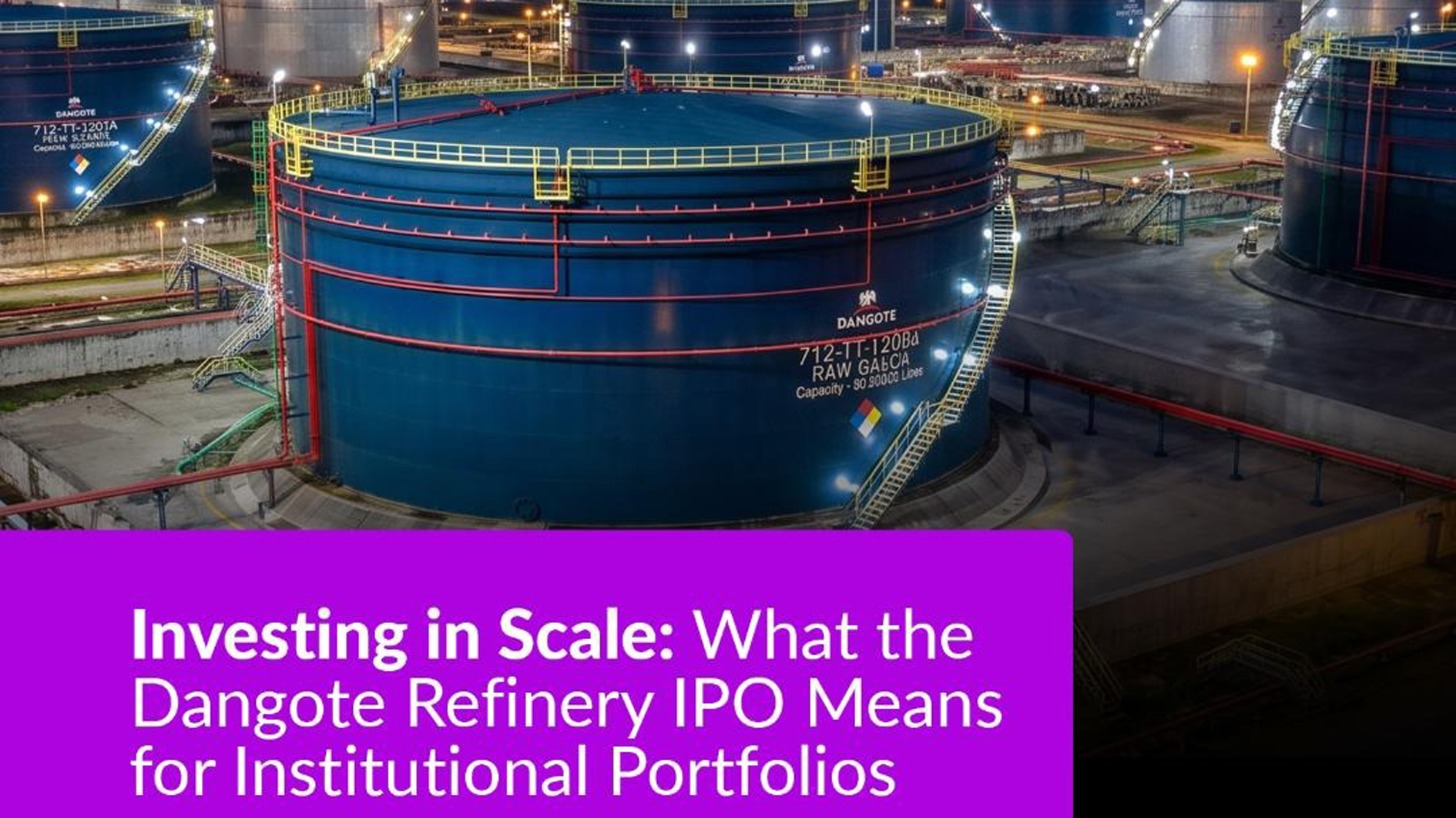
The refinery, located within the Dangote Industries Free Zone in Lagos, represents a capital investment of approximately US$19 billion according to the Prospectus. Its nameplate processing capacity has been rerated from 650,000 barrels per day to 700,000 barrels per day following debottlenecking and operational optimisation.
The Issuer intends to expand capacity to approximately 1.4 million barrels per day through a second crude distillation unit and associated processing units. The Prospectus targets approximately 1.4 million barrels per day by 2029, and completion of the broader expansion programme by 2030. These targets remain subject to regulatory approvals, financing availability and the timely execution and commissioning of the required facilities.
At this scale, the refinery sits at the intersection of energy, manufacturing, logistics, trade and foreign exchange flows. It can influence the availability of refined petroleum products and Nigeria’s position in regional and international product markets. These characteristics make the asset economically significant, but strategic importance alone does not establish the value or suitability of its shares.
Operating performance and earnings quality
The Prospectus reports revenue of ₦19.15 trillion and profit after tax of ₦2.504 trillion for the six months ended 30 June 2026, compared with a loss after tax of ₦723.1 billion for the 2025 financial year. In US dollar terms, H1 2026 profit after tax was US$1.821 billion. The improvement reflects the ramp-up of operations and provides evidence of the operating asset’s earnings potential.
Institutional investors should nevertheless avoid treating one half-year period as a steady-state earnings base. Refinery earnings can vary materially with throughput, plant availability, crude sourcing and pricing, product yields, regional demand, freight differentials, refining margins, financing costs and exchange rates. Investors should therefore test the reported performance against normalised operating assumptions rather than extrapolate it without adjustment.
Valuation requires more than a headline multiple
At ₦525 per share and approximately 124.2 billion shares after the base Offer, the indicative post-offer equity value is approximately ₦65.2 trillion. A simple annualisation of H1 2026 profit after tax implies an indicative price-to-earnings multiple of approximately 13 times. That calculation is a reference point, not a forecast or a complete valuation.
A robust institutional assessment should consider whether H1 2026 earnings are representative, how much debt and other claims sit ahead of equity, the funding structure of the expansion programme and the returns expected from the additional capacity. It should also test the equity value under different assumptions for utilisation, refining margins, crude costs, exchange rates, interest expense, maintenance shutdowns and capital expenditure.
The offer price should therefore be evaluated through a range of methods, including normalised earnings, cash flow and enterprise value measures, and compared with relevant refining and integrated energy peers after adjusting for differences in leverage, geography, growth, governance and currency risk. The refinery’s scale may justify strategic interest; it does not remove the need for price discipline.
Portfolio relevance
Diversification and productive economy exposure
The shares could give institutional portfolios exposure to a large industrial and energy business whose drivers differ from those of sovereign fixed income and financial-sector equities. For mandates with significant concentration in government securities, this may broaden participation in Nigeria’s productive economy. The diversification benefit, however, depends on the investor’s existing exposures and on how the security behaves under stress. A new sector label does not automatically produce effective diversification.
Growth and investment horizon
The proposed expansion offers a potential long-term growth pathway, but it also introduces construction, funding, and commissioning risk. Investors with long-duration liabilities may be better placed to absorb the time required for expansion, provided the allocation remains consistent with their liquidity needs and risk budgets.
Concentration and mandate fit
The Issuer’s large market value could make the shares significant within domestic equity benchmarks and portfolios. Institutions should nevertheless set position sizes by reference to mandate limits, liquidity, downside tolerance and total exposure to the energy value chain. The company’s economic importance should not substitute for portfolio-level concentration discipline.
Liquidity and free float
The 4.1 billion shares offered represent approximately 3.3% of the enlarged share base under the base Offer. Although the Prospectus records a recently completed private placement of 7,148,146,671 shares within the pre-offer issued capital, those shares are subject to a 365-day lock-up from allotment. They are not part of the tradable free float at listing.
The relatively limited immediate free float may constrain secondary-market liquidity and price discovery, particularly for institutions seeking to build or exit large positions. It could also increase sensitivity to order flow and make quoted prices less representative of the price available for institutional-size trades.
When the private-placement lock-up expires, those shares may become transferable. Still, transferability should not be treated as certainty that the shares will be sold or that they will immediately contribute to effective market liquidity. Investors should monitor the final allotment, shareholder distribution, trading volumes, bid-offer spreads, and the evolution of the public float after listing.
Index inclusion is not automatic
The NGX maintains indices used for benchmarking and investment management. Eligibility and inclusion depend on the applicable methodology, which may consider market capitalisation, investable free float, liquidity and trading history. The Issuer’s scale may make future index relevance possible, but investors should not assume inclusion at listing. Passive and benchmark-aware investors should assess timing and methodology risk separately from the investment case.
Regulatory and Sharia considerations
Under PenCom’s Revised Regulation on Investment of Pension Fund Assets, pension fund assets may be invested in ordinary shares of listed companies, subject to the applicable eligibility requirements and investment limits. PenCom’s Addendum dated 25 March 2026 revised the limits for ordinary shares under RSA Funds I, II, III and VI Active. For a PFA, listing does not create automatic investability: any allocation must comply with the relevant fund, issuer, asset class and internal risk limits.
The Prospectus states that Buraq Capital Limited, the appointed Shariah Adviser, assessed the Issuer and the Offer against AAOIFI Shariah Standard No. 21, and that the Offer received certification from the Central Bank of Nigeria’s Financial Regulation Advisory Council of Experts. This may bring the shares within the investable universe of eligible non-interest mandates, subject to each investor’s governing documents, screening process, and continuing compliance requirements.
Risks that require explicit underwriting
Risk What it means for an institutional investor
Earnings volatility Refining margins, crude costs, product prices, utilisation and plant reliability can materially affect earnings.
Foreign exchange Crude procurement, debt service, capital expenditure and product sales may create currency mismatches and translation risk.
Leverage and funding Existing obligations and the financing of the expansion programme may affect cash available to equity holders.
Execution The proposed capacity expansion is exposed to approval, construction, commissioning, cost and timetable risk.
Liquidity The limited immediate free float may constrain entry and exit for institutional-size positions.
Governance and control The concentrated ownership structure makes board effectiveness, related-party governance, and minority shareholder protections important.
Regulatory and policy Free zone status, petroleum regulation, fiscal policy, pricing arrangements and changes in trade or import policy may affect operations.
These risks are not exhaustive. Investors should review the Prospectus risk factors in full and determine whether the potential return is adequate for the risks assumed.
What the Offer means for Nigeria’s capital market
The Offer expands the range of large Nigerian businesses accessible through the public equity market. The base Offer seeks to raise ₦2.1525 trillion in gross proceeds, with net proceeds intended for the refinery expansion programme. If successfully executed, the transaction could demonstrate the capacity of Nigeria’s capital market to connect productive businesses requiring long-term funding with domestic and international investors.
For institutional capital, the broader significance lies in the potential development of a deeper pipeline of investable assets across energy, infrastructure, manufacturing and other productive sectors. More listings of scale could improve asset choice and reduce overdependence on a narrow set of securities. That outcome will depend not only on the size of new listings, but also on disclosure quality, governance, investable free float, liquidity and credible protection of minority shareholders.
An institutional decision framework
Decision area Institutional question
Mandate Is the security eligible, and what fund, issuer and concentration limits apply?
Valuation What assumptions are embedded in the offer price, and how does value change under downside scenarios?
Balance sheet How do debt, financing costs and expansion commitments affect equity cash flows?
Liquidity Can the required position be built, monitored and exited within acceptable cost and time?
Governance Are board oversight, disclosures, related-party controls, and minority protections adequate?
Portfolio role Does the allocation improve expected return or diversification after accounting for existing exposures?
Monitoring Which operating, financial and market indicators will trigger review after investment?
Investing with perspective
The Dangote Refinery IPO is a consequential transaction for Nigeria’s capital market. It introduces a large industrial asset into the public investment landscape and gives investors potential exposure to an operating business with significant regional scale and expansion ambitions.
For institutional investors, the appropriate conclusion is not that scale necessarily warrants participation. Investors must assess scale alongside price, earnings quality, leverage, liquidity, governance, risk, and mandate fit. The most durable investment decision will be the one grounded in disciplined underwriting and a clear understanding of the role the security is expected to play within the total portfolio.
For information on approved subscription channels and execution support, institutional investors may contact Coronation Securities, a Joint Stockbroker to the Offer, at [email protected]. Applications and payments should be made only through SEC-approved receiving agents and electronic application channels identified in the Prospectus and official Offer materials.
Disclaimer
Coronation Merchant Bank is a Joint Issuing House to the Dangote Petroleum Refinery and Petrochemicals FZE public offer, Coronation Securities is a Joint Stockbroker to the Offer, Coronation Registrars is the Registrar to the Offer, and the Coronation Wealth platform provides access to an approved subscription channel.
This publication is provided for general information and educational purposes only. It does not constitute investment advice or an offer, invitation, recommendation or solicitation to buy or sell any security or financial instrument. This publication is not independent research and should be read together with the SEC-approved Prospectus and other applicable Offer documents. Investment decisions should be based on the approved Offer documents and the investor’s objectives, risk tolerance, investment horizon and applicable mandate. Investors should seek independent professional advice where appropriate.
Past performance is not indicative of future results, and investment values may rise or fall. Calculations in this publication are illustrative and based on information stated in the Prospectus; they are not forecasts. While reasonable care has been taken in preparing this publication, no representation or warranty is made as to its completeness or accuracy, and information may change without notice.
Coronation Group Limited is registered as a Capital Market Holding Company and regulated by the Securities and Exchange Commission, Nigeria.
Investing in Scale: What Dangote Refinery IPO means for institutional portfolios
Date: 8 October 2026 4:13am WAT