 Follow Us on Google News
 Follow Us on Google Discover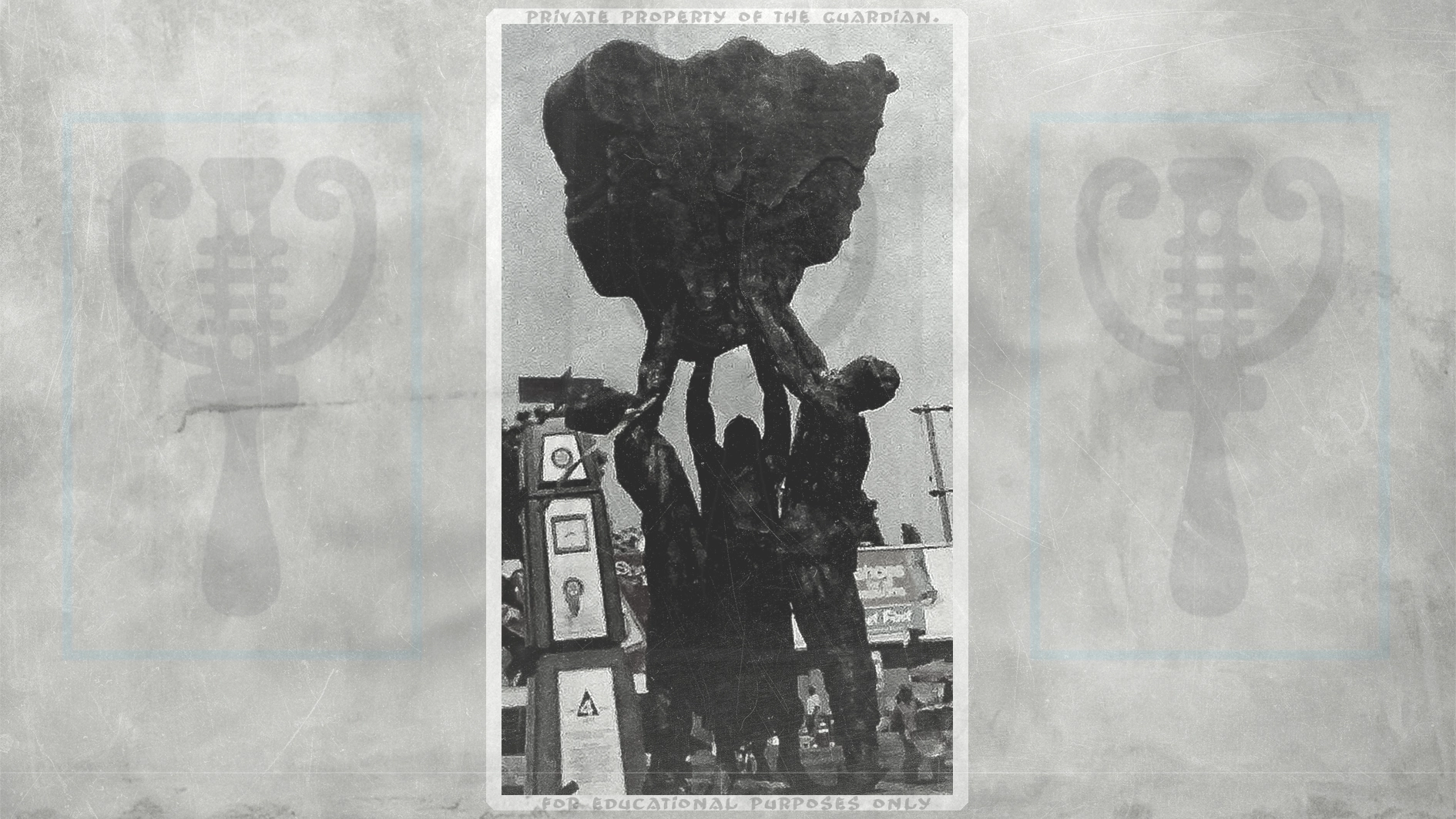
Public monuments have always served as the silent storytellers of Nigeria’s political journey, but few carried as much raw ideological weight as the iconic sculpture that once stood at the heart of Maryland Junction in Ikeja [LASRAB Maryland Statue Archive]. Commissioned on the twenty-second of November 1991 by the then-Deputy Governor of Lagos State, Alhaja Lateefa M. Okunu, the monument was designed to be a permanent visual manifesto for a country striving toward stability.
Officially titled “Salvaging Nigeria,” the installation was collectively sculpted by a dedicated group of National Youth Service Corps members who sought to capture the ultimate spirit of inter-ethnic cooperation and national integration.
The sculpture shows three distinct human figures straining under immense physical pressure to hoist a heavily textured, massive map of Nigeria into the air. While urban redevelopment and subsequent road expansions eventually swallowed the Maryland intersection and led to the removal of the monument, its imagery remains preserved in old media records. A look back at the archival layout files of The Guardian Nigeria reveals a handwritten editorial caption on the back of the print records detailing the true intent of the artwork: it was a deliberate, artistic plea aimed at helping to build a virile nation. Photographed in early January 1992, the image captures a moment in Nigerian history when public art was explicitly used to foster patriotism and civic duty.
Today, the profound visual metaphor left behind by these youth corps artists provides an urgent socio-political commentary on governance, citizen responsibility, and the communal weight of moving a nation forward.
The metaphor of the collective “lift”
The sculpture’s core power lies in its literal interpretation. The artwork does not present a nation effortlessly floating on its own, nor does it glorify a singular political leader or military general steering the ship of state. Instead, it positions the country as a heavy, unyielding physical mass that will collapse into the earth if it is not actively, muscularly sustained by its people.
The three figures represent the major regions and ethnic backgrounds of Nigeria working in total alignment. It is a stark visual statement showing that the survival of the republic is an ongoing, exhausting act of collaboration.
The straining muscles of the figures tell a story of absolute synergy. If one figure slackens his grip, shifts his stance, or steps away to look after only his own interests, the balance is broken. The immense weight of the map tilts violently, threatening to crush the remaining protectors. In the context of nation-building, the statue declares that total civic participation is not a luxury, but a structural necessity.
However, Nigeria today faces significant economic pressures, currency fluctuations, and institutional friction. In public discourse, blame is normally cast entirely upward toward governance structures, or outward toward global market forces.
While leadership holds undeniable accountability, the salvaging Nigeria monument shifts the focus back to the grassroots base. It asks difficult questions about the modern citizen’s role in keeping the map afloat.
The citizen is often faced with a profound dilemma. On one hand, there is the common temptation to gaze upward, demanding top-down institutional reform and government accountability while remaining passive. On the other hand, the monument calls for a collective lift, which means accepting a shared civic burden, engaging in local execution, and embracing collaboration across communities.
The visual metaphor implies that governance and citizen responsibility are two sides of the same coin. A government can enact policies, but the actual execution of a unified society requires everyday people, represented by the youth corps sculptors, to bear the communal weight. Moving the nation forward cannot be achieved through passive observation.
