 Follow Us on Google News
 Follow Us on Google Discover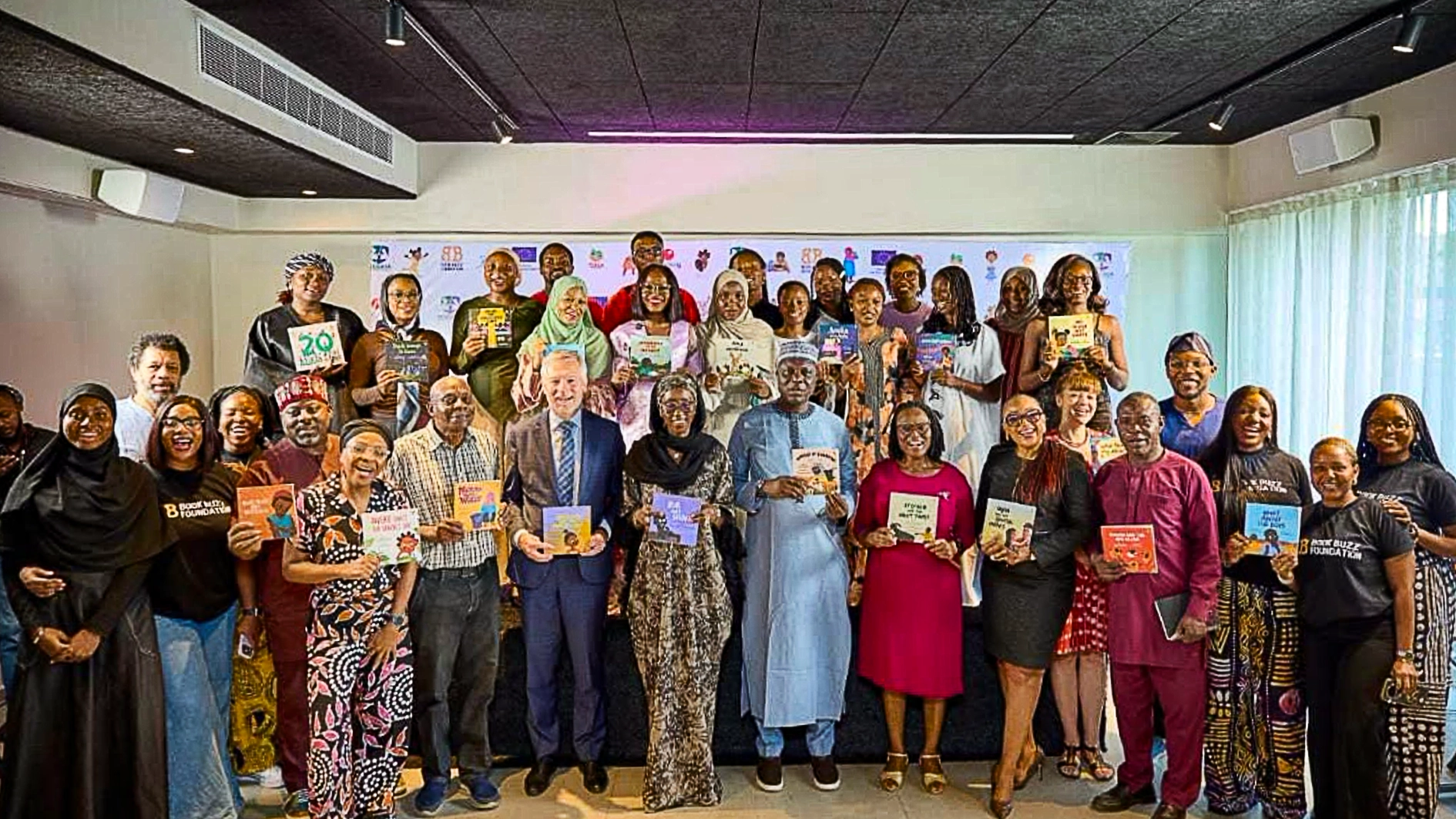
Stakeholders in the education and creative sectors, has called for increased investment in indigenous children’s literature, functional libraries and wider distribution of locally produced books to strengthen reading culture and improve learning outcomes among Nigerian children.
They spoke at the launch of the Nigerian Picture Book Project (NPBP), an initiative of the Book Buzz Foundation, supported by the European Union, which produced new picture books by Nigerian writers and illustrators for Nigerian children.
Speaking at the event in Abuja, the Executive Secretary of the Universal Basic Education Commission (UBEC), Aisha Garba, said books written and illustrated by Nigerians were important because they were created with Nigerian children and their experiences in mind.
Garba, who was represented by her Special Adviser, Ibrahim Gold, commended the Book Buzz Foundation and the European Union for the initiative, congratulating the 24 young Nigerian women whose creativity and commitment contributed to the project.
She said the responsibility of UBEC went beyond getting children into classrooms, stressing that the ultimate objective was to ensure that children learn, develop strong foundations and discover their potential.
She said: “A child who can read can begin to explore the world around them. A good book can introduce a child to new words and ideas, strengthen understanding, feed curiosity and imagination, and teach them. But, just as importantly, a good book can make a child fall in love with reading.”

The UBEC executive secretary said the project was particularly relevant because Nigerian children could identify more easily with books containing familiar names, places, people, cultures and experiences.
She said such books could make reading more than a school activity by helping children connect with and enjoy the experience.
Garba said the initiative was also consistent with the Federal Government’s emphasis on education and human capital development under the Renewed Hope Agenda of President Bola Ahmed Tinubu.
She noted that for UBEC, getting children into school must go hand in hand with ensuring that they were actually learning.
Garba urged governments, development partners, publishers, authors, illustrators, schools and communities to deepen collaboration to ensure that quality Nigerian children’s literature reached more children, particularly those in underserved and hard-to-reach communities.
She added, “It will be the little girl who picks up one of these books and says, ‘This story is about people like me.’ It will be the child who discovers that meaning can be found in stories. It will be the young mind whose imagination is opened to a world of possibilities.”
Also speaking, the First Lady of Kwara State and Chairperson of the Nigeria Governors’ Spouses Forum, Ambassador Professor Olufolake Abdulrazaq, who was represented by the Chief Executive Officer of the Forum, Hauwa Halira, called for the translation of Nigerian children’s books into indigenous languages.
Halira said although English remained Nigeria’s lingua franca, children who were more comfortable with indigenous languages should also be able to read the stories in languages they understood.
She said: “We have three major indigenous languages in Nigeria, and we should ensure that children who are not able to speak English, although English is our lingua franca, can also read these stories in their own languages and connect with them.”
She urged other partners and stakeholders to support the project, describing it as an initiative capable of making a meaningful impact on Nigerian children.
In her remarks, the Director of the Book Buzz Foundation, Lola Shoneyin, said the project was established partly to address the gap in Nigeria’s children’s publishing industry and develop a pipeline capable of producing high-quality books that could compete internationally.
Shoneyin said her exposure to international book fairs had made her appreciate the value attached to children’s literature in other countries.
She said: “I have visited a lot of international book fairs, and I have seen how children’s books are valued outside the country.”
She said Nigeria had considerable talent and cultural diversity that could provide rich material for children’s literature, stressing the need to celebrate the country’s different cultures and histories.
Shoneyin, who is also a writer and children’s author, said the project was designed to combine cultural identity, values, inclusion and entertainment.
She added, “We want to do everything we can to make sure they reach as many people as possible in as many different ways as possible.
“When a child grows up seeing a character called Amina in a wheelchair, she is no different. She is enjoying herself. She is drawing. She is doing things and showing that she is capable.”
One of the authors, Nana Sule, said the project also offered an opportunity to document Nigerian cultures and expose children to parts of the country beyond their immediate environments.
Sule, whose latest book before the project was a 2025 collection of short stories titled Not So Terrible People, said she had previously written for several journals and worked as a journalist with Daily Trust.
She said her motivation for participating in the project was partly to create a story that she could read with her son while documenting aspects of her culture.
Sule, who also runs a bookstore, said she intended to acquire copies of the books for children who visit the facility, allowing them to read the books and purchase copies where possible.
She said the books addressed themes ranging from erosion and urbanisation to the environment, animals, different cultures and people living with disabilities.
She said: “The more our children read, the better it is for us. Through these books, they can see that what they know is not all that exists in the world. They can see other parts of Nigeria and begin to learn more about the country. The challenge is not necessarily that children cannot read or will not be able to read. It is a challenge of access.”
She called for greater support for writers and illustrators, improved distribution of books and the restoration of functional libraries across the country.
The books produced under the project cover a range of themes, including culture, history, environment, childhood experiences, disability, community life and social issues.
The titles include Ariyo and the Spelling Tree; Etefolo and the Goat Thief; Talatu and the Desert Sates; Amaka and the Ants; No More Wet Sheets: What About the Boys; Okon Can’t Dance; Bakura’s Big Mistake; Dark Enough to Dance; Who Took My Akara; Oyin and the Special Marks; Adeji and the Garden Eggs; Maimuna Waits for Water; Awero Saves the Market Day; When the Bulldozers Came; Mmesoma and the Big Gully; Wheels of Sunshine; Emike and the Idu Mask; Ewatomi and the Magic Loom; and Rub and Shine.
The stakeholders said wider access to culturally relevant books, stronger libraries, digital distribution and sustained partnerships would be critical to ensuring that more Nigerian children develop strong reading habits and see themselves reflected in the stories they read.

