 Follow Us on Google News
 Follow Us on Google Discover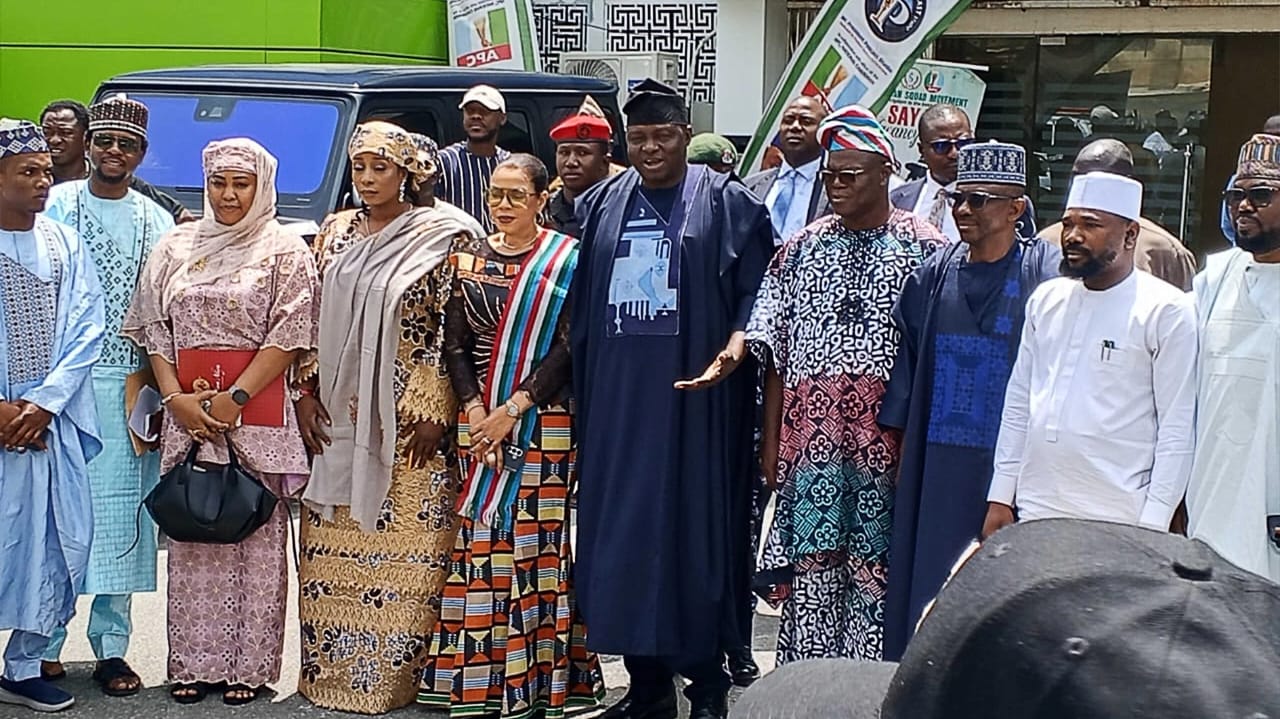
The All Progressives Congress (APC) has accused former Vice President Atiku Abubakar, former Rivers State governor Rotimi Amaechi and other opposition leaders of hypocrisy in their criticism of President Bola Tinubu’s economic reforms, challenging them to account for their records in government.
The ruling party also defended the administration’s infrastructure investments in Northern Nigeria, insisting that its policies were designed to promote national unity, strengthen the economy and improve the welfare of citizens.
The APC National Secretary, Senator Surajudeen Ajibola Basiru, and National Chairman, Prof. Nentawe Yilwatda, spoke on Friday in Abuja while receiving opposition politicians, including 12 House of Representatives and state House of Assembly candidates from the African Democratic Congress (ADC) and Nigeria Democratic Congress (NDC), who defected to the ruling party.
The defectors, drawn from Sokoto, Kaduna, Jigawa, Kano and Plateau states, were led by Princess Asmau Aliyu, while Prof. Murtala Yusuf represented the ADC group and Mohammed Rabiu represented the NDC contingent from Kaduna State.
Basiru, who was flanked by Yilwatda and other members of the party’s National Working Committee, questioned whether opposition leaders were genuinely concerned about Nigeria’s economic challenges or merely seeking to regain political power.
“Is it just about delivering for the Nigerian people or pursuing inordinate ambition?” he asked.

Taking a swipe at Amaechi over his reported criticism of the proposed seaport project in Ogun State, the APC national secretary questioned why an infrastructure initiative expected to stimulate economic activity should be opposed on the grounds of alleged personal interests attributed to the President.
“I heard a Rotimi Amaechi saying that we should not have done a seaport in Ogun State because we are only doing a seaport in Ogun State because the President wants to make money from it,” he said.
“The President could have as well pocketed the money without doing any seaport itself. How can you say that a developmental project, which is going to impact on the economy, should not have been done because we want to politicise it?”
Basiru argued that infrastructure projects should be assessed on their potential to promote trade, generate employment and stimulate economic growth rather than through partisan considerations.
He also questioned the credibility of opposition politicians who, after holding public offices, were now presenting themselves as agents of change without adequately accounting for their records.
Referring to privatisation exercises undertaken under previous administrations, he cited the Ajaokuta Steel Company, Osogbo Steel Rolling Mills, Delta Steel Company and Nigerian Airways as examples of national assets whose fortunes, according to him, deteriorated.
“The steel mills were sold at half value. Delta Steel was sold at half value, and the Ajaokuta Steel Mills are comatose. The Osogbo Steel Rolling Mills are comatose. Nigerian Airways is comatose,” he said.
The APC chieftain maintained that Nigerians should scrutinise the records of opposition figures before accepting their promises of a new Nigeria.
“Coming around now to say, at this age, that they want to have an agenda for a new Nigeria, I think it is very important for us to address it,” he added.
On the removal of petrol subsidy, Basiru ruled out a reversal of the policy, arguing that the country could not afford to return to a system that placed enormous pressure on public finances.
“As the Minister of Petroleum has said, we are not going back to subsidy. It’s gone and gone forever,” he said.
He urged Nigerians to distinguish between fuel price modulation and subsidy, recalling the difficulties governments faced in meeting salary and pension obligations before the reforms.
Basiru, who said he experienced the situation while serving as a commissioner in Osun State, recalled that the government had to borrow from the capital market to pay workers and finance development projects.
“At that time, we could not pay salary. We had to get into bad debt to pay salary. We could not pay pensioners. If we wanted to do developmental projects, we had to go and borrow money in the capital market,” he said.
He warned that reversing the reforms could undermine the capacity of governments to meet their obligations and fund infrastructure.
“Will somebody, because of his inordinate ambition, reckless ambition, now want to get us back in the era where pensioners will be dying on queue looking for what they will eat?” he asked.
Basiru also criticised opposition arguments against the administration’s student financing initiative, saying more than 1.4 million students had benefited from the Nigerian Education Loan Fund (NELFUND).
He defended the provision of student loans and monthly upkeep allowances of N20,000, arguing that the amount could make a significant difference to students from disadvantaged backgrounds.
“For people who have stolen money to buy cars that they don’t need and assets they don’t need, N20,000 will not make meaning. But children of vulnerable people, like some of us when we were in school, N20,000 is really a deal,” he said.
He further argued that education should not be assessed solely by its ability to secure paid employment for graduates, but also by its role in developing responsible citizens.
“Education is to create a rounded citizen that is able to contribute meaningfully to society,” he said.
In his remarks, Yilwatda defended Tinubu against accusations that his administration had neglected Northern Nigeria in its infrastructure spending, listing road, rail, gas and power projects which he said would benefit the region.
He recalled Tinubu’s support for northern presidential candidates in previous election cycles, including Atiku in 2007, former National Security Adviser Nuhu Ribadu in 2011 and former President Muhammadu Buhari in 2015 and 2019.
According to him, Tinubu’s political decisions demonstrated a commitment to national unity and the principle of power rotation, even when some of those he supported subsequently failed to reciprocate his political support.
Yilwatda said Tinubu stood behind Buhari in 2019 and led reconciliation efforts to consolidate support for the former president’s re-election.
He argued that the President’s commitment to national cohesion should be assessed against his political history and the infrastructure projects being undertaken across the country.
Responding to criticism that the administration’s Lagos-Calabar Coastal Highway favoured the South at the expense of the North, Yilwatda said several major road projects were also ongoing in the northern region.
He cited the Abuja-Kaduna-Kano road and the Kano-Maiduguri corridor, alongside projects linking Kano to Katsina, Daura and Zaria, as well as road construction in Sokoto and Kebbi states.
“The coastal road is 700 kilometres,” he said, arguing that the length of the project should not be used to dismiss investments in other parts of the country.
Yilwatda said the road projects, together with railway development and gas infrastructure, would strengthen trade, improve transportation and support agricultural production in the North.
He also highlighted the planned and ongoing rail connections involving Kano, Kaduna and Maradi, arguing that improved rail transport would expand access to seaports and create new opportunities for businesses in landlocked neighbouring countries.
According to him, the projects would enable northern entrepreneurs to move goods more efficiently and support exports to countries such as Niger, Chad, Burkina Faso and Cameroon.
The APC chairman further cited gas infrastructure, compressed natural gas (CNG) initiatives and electricity sector reforms as evidence that the administration was investing in the economic development of the North.
He also challenged opposition proposals to offer a N500-per-litre discount on petroleum products, arguing that such a commitment would require substantial public expenditure and could undermine the gains the government claimed to have made in fiscal management.
Yilwatda questioned the feasibility of supplying domestic refineries with sufficient crude oil at discounted rates, noting that a substantial proportion of Nigeria’s crude production belonged to joint-venture partners.
He argued that any policy requiring the government to subsidise crude supplies on such a scale would place additional pressure on public finances and threaten capital spending.
The APC chairman said the administration had inherited substantial financial obligations, including debts to power generation companies, gas suppliers, foreign airlines and investors whose funds had been trapped under the previous foreign exchange regime.
He claimed that the government had settled outstanding obligations running into trillions of naira, although he did not provide a detailed breakdown of the amounts during the event.
Yilwatda also cited the sale of the Aluminium Smelting Company of Nigeria and steel assets as examples of what he described as the poor management of public assets under previous administrations.
He alleged that the aluminium company, which he said cost about $3.5 billion to build, was sold for less than $130 million, while steel assets valued at more than $1.5 billion were disposed of for substantially lower amounts.
The APC chairman argued that the government’s current economic policies were intended to address inherited financial difficulties and redirect public resources towards capital projects.
He said the administration had increased the emphasis on capital expenditure, contrasting this with previous budgetary patterns which, according to him, left insufficient resources for infrastructure and development.
Yilwatda urged the defectors to help mobilise support for Tinubu ahead of the 2027 general elections, describing their decision to join the APC as a commitment to continuity and national development.
He assured them that the party would accommodate new members and provide opportunities for them to participate in its political activities.
Basiru, meanwhile, maintained that opposition criticisms of the reforms were driven more by the desire to return to power than by concern for ordinary Nigerians.
“The men of yesteryears who were hungry for power, they are not hungry for food,” he said.
Referring to a past remark attributed to former President Olusegun Obasanjo about a politician having enough money to feed Nigerians for 200 years, Basiru argued that the backgrounds of opposition leaders should inform public assessment of their claims.
“It is not about hunger for food, but hunger for power. And the power is not even power with responsibility,” he added.
He also cited the ability of Nigerians to use naira-denominated payment cards for international transactions as one of the developments he considered evidence of progress under the current administration.
The APC said the defections reflected growing confidence in Tinubu’s leadership and the Renewed Hope Agenda, expressing optimism that more opposition politicians would join the party as political activities intensify ahead of the 2027 elections.
However, opposition leaders have continued to question the impact of the administration’s economic reforms on household incomes, food prices and transportation costs, arguing that the hardship experienced by many Nigerians requires urgent policy responses.
The Tinubu administration has maintained that the reforms are necessary to strengthen public finances, attract investment and establish a more sustainable foundation for long-term economic growth.

