 Follow Us on Google News
 Follow Us on Google Discover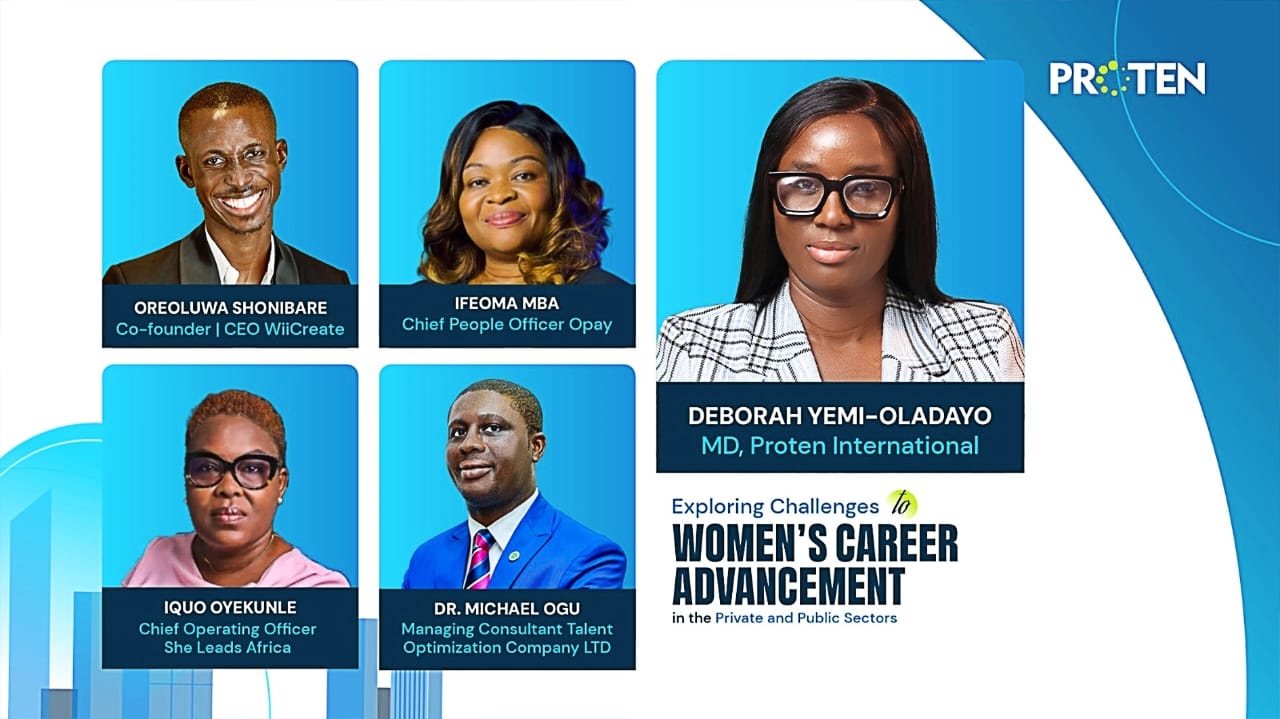
Proten International has called for deliberate workplace reforms to improve women’s career progression, close leadership gaps and ensure that organisations measure success beyond the number of women they employ.
The call was made at the company’s Executive Roundtable on women’s career advancement, where business leaders, human resource professionals and other stakeholders examined the barriers affecting women’s progression and explored practical ways to create more inclusive workplaces.
In her opening remarks, Managing Director of Proten International, Deborah Yemi-Oladayo, said the roundtable was designed to challenge existing assumptions about women’s advancement and encourage research-driven solutions that organisations could implement to achieve measurable change.
She stressed the need to move beyond conversations about inclusion to practical interventions that address the structural barriers limiting women’s career growth.
Delivering the keynote address, Ibijoke Faborode said the challenges women face in the workplace were often rooted in organisational structures rather than a lack of competence or ambition.
“The gap between the employer and the employee is not a value gap. It is a design gap,” she said.

She noted that workplace systems must reflect the realities of employees’ lives, particularly those balancing professional responsibilities with caregiving.
Chief People Officer at OPay, Ifeoma Mba, said career progression was rarely a straight line, adding that organisations must assess whether women were being retained, promoted and given opportunities to assume leadership responsibilities.
According to her, companies should monitor women’s progression from recruitment through to senior management, while providing access to strategic projects, mentorship and sponsorship opportunities.
“Recruitment is only the beginning. You can hire 50 women today and still have a leadership problem five years later if those women are dropping off along the way,” she said.
She called on employers to consult employees when designing workplace policies, measure outcomes rather than physical presence, invest in care infrastructure and establish clear accountability for gender inclusion.
She noted that workplace systems must reflect the realities of employees’ lives, particularly those balancing professional responsibilities with caregiving.
Chief People Officer at OPay, Ifeoma Mba, said career progression was rarely a straight line, adding that organisations must assess whether women were being retained, promoted and given opportunities to assume leadership responsibilities.
According to her, companies should monitor women’s progression from recruitment through to senior management, while providing access to strategic projects, mentorship and sponsorship opportunities.
“Recruitment is only the beginning. You can hire 50 women today and still have a leadership problem five years later if those women are dropping off along the way,” she said.
Mba also identified workplace cultures that demand constant availability as a major barrier for employees with family responsibilities, particularly women who often bear a disproportionate share of caregiving duties.
A representative of the Chartered Institute of Personnel Management of Nigeria (CIPM) also highlighted the importance of workplace relationships and managerial support, noting that informal support from colleagues and supervisors could be as important as formal policies in determining women’s career outcomes.
The representative advocated parental leave policies, gender-based career progression audits and transparent promotion criteria to ensure that women were assessed fairly and had equal access to advancement opportunities.
Findings from a survey of more than 3,000 Nigerian professionals presented at the roundtable highlighted both progress and persistent gaps in workplace inclusion.
The survey found that 59 per cent of female respondents considered it somewhat easy to regain career momentum, while 36 per cent reported having no mentor.
It also showed that 87 per cent of respondents favoured flexible work arrangements, while 59 per cent supported structured return-to-work programmes for employees resuming their careers after maternity leave.
The discussions further examined the need to assess whether women returning from maternity leave were able to regain professional momentum and progress at the same pace as their colleagues.
Participants argued that organisations should track how many women return to work after maternity leave, whether they are included in performance appraisals and whether they secure promotions or take on greater responsibilities within six to nine months of returning.
They warned that excluding women from annual performance assessment cycles because they had taken maternity leave could undermine their career progression and delay opportunities for advancement.
Co-founder and Chief Executive Officer of WiiCreate, Oreoluwa Shonibare, and Chief Operating Officer of She Leads Africa, Iquo Oyekunle represented by Abimbola Ajala, were among the other contributors to the discussions, alongside Managing Consultant at Talent Optimization Company Limited, Dr Michael Ogu.
The panel also stressed that increasing the number of women in employment would not automatically translate into gender equality if they remained underrepresented in managerial and decision-making positions.
One of the contributors, Abimbola, urged organisations to measure the number of women occupying managerial and leadership roles, arguing that progress should be assessed by how many women were advancing into positions where they could influence decisions.She explained that exposure to such responsibilities could strengthen women’s prospects for promotion into senior leadership positions.
The discussion also underscored the importance of support beyond the workplace, with participants calling for stronger family and community involvement in caregiving, alongside effective government policies and enforcement by relevant labour authorities.
They called for holistic solutions designed with the people directly affected by workplace barriers, while advocating stronger legislation and accountability to ensure organisations followed through on their commitments.
The moderator summarised the discussion by emphasising that sustainable progress required support from employers, families, communities and policymakers, adding that responsibility for change rested with individuals as well as institutions.
In her closing remarks, Yemi-Oladayo called for participants to translate the discussions into practical action, stressing that advancing women’s careers required collective responsibility from employers, policymakers, families and individuals.
She urged organisations to measure progress through concrete outcomes, including the number of women returning from maternity leave, their subsequent career progression and their representation in leadership positions.
Yemi-Oladayo also stressed the importance of ensuring that women returning from maternity leave were fairly assessed, considered for promotion and given opportunities to take on strategic responsibilities.
“The real change begins with you. It begins with me. By tomorrow, we want to see great things happening in our organisations. I want to see more women ascending in their careers and assuming leadership positions,” she said.

