 Follow Us on Google News



 Follow Us on Google Discover
When an important political leader, a governor, or a foreign billionaire arrives at a venue in modern Nigeria, how do you know they have arrived? Usually, the signs are mechanical, loud, and intimidating. You will hear the piercing blare of police sirens, see a long convoy of tinted bulletproof sports utility vehicles, and watch security guards in dark sunglasses clear the path. It is a display of power designed to create distance between the ruler and the ruled.
But looking back at our historical archives, you will find that our ancestors had a completely different way of heralding power. They did not use sirens or iron gates. Instead, they used the breathtaking power of sound, art, and rhythm.
These throwback photographs from The Guardian’s archive do not just capture musicians; they capture Nigeria’s original, living protocol teams. From the royal horn blowers to the elite talking drummers, these images reveal a sophisticated civilisation where music was the ultimate red carpet, designed to welcome dignitaries with immense dignity, celebrate authority, and pass messages across vast distances.
The royal trumpeters
In Northern Nigeria and parts of the ancient Oyo and Benin kingdoms, these instruments, often known as the Kakaki or royal horns, were the literal voice of state authority.
The Kakaki is a remarkably long metal trumpet, sometimes reaching over two metres in length. Traditionally, it was not an instrument that just any musician could pick up and play in the marketplace. It was strictly reserved for royalty, emirs, and supreme dignitaries.
When a king or an important ambassador was approaching a palace or entering a city boundary, these trumpet blowers would stand in formation, puffing out their cheeks to blast a deep, metallic, heralding sound into the air. The long pipes could project sound across kilometres, acting as an ancient broadcast network. The moment the townspeople heard that distinct, golden blast, everyone knew without looking that someone of immense importance had arrived. It created an immediate sense of order, awe, and collective pride.
The Onigangan Squad
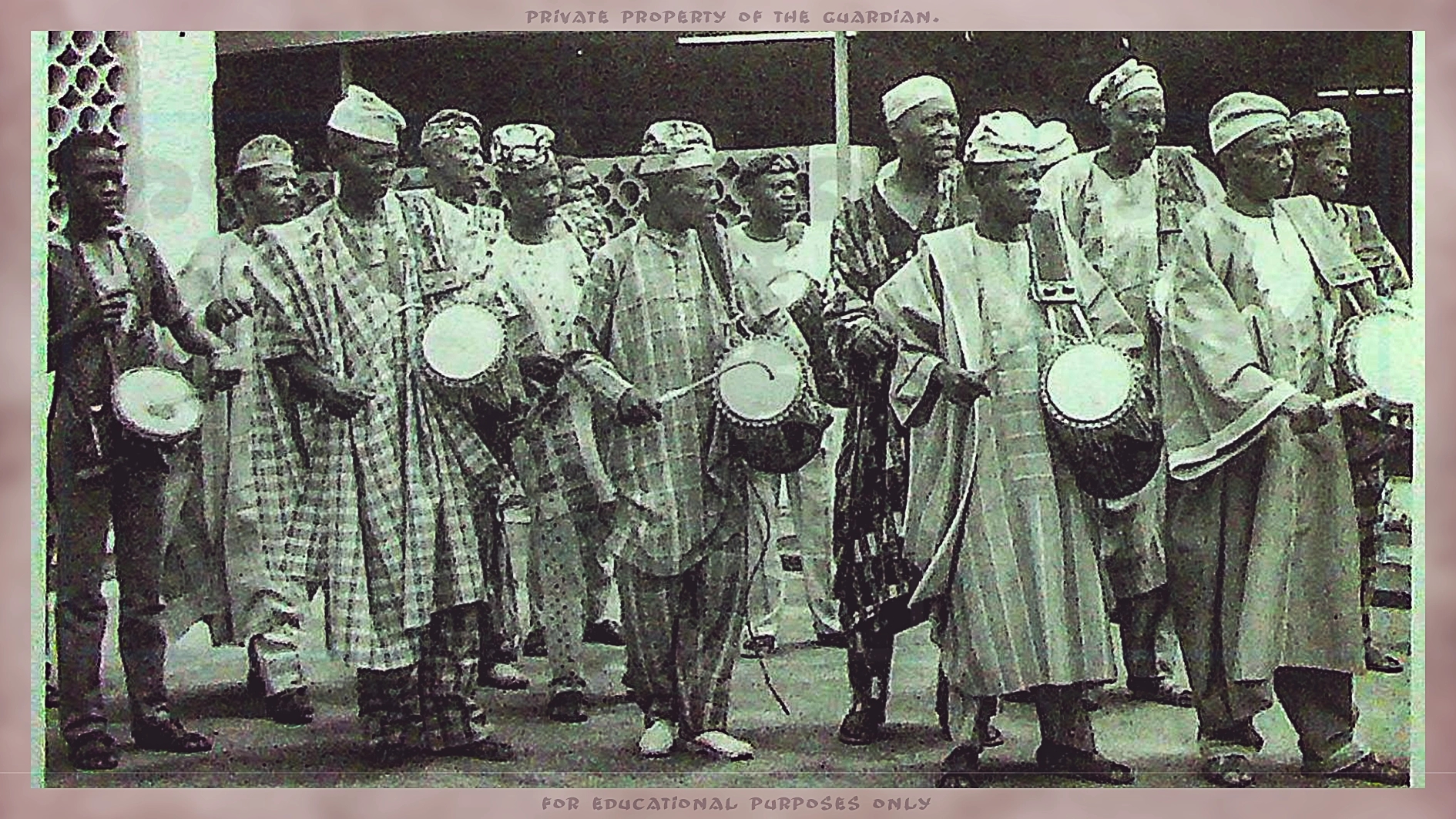
Our second archival image moves us directly into a formal, sunlit courtyard. Here, we see a line of distinguished older men dressed in beautifully tailored, matching traditional agbada attire and fila caps. Tucked snugly under their arms are Gangan (the famous Yoruba talking drums).
These are the Onigangan, the master palace drummers. Long before modern state visits required written programmes and microphones, these men directed the entire flow of royal protocol. They did not just play random beats to entertain the crowd; they were literally speaking through their instruments.
By squeezing the leather strings under their armpits, a master talking drummer can perfectly mimic the tonal inflections and pitches of human speech. As a guest or a political dignitary walked into the palace grounds, the drummers would beat out their names, praise their family lineage, and recount their great achievements. They could tell the guest when to slow down, when to step forward, and when to bow before the king. It was a deeply personalised, artistic welcome that modern red carpets simply cannot replicate.
The rhythm of the people
This image highlights the pure performance and community integration that accompanied every historical welcome. When a VIP arrived in old Nigeria, the reception was never a cold, stiff corporate meeting. It was an immersive, high-energy theatrical experience.
The drummers in this photo sync their heartbeats with the stomping feet of the acrobatic dancers, creating a shared rhythm that unified the entire community. The performance allowed the ordinary citizens to gather, dance, and share in the celebration of leadership. It served as a powerful reminder to the visiting dignitary that their power was deeply tied to the energy, happiness, and support of the collective public.
