 Follow Us on Google News
 Follow Us on Google Discover
 THE setting was the media centre of the National Stadium, Lagos, where past Nigerian athletes, most of them Olympians, had gathered to talk on plans for this year’s Olympic Day celebrations, scheduled for Saturday, July 4 across the country.
The Olympic Day is a special occasion for athletes, officials and the general public to come together to run, walk and engage general physical exercise to keep body and soul healthy.
But on this day, Friday, June 18, 2015, there other issues that cropped up among some of the participants in the event organized by Sports For All President, Henry Amike, an Olympian, was the fallen standard of Nigerian sports. Of particular worry to some of those at the event was the poor response of the stakeholders at the grassroots to the decline in Nigerian sports.
In fact, most of the discussants believed that aside Cross River State, Lagos and to some extent, Ogun, most of the other states have abandoned their responsibility of grooming young athletes through concerted grassroots programmes.
Athletics buff, Dare Esan, is sad that most of the local councils and states have abandoned their responsibility of identifying and grooming talents from their areas.
Esan, who is also the Editor of Complete Sports newspapers, believes that if all the states embraced the sports development model in use in Cross River State, Nigeria would regain its position in world’s sports easily.
According to Esan, Cross River State has a programme that has built sustainable structures within the primary and secondary schools system throughout the state for the long-term discovery of talented youths who can be trained and nurtured to become state, national and international champions.”
He said the state’s programme ensures an organized mass participation in sports as well as a youth mobilization and empowerment initiative.
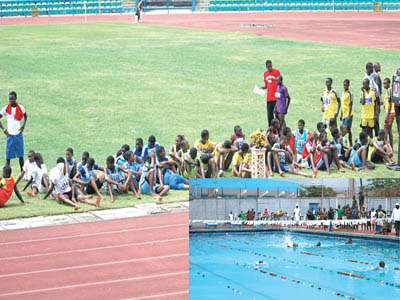
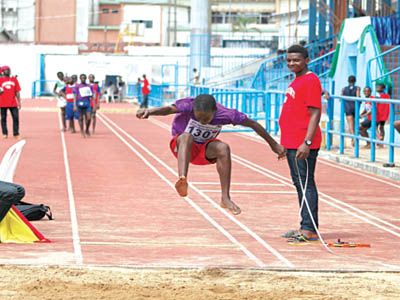 The programme, he says, employs world-class coaches from USA, Cuba and Jamaica to train local game masters and coaches as well as to groom discovered athletes. “The result is that annually, all schools in the state are required to participate in a series of competitions from inter-house sports to inter-school, to LGA championship.
The final competition in the series is the State Primary and Secondary School Championships held annually at the U. J. Esuene Stadium in Calabar with over 3,500 boys and girls participating in each edition.
“The state championship provides opportunity to identify and select the best athletes for distribution to the six model secondary schools designated as Centers for Sports Excellence. The six schools were selected through a meticulous and painstaking process involving the Ministries of Education, Youth and Sports Development, Sports Commission and KimaSports Consultants.”
The Cross River model ensures that in addition to a good quality education, the schools allow the students to receive continuous year round coaching and specialized training to prepare them for state and national competitions in their various sports.
“The programme is equipped with equipment worth more than N220 million, which are suppose to be distributed to the schools. You can imagine the start this programme is giving to this children in their sports career.”
To the Press Officer of the Nigeria Olympic Committee (NOC), Tony Ubani, the standard of Nigerian sports would continue to fall if those concerned do not pay attention to the fundamentals.
“We have become a country of sports promoters rather than sports developers. We wait for events to come before we start running about looking for means of getting results when we have not worked for the result. “That is why I will continue to praise Cross River State for showing us the way things should be done. I have been privileged to see a report by the programme consultants and I want to say that all the other states need to borrow from the well thought out development path.
“It is no wonder that Cross River has won the National Schools Sports Festival for four consecutive years since 2011. “Cross River also has the best junior team in athletics, boxing, weight lifting and swimming in Nigeria today.” In spite of all these achievements, Esan, who is one of Nigeria’s most travelled athletics writers, is saddened by the report that the current Cross State government wants to discard the programme.

He said, “I hope the report that Cross River wants to discard the programme is just a rumour because doing so will amount to denying the children, who now see sports as an avenue to escape poverty and crime, the way to greatness. “I say greatness because more Cross River athletes have started representing Nigeria in major international competitions. Some of them are already in the team to the All Africa Games billed for Congo later this year. That would not have been possible without the programme.
“I want to use this opportunity to appeal to Cross River State Governor, Ben Ayade, to continue with this programme, which aside from producing champions at every level of competition for the state and nation, has become a major human capacity building project.” During a recent interaction with Cross River State Sports Development Consultant, Bruce Ijirigho, in Calabar, the former captain of the Nigerian Olympic team disclosed how the programme has built a quality talent bank for the state.
According to Ijirigho, “since its inception, over 3,500 boys and girls have converged in Calabar every year from the 18 local government areas to participate in the Cross River State Athletics and Swimming Championship. “For most of the 17,500 children, coming to Calabar is their first exposure to a major city outside their village.
It is a time to marvel at many new things, experiences, people and lifestyles that they never knew existed. It is an opportunity to make new friends and play all night under the floodlight at the U.J. Esuene Stadium. “It is an experience that will stay with them all their lives and help to shape their future.
Through the programme they were taught how to plan, set goals and achieve them. We teach them about hard work, discipline, dedication. They learn about the importance of quality education and how to combine it with competitive sports. We teach them how to win fairly through hard work and preparation rather than fraudulently which is the common denominator in Nigerian society today. “Above all, we teach them how to imbibe the spirit of good sportsmanship.

These are all qualities that will serve them well in their pursuit of excellence and success in all life’s endeavors. We can say with certainty that CRS athletes are the most disciplined and best cared for in Nigerian sports today.”
He revealed that the programme has a system that ensure money is “paid monthly to athletes to help them with basic needs, transport money to and from practice daily and to supplement their feeding. Payment is made to 75 of our best primary, secondary school and elite athletes in Athletics, Boxing, Weightlifting and swimming.
The state championship provides opportunity to identify and select the best athletes for distribution to the six model secondary schools designated as Centers for Sports Excellence. The six schools were selected through a meticulous and painstaking process involving the Ministries of Education, Youth and Sports Development, Sports Commission and KimaSports Consultants
“The least paid receives N5,000.00 monthly, while the highest paid receives N30,000.00. The athletes earn prize money in some competitions. The athletes get monetary gifts for good performance in major national competitions. Oftentimes, the reward runs into tens of thousands of naira and hundreds of thousands for some.
This includes primary school boys and girls. “We maintain bank accounts for some of the athletes to protect their money. Some of our local athletes received millions of naira from former President Goodluck Jonathan as reward for good performance and winning medals for Nigeria in international competitions.
“So, you see, some of these athletes, as young as they are, have become bread winners for their families. Three of them have assisted their parents to build new houses and bought cars.”

