 Follow Us on Google News


 Follow Us on Google Discover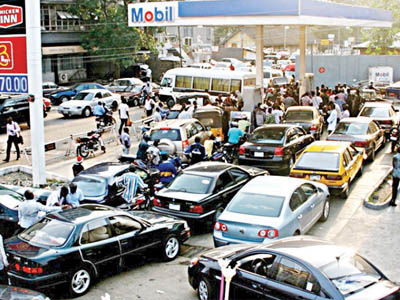

• Say Nigerians Already Buying Product Above Subsidised Price
ECONOMIC experts and professionals have distanced themselves from the position taken by President Muhammadu Buhari on petroleum subsidy, saying Nigerians are no longer benefitting from the scheme as most filling stations are already selling the commodity above subsidised price.
They disagreed with the president, who said subsidy removal will reduce the purchasing power of average Nigerians, when they said fuel is already being sold at between N110 and N150, depending on location and distance from Lagos, adding that the price was not as high when subsidy was first removed during the early days of the last political dispensation.
According to them, the price then was N140 per litre, even when the product sold for as high as $113 per barrel at the international market.
They argued that with the downward slide in the price of crude at the international market, the price of the product might not be up to N120 per litre if subsidy is removed. According to them, president Muhammadu ought to have taken the advantage of the prevailing price of fuel at filling stations to remove subsidy as Nigerians are already getting used to the high price of the commodity.
They, therefore, suggested complete deregulation of the downstream sector and creation of viable framework to sustain investment n private refineries so as to deemphasise importation of the product.

To Muda Yusuf, the Director General of Lagos Chambers of Commerce and Industry, it was disturbing for president Buhari to say argument against subsidy lacks depth, when he needs to conserve funds to execute his electoral promises to Nigerians.
He advised the government to use the opportunity of the current pump prices to remove subsidy, as Nigerians are already buying the product at between N110 and N150 per litre.
He said with the removal, the pump price might not be higher than what it is now. “It is disturbing that the president made that kind of statement, because it has fierce chain of implications.
It has implications for investors, who have been looking forward to invest in the downstream. It will encourage the perpetuation of corruption in the downstream sector; it will encourage epileptic supply of petroleum and scarcity. It also has implication on confidence of the people.
This is why many of us have been clamouring that the president should come up and declare an economic movement; so that we know exactly what direction he intends to go. Without official pronouncement, investors would get confused as to the character of economic movement under this administration.
I was surprised that the president said the argument for subsidy removal lacks depth.” Continuing, he said: “One of the sources of damage to the economy is this fuel subsidy issue, because it has put a lot of pressure on our resources and foreign exchange market. It has created problem for exchange market and our reserves, and on top of that, it has provided room for a lot of fraud.
We know that he is committed to fighting corruption, but when you fight corruption, you fight it in two principal ways. You can police the system very well to ensure that there are no leakages or room for people to maneuver or cut corners. You can also ensure that the system you are running with is not vulnerable to corrupt practices.
But the point is that no matter how good you are at policing people on corruption, the kind of chain involved in this subsidy scheme will make it very difficult to police and we are in a time when we have very serious challenges. Many of his campaign promises need a lot of funds for them to be delivered.
And here is an area where he can make very good savings easily, and he is now saying the argument for subsidy removal lacks depth. I find it difficult to believe, because, to generate more foreign exchange, you need investors.” On the need to urgently discontinue subsidy regime, he said: “the downstream sector, for instance, should be exporting refined products, not importing. They should be exporting a lot of petrochemical products.
Unless these policies are right, these investments will not come. On this, the president should also see how he could engage stakeholders, the labour union and organised private sector, on how they can get government to exit from this subsidy. The president may be worried about the political implication, because he seems to be taking a step that he thinks is a popular step, which may not be of economic interest to the country.
It is even better to subsidise power than to be subsidizing petroleum products because if you have stable power, the demand for petroleum products will reduce.”
Making a strong case for the removal of fuel subsidy, he said: “how would you explain that kerosene is being subsidised to be sold at N50 per litre, yet everywhere you go, they are selling. at N150 per litre? The president needs to constitute his economic team quickly. Right from day one, he ought to have cancelled subsidy.”
On the swap alternative being proposed for subsidy, Yusuf said that model would not work, insisting on the need to refine our crude locally. “They need to deregulate the downstream sector and ensure a regulatory framework to ensure good standard. We should not be importing fuel.
They should create the right policy and environment for refineries to emerge. You cannot have a system where bureaucrats will be managing the refineries for us. The private sector should be allowed to do that. It is a very lucrative business. But with this pronuncement by the president, the corrupt people, who have been milking the country dry, will just be jubilating and say it is business as usual.
The oil price is going to drop further with Iran coming on board and with nuclear deal already signed. Nobody is enjoying subsidy. The implication of subsidy is that resources will continue to be used for fuel importation. There will be pressure on foreign exchange.
Foreign reserve will be under pressure.” The Speaker of the House of Representatives, Mr Yakubu Dogara had argued that it was not possible to remove fuel subsidy by presidential declaration, saying it could only be removed by Legal processes. According to him, to remove subsidy permanently, the government would need to initiate an amendment to the price control Act or have it repealed by the National Assembly.
He noted that in the schedules to the Act, petroleum products were listed among the items to be regulated through pricing. To the Speaker, the alternative was for the government to inaugurate the price control board provided for under the act so that the board, in performing its functions, could remove petroleum products from the list.
“This is the most legal way to do it, so that subsidy can go permanently. It is not by policy pronouncements alone; so it is for government to quickly put the board in place and this issue can be done once and for all,“ The speaker made this clarification, few days ago, when he received a delegation of members of the Independent Petroleum Marketers Association of Nigeria (IPMAN), at the National Assembly.
The marketers of the commodity had sold the crude swap idea to the Federal Government for adoption as a short-term measure against subsidy. They assumed it could bring to a permanent end to the subsidy regime and the current fuel crisis in the immediate future.
According to them, the arrangement was necessary as the government could no longer sustain subsidy of the products. The long-term solution, according to the marketers required the encouragement of local refining of crude so as to put a permanent end to importation refined products, and to make it affordable to all Nigerians.
National Chairman of IPMAN, Chief Okoronkwo Chinedu, gave hint recently that the marketers were working on “swap” arrangement with the government as a short-term solution.
The IPMAN chairman said his association was no longer interested in subsidy, but its alternative that could bring normalcy into the Nigerian petroleum market. An associate professor of economics at the University of Lagos, Dr. Shuaib also did not see the need to continue with the subsidy regime, when the commodity is already being sold at non-subsidy price.
According to him, there could be slight removal provided the government was ready to compensate the people in many other ways, for them to bear the burden of that little subsidy removal. He also disagreed with president Buhari that subsidy removal would affect the purchasing power of Nigerians.
They should be exporting a lot of petrochemical products. Unless these policies are right, these investments will not come. On this, the president should also see how he could engage stakeholders, the labour union and organised private sector, on how they can get government to exit from this subsidy. The president may be worried about the political implication, because he seems to be taking a step that he thinks is a popular step, which may not be of economic interest to the country
“I want to disagree with president that the subsidy would affect purchasing power of the people,” he said, adding that only a few filling stations are selling at subsidy price.
A University lecturer and Consultant on oil and Gas, Yekini Adeboye described subsidy removal as the best option for government to industrialise the country, using the oil and gas sector as an indicator. “Already, we are buying fuel at N150, so removing subsidy might result in a little increase in the price.
But if the sector is open, there would be competition and the price would fall, especially, when the industry is dominated by practitioners. Subsidy cannot be sustained; nothing meaningful would come out of It.” he said.

