 Follow Us on Google News


 Follow Us on Google Discover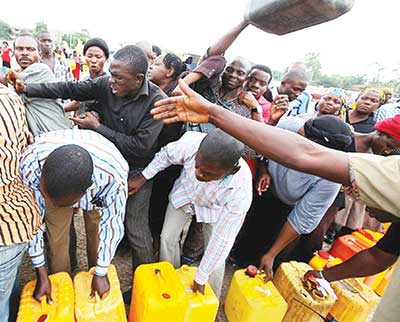
 • Tarabans Groan As Price Continues To Soar
• Fuel Scarcity Grinds Delta, Petrol Now Sells For N140 A Litre
• Petrol Boom In Calabar,
• Pump Price Regulation Okay For Now, Mpama
FROM the pathetic deaths of over a hundred people at the Organiser filling station in Amunko, Nnewi Okpuno Nnewichi, Anambra State to the man hours lost by commuters in queues at the few retail outlets that have Premium Motor Spirit (PMS), these are, no doubt, hard times for Nigerians.
Hopes were high last week; when the Federal Government announced that the Port Harcourt Refinery would commence production of petroleum products, as well as, the selling of PMS at N86.50 per litre. However, days after the announcement, problems associated with the downstream sector of the petroleum industry have become worse.
The Guardian investigations revealed that long queues still persisted in stations that had products, but and even when the old price of N87 was displayed in such station, they sold between N140 and N250 to motorists.
From the East to West, North to South, and in all the nooks and crannies of Nigeria, the number of fuel stations without products far outnumbered those selling, thereby, creating opportunity for black marketers to have a field day.
Almost all the major retail outlets in Asaba and its environs lacked PMS, while some independent marketers, which had, sold for between N125 and N140 per litre. The only exception was an independent marketer, Rainoil, on Okpanam Road, where a litre of the scarce commodity sold for N87, resulting in long line of anxious motorists waiting patiently to fill their tanks.
The renewed scarcity has since affected transport fares in the Delta State capital, as commercial tricyclists and taxi drivers have increased their fares. A trip in either a taxi or tricyclist from Summit to Ogbeogonogo Market, which before now, went for N50, has almost doubled to N80. A commuter will have to cough out N100 from Summit to Cable instead of N60.

An hour and 15 minutes drive from Asaba to Benin, the Edo State capital, has increased to N800 from N600, while the two-hour journey from Asaba to the oil rich city of Warri, which was formally N800, is now N1, 200.
An Asaba-based barber, who gave his name as Charles, while lamenting the situation, said he would need over N30, 000 to power his generating set monthly, as a result of the high cost of petrol coupled with the incessant power cut. Left with no alternative, he said that he had to double the price of a haircut to N400 instead of N200.
John Chukwu, a businessman, who lives in the nearby town of Ibusa, said it has not been easy buying fuel for his generating set. The electricity supply from the Benin City Electricity Distribution Company has been cut-off for over five years in the whole town.
In spite of the strict warnings given to operators in the downstream sector to sell at the official rate of N86.50 per litre, the level of compliance in Taraba State, The Guardian gathered is zero, as marketers have stuck to their guns not to sell at that price.
With the exception of the Nigeria National Petroleum Corporation (NNPC) mega station, which currently sells at government-approved price, a litre of the product in virtually all the filling stations in the state is N140.
Black marketers, especially, those selling in plastic, it was gathered, are not helping matter, as the product is currently being sold at the rate of N180 per litre.
For fear of their filing stations being sealed by the Department of Petroleum Resource (DPR), most of the stations now dispense only at night.
The Guardian gathered from some of the marketers that the reason for non-compliance is because they still have old stock that was bought at very high price. According to one of them, who spoke in Hausa language, through an interpreter, “it would be impossible for marketers in the state to adjust their pump price to the newly approved price pending when we finish discharging our old stock?”
Wondering why the Federal Government would want them to lose instead of making profits, the marketer, who spoke under condition of anonymity for fear of incurring the wrath of the DPR, said, “the essence of going into business is to make profit and not loss.”
The marketers sell when DPR officials are not in sight and have vowed that no amount of pressure would make them embrace the new price. “We have collectively agreed to turn deaf ears to government’s directives. So, the only way out now is for them to allow us to sell the product at the former price, because we did not purchase it at the rate they now want us to sell to the public,” he said.
The situation in Imo State is not different. There is a general non-compliance to the new template in virtually all the 27 council areas. However, the mega stations in few areas in the state still sell at the regulated price, but the queues in these stations are usually too long, thus, leaving consumers and motorists at the mercy of biting sun and hoodlums, who often capitalise on the situation to make brisk money.
In some stations, though the metres have been adjusted to read N86.50, they are actually sold for between N135 and N145 per litre. Only Oando fuel stations sell at N86.50, still with the long queue problem. When The Guardian visited the station, which is situated along Egbu Road, near Owerri metropolis, the queues stretched far into the major road, causing gridlock.
Like Asaba, inter and intra state transport fares have gone up in Imo State. Tricycle inside Owerri is now between N80 and N100, from N50. Only short distances are still N50.
Attempts to speak with an attendant on why they were not selling at regulated price did not yield any positive result. But the Manager of the NNPC mega station in Owerri, Michael Ogbonnaya, confirmed that they complied to the directive of the Federal Government the same day, January 1, regretting that ‘crowd control’ is now the big challenge.
Residents of Port Harcourt, who spoke with The Guardian, also complained that the Federal Government might have shot itself in the leg with the decision, as it is now more difficult to get fuel in the stations. They said that when PMS was N97 per litre, it was not only available and stable in price; it did not bring difficulties to them.
Since the Federal Government directive, only NNPC mega stations and Total were selling at the new price with long queues, everywhere.
Some motorists, especially, taxi drivers, told The Guardian that since the new price, they have tried NNPC on the few occasions it sold, but they couldn’t buy, so, they have resorted to buying from the illegal market. “In fact, in Port Harcourt now if you are not ready to patronise black marketers, then be ready to suffer,” said a commercial bus driver.
Further findings at the Port Harcourt Refinery to know if it has actually commenced productions as promised by the government showed that some plants have started running at different levels of production, but The Guardian could not ascertain the exact level of performance, as our correspondent was not allowed access to the facility. She was informed by the public relation’ unit of the firm that the management would brief the press on the production update soon.
Scarcity of petrol products still persists in Abia State; hence, it still sells at between N120 and N130 per litre, except at government’s stations. However, a few outlets that claim to have received their supplies from government designated sources sold on Thursday in Umuahia, the state capital at N86.50 per liter.
One of such dealers, an Oando station, located along Aba road in the heart of Umuahia, sold at the regulated price. The Director of the station, Mr. Chinwe Okwu, who is a known complier to selling at regulated prices over the years and for which the state government honoured him with an award, said he got his supply from Lagos.
He said that dealers have different procuring/supply sources depending on which depot they are attached to; Port Harcourt, Calabar or Lagos.
On why some stations are not selling, even though they have stock, an independent dealer dismissed this impression, saying that officials of the Task Force inspect stations, using deep sticks to verify if a station had stock.
Another dealer boldly said that he couldn’t sell at a loss the supplies he procured at above regulated price. According to him, the varying approved prices of N86.50 and N87 was unjust to private marketers because “it naturally takes away patronage from us to public /mega stations. We are watching, the solution is for government to make the supply easily available and allow every dealer sell at uniform and not discriminated prices.”
Marketers are determining the pump price of petrol in Cross River State at will. Apart from the mega station that sells at N86.50 per litre and major marketers like Mobil, ConOil, North-West Petroleum when they have product, the independent marketers are selling at between N120 and N140 per litre.
In Calabar, there are a total of 23 depots and the Calabar Free Trade Zone (CFTZ) is host to over 18 of the tank farms that are into the business of petrol importation yet price of the product is on the high side. However three out of the 23 are not functional.
Sources in the zone said there is a big racket going on in the oil industry causing lots of hardship to Nigerians and petroleum consumers in the state and its environ.
The inside sources alleged, “the Federal Government, importers and tank farm owners know what they are doing. Calabar is littered with tank farms yet we are suffering. Government should investigate activities of NNPC and others. We believe there is a lot of diversion or bunkering of products in high sea before they finally land the depot in Calabar. In most cases, NNPC will attribute shortage to pipeline vandals, which is very insignificant.
“They do this so as to cover up for the deals going on and that is why they are not interested in completing the three security posts projects along the about 10-kilometre pipeline route that would have enhanced effective policing of the pipeline. These security posts cost N1m each when the contract was awarded seven years ago and as at today only one is ready and put to use by security men while the rest have been abandoned for obvious reasons.
However, there is improvement in the fuel supply situation in Enugu. From about
12 trucks, which the state was receiving between November and December last year, the state now receives about 20 and above daily, although the figure is still a far cry from the 40 trucks per day required.
DPR’s Operations Controller for Enugu, Anambra and Ebonyi states, Mr. Peter Ijeh, had said recently that, despite the situation, the agency was poised to ensuring that all petrol stations in the area sold at government’s regulated price, adding that those who have flouted the directive had either been sealed off or forced to comply.
But petrol has continued to sell at between N120 and N125 per litre in Enugu state in fuel stations operated by independent marketers. The situation in the state is such that these stations, which sell even till late in the night, have steady supply.
The major marketers who have complied with the official price of N86.50k hardly have sufficient supplies. While in most cases, there are long queues of vehicles where there are supplies; many of them have not seen the product for sometime.
A public analyst, Dr. Solomon Nwosu, said he was yet to understand how government wants to tackle the situation, stressing that the recent announcement reducing the price to N86.50k when the product ‘is barely available leaves much to be desired.”
According to him: “We are now into the second week of the new price regime. The only thing I can say has changed is that for now, you can see two or three major stations selling at the same time, yet you cannot easily buy from them. On the other hand, however, the prices in other stations operated by major marketers have remained same. You buy N120 or N125 or even N130 per litre.”
Looking at the non-budget provision for subsidy, he stated that it was wrong for government to come up with a regulated price, when most petrol sellers still import at different prices and difficult circumstances. “We have merely sustained the import regime since the few refineries working cannot provide sufficient supplies. As much as that remains the case, you cannot force a price regime that is sustainable. On the other hand, if government wants to completely pull out, let it do so, to enable the market forces determine the price for the products. I think that is the reasonable thing to do,” he said.
He noted that it had been a difficult task getting petrol sellers to adjust downward prices of the product, explaining that they would always live in the guise that they were selling at high prices because they got their supplies at high costs.
A lecturer, Stan Obi, while reacting to the situation, said the demand for petroleum products has far exceeded the nation’s daily supply, stressing that apart from households, vehicles, there are other areas where petrol was needed to run the economy.
“I don’t think that it is the right time for government to remove subsidy. We need to get these refineries back on track, and then subsidy goes, as the masses will now determine the cost for the product. In this arrangement, government becomes a regulator, ensuring that those in the business are evenly served and not one person having advantage over others. Where there is no equity in the distribution, there will always be the challenge of price differences that will make people buy at exorbitant rates.
“Fixing prices for now should be the responsibility of government. It can only benefit the masses if those stations that get supplies directly from government have sufficient supplies. There is no time government cannot make more money from petrol as far as it is available. I say so because, everything we do here depends solely on petrol. You run your factories; residences, cars and what have you, since there is no efficient supply of electricity. So I want to say that government will continue to make money from petrol as long as the masses and every household in the country continue to depend on it,” he argued.
Speaking on the development, a policy analyst and the Chairman of Trade Union Congress in Rivers State, Chika Onuegbu, explained that there are two concepts to what the Federal Government did to arrive at the current cost of petrol, which according to him is; Subsidy and Deregulation.
He said, “the landing cost of PMS is N70.80; margins is N14.30. This gives total cost of N85.10k. Then add under recovery charge of N1.40k, that gives you retail price per liter of N86.50k. Now, subsidy is a situation where the retail cost is less than the sum of total cost plus under/over recovery and someone must pay that difference which in the case of Nigeria is the government. So, there is no subsidy on PMS and so no subsidy to pay for. Hence, no payment of subsidy. In the case of deregulation, government does not fix the retail price of PMS and each retailer sells at his/her own price. In Nigeria, currently, there is no deregulation. Government still regulates the price, but ensures, as is currently doing, that retailers and all those in the chain maintain their profit margin as agreed.
“What is happening is that we are confusing non payment of subsidy with subsidy removal. Government has not removed subsidy to the best of my knowledge, if government has removed subsidy, the price of petroleum product would have gone up. The only thing government has removed is the inefficiency in the template it is using. Marketers are confusing the whole situation with deregulation.”
Continuing, the TUC boss said, “You know that people always enjoy making maximum profit. The importers themselves know that at N86, they are still making the profit, that is why the major marketers are not complaining, it is the independent marketers that know how to cut corners that are still complaining.”
While emphasizing the need for adequate enforcement of the new pump price, he advocated for the refining of crude locally, noting that it will positively add to the economy.
Also, an economist and senior lecturer in the Department of economics, University of Port Harcourt, Dr. Peter Mede, argued that subsidy removal on petroleum products has been abused.
He lamented the situation, where cabals in the oil industry are sabotaging the efforts of government towards alleviating the suffering of the masses via subsidy removal. He said, “no matter how much government wants to use that policy to alleviate poverty and other incentives to reach out to the poor, it has been abused and hijacked by some cabals, so, it is appropriate for government to stop subsidy, and as well, stimulate local production of petroleum products.”
Mede reasoned that local production of PMS would boost supply, “if you boost supply and supply is greater than demand, definitely price of PMS will fall. So that is the direction and I will encourage government to stop subsidy, because where the marketers collect subsidy money from you and still charge prices that are higher, plus subsidy, it makes nonsense of the whole thing.”
He advised government to do its best to stop the cabals, saying, “until government stops those cabals, our refineries will not work, because they will continue to sabotage the system and ensure people continue to puncture the pipeline so that refineries will not get product. They know that once refineries are working, they will no longer be relevant as they will no longer be importing and without such importation, they will not be making such bogus claims on government”.
The President of Port Harcourt Chamber of Commerce, Industry, Mines and Agriculture, Dr. Emee Membere Otaji told The Guardian that subsidy removal would not solve all the problems in the country but would take away the main source of leakage with associated fraud.
While noting that regular and affordable petroleum products remain the key ingredients to industrialisation, Membere urged government make private sectors to own refineries, pointing out that government is usually poor in doing business.
An economist and public commentator, Mr. Lawrence Mpama, said, “first and foremost, the price of oil in Nigeria is determined by the international price of crude and for the past six months the crude price has been going down. Now it is dangling between $31 and $33 per barrel, so, there is no reason why Nigerians should continue to pay for petrol at the old price when crude was over $100 per barrel.
Mpama said, “yes government can fix the price for now. Even in America when gasoline price was very high, the Obama government had to regulate the price, but did not subsidise. So, if the Nigerian government now says we are fixing pump price at this level, they are just trying to help Nigerians, because these marketers don’t give a damn, even if the price of crude goes down to $10 per barrel, they can continue to sell at N100 or more per litre; they don’t care. What concerns them is the much money they are making from it, because the amount they are using to import fuel now is not the same as when price of crude was high.
“In this kind of situation, we cannot allow the market forces to determine the pump price. You can only allow that when the refineries are working at near or full capacity. If you allow the market forces now, it is dangerous. Yes, the fears now is that of the unknown because what do you think will happen if the importers decide to connive and speak with one voice it will be bad for Nigerians. What the government is doing now is to see how the refineries can work at full capacity. For now, government is saying that the refineries are generating about 25 per cent of our consumption, but if they step up to 60 per cent and what is imported is 40 per cent then the marketers can do what they want to do, at the end of the day, the final consumers will not pay more. Naturally the market forces of demand and supply will come to play.”

